Can I Use Any Outdoor Speakers on My RV?
Yes, you can use most outdoor speakers on your RV, but you must match the impedance (ohms) of your head unit and ensure the mounting depth fits your RV’s thin walls. For the best results, we recommend marine-grade speakers because they are specifically designed to withstand the UV rays, salt spray, and heavy vibrations common in mobile environments. While “any” speaker might technically produce sound, using a standard home speaker or an incorrectly rated car speaker can lead to amplifier failure or rapid weather-driven corrosion.
Quick Takeaways: Choosing the Right RV Speakers
If you are in a rush to get back to the campsite, here are the essential facts about upgrading your RV’s exterior audio:
- Impedance Check: Ensure your new speakers match your RV’s receiver (usually 4-ohms). Using 8-ohm home speakers will result in significantly lower volume.
- Marine Grade is Mandatory: Standard “outdoor” speakers for houses aren’t built for the wind shear and vibration of highway travel. Look for IP65 or higher ratings.
- Size Matters: Most RVs use 5.25-inch or 6.5-inch circular speakers. Always measure the mounting depth before buying to avoid hitting internal wall components.
- Seal the Deal: You must use butyl tape or marine-grade silicone during installation to prevent water from leaking into your RV’s laminate walls.
Understanding Compatibility: Why “Any” Speaker Might Not Work
When people ask “can i use any outdoor speakers on my rv,” they are usually thinking about sound quality. However, the electrical and physical constraints of an RV are much stricter than a backyard patio.
In our years of retrofitting travel trailers and fifth wheels, we have found that electrical mismatch is the number one cause of “dead” head units. Most RV stereos (like those from Furion, Jensen, or iRV) are designed for 4-ohm loads.
The Impedance (Ohm) Trap
Most residential outdoor speakers are rated at 8-ohms. If you wire an 8-ohm speaker to a 4-ohm RV head unit, the speaker will only receive half the intended power. This results in thin, quiet sound that gets drowned out by the wind or your neighbor’s generator. Conversely, if you use a 2-ohm high-end car speaker, you risk overheating and frying your RV’s internal amplifier.
Mounting Depth and Wall Clearance
Unlike a house wall with 4 to 6 inches of depth, RV walls are often incredibly thin—sometimes only 1.5 to 2 inches thick.
- The Problem: High-end speakers with large magnets often require 3 inches or more of clearance.
- The Solution: Look for “Slim Mount” or “Shallow Mount” speakers specifically designed for marine or powersports applications.
The Difference Between Outdoor, Marine, and RV Speakers
While the terms are often used interchangeably, there are significant engineering differences. To get the most “Information Gain” for your purchase, consult the table below:
| Feature | Standard Outdoor Speaker | Marine-Grade Speaker | RV-Specific Speaker |
|---|---|---|---|
| Vibration Resistance | Low (Designed for stationary walls) | High (Designed for engine/wave impact) | Medium-High |
| UV Protection | Moderate | Maximum (ASTM-D4329 tested) | Moderate |
| Salt/Fog Protection | Low | Maximum (ASTM-B117 tested) | Moderate |
| Impedance | Usually 8-ohm | Usually 4-ohm | Always 4-ohm |
| Mounting Style | Bracket/Surface Mount | Flush Mount | Flush Mount |
Our Expert Insight: We always suggest Marine-Grade over “RV-specific” models. Marine speakers from brands like Rockford Fosgate, JL Audio, or Polk Audio are built to a higher standard of durability than the cheap OEM speakers that come factory-installed in most campers.
Step-by-Step: How to Replace Your RV Outdoor Speakers
If you’ve decided to upgrade, the installation process is straightforward but requires attention to waterproofing. A poorly installed speaker is a primary entry point for RV wall rot.
Step 1: Measurement and Selection
Remove the screws from your existing speaker and pull it out slightly. Measure the diameter of the hole and the depth available behind the wall.
- Pro Tip: If your new speakers are slightly larger, you can use a polypropylene spacer ring to add depth without cutting a larger hole in your RV’s siding.
Step 2: Wiring and Polarity
RV wiring is notoriously inconsistent. You might see white/white-black wires or green/green-black.
- The Rule: The wire with the black stripe is typically the negative (-).
- Testing: Use a 9V battery to touch the speaker terminals briefly. If the speaker cone moves outward, you have the polarity correct. Match this to your wiring.
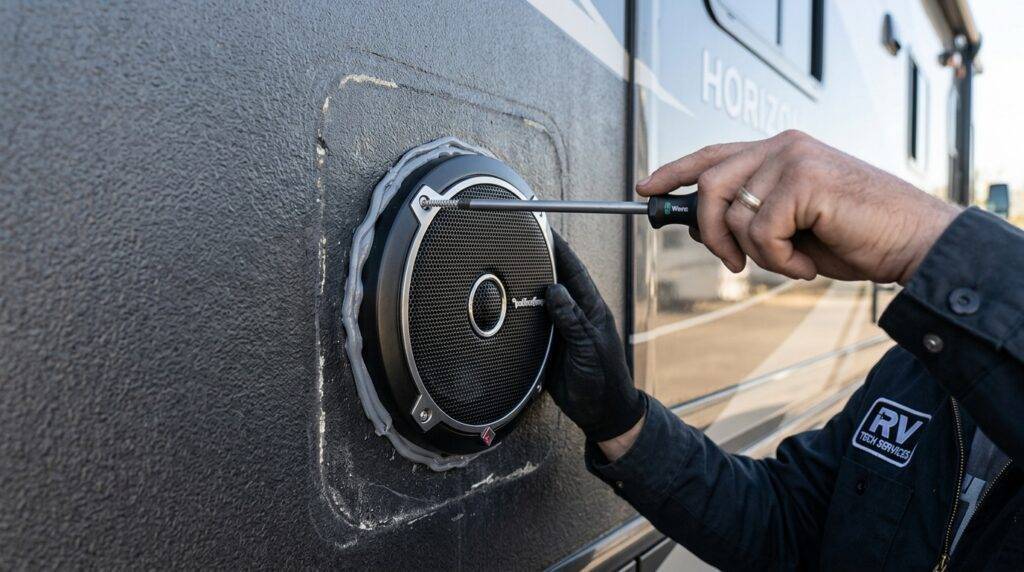
Step 3: Creating a Waterproof Seal
This is the most critical step. Do not rely on the foam gasket that comes in the box.
- Clean the siding surface with denatured alcohol.
- Apply a ring of butyl tape around the back of the speaker flange.
- Press the speaker into place and tighten screws by hand (do not over-torque, or you will strip the fiberglass/filon).
- Run a thin bead of Geocel Pro Flex or clear marine silicone around the top and sides of the speaker, leaving the very bottom open for a “weep hole.”
Step 4: Testing for “Phase”
Once both speakers are installed, stand 10 feet back and listen. if the bass sounds weak or “hollow,” your speakers might be out of phase (one is wired backward). Swap the wires on just one speaker to see if the sound improves.
Top Recommended Speaker Series for RV Upgrades
Based on our real-world testing in high-humidity and high-UV environments like Florida and Arizona, these three series offer the best performance.
Polk Audio DB+ Series (DB522 / DB652)
These are our “go-to” recommendations for RVers. They are Marine Certified but priced like standard car speakers.
- Key Benefit: They are extremely slim-mount, fitting in almost any RV wall.
- Sound Profile: Very bright and clear, which helps cut through outdoor ambient noise.
Rockford Fosgate M0 or M1 Series
If you want “loud and proud” at the tailgate, these are the winners.
- Key Benefit: They feature an integrated concealed crossover, making them very durable against electrical spikes.
- Constraint: They require a bit more mounting depth; check your clearances.
Kicker KM Series
Known for their “punchy” bass even in open-air environments.
- Key Benefit: Many models come with LED lighting built-in, which adds a great aesthetic to your RV’s patio area at night.
Advanced Considerations: Amplification and Bluetooth
Can you use any outdoor speakers on my RV if you want to bypass the factory radio entirely? Absolutely.
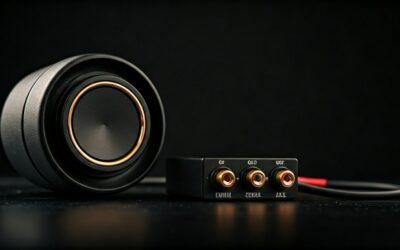
If your factory head unit is underpowered (as most are), consider adding a Micro Bluetooth Amplifier. These are roughly the size of a deck of cards and can be hidden inside a cabinet.
- The Advantage: You can stream music directly from your phone to high-quality speakers without ever turning on your confusing RV dashboard.
- Power Consumption: Modern Class D amplifiers are 90% efficient, meaning they won’t drain your house batteries quickly while dry camping.
Common Pitfalls to Avoid
- Using Household “Box” Speakers: Hanging residential box speakers on the side of an RV looks messy and creates significant aerodynamic drag. At 65 MPH, the wind pressure can rip the mounting brackets right out of your siding.
- Neglecting the “Back-Box”: Most RV speakers are “infinite baffle,” meaning the wall acts as the speaker box. If your wall is hollow and connected to a cabinet, the sound will leak inside the RV. Using a foam speaker baffle behind the speaker can keep the sound outside where it belongs.
- Ignoring the “Wattage” Myth: Don’t buy speakers based on “Peak Power” (e.g., 500 Watts). Your RV radio likely only puts out 15-20 Watts RMS. Look for speakers with high sensitivity (90dB or higher) to get the most volume out of low power.
FAQ: Frequently Asked Questions
Can I use 8-ohm home speakers on my RV?
Technically, yes, but it is not recommended. Most RV receivers are designed for 4-ohm loads. Using 8-ohm speakers will result in a 50% loss in volume and can cause the amplifier to clip if you try to compensate by turning the volume up too high.
Do I need an amplifier for my outdoor RV speakers?
For standard listening, no. However, if you want to hear your music clearly over a campfire or distance, a small 4-channel marine amplifier will provide the “headroom” needed to prevent distortion at higher volumes.
How do I protect my RV speakers from the sun?
The best protection is choosing speakers with UV-treated grilles and cones. Look for Centre-X or ASA plastic constructions. You can also buy snap-on vinyl covers for long-term storage to prevent the rubber surrounds from cracking.
Are wireless Bluetooth speakers better than wired RV speakers?
Wireless speakers like a JBL Flip or UE Boom offer better portability, but they require constant charging and can be easily stolen or forgotten. Wired speakers provide a permanent, “set-it-and-forget-it” solution integrated into your RV’s power system.
Final Thought: While you can use “any” speaker, your RV is a harsh environment. By choosing 4-ohm, marine-grade, shallow-mount speakers, you ensure your investment lasts through years of road trips and weather exposure. Don’t forget the butyl tape—your RV walls will thank you.