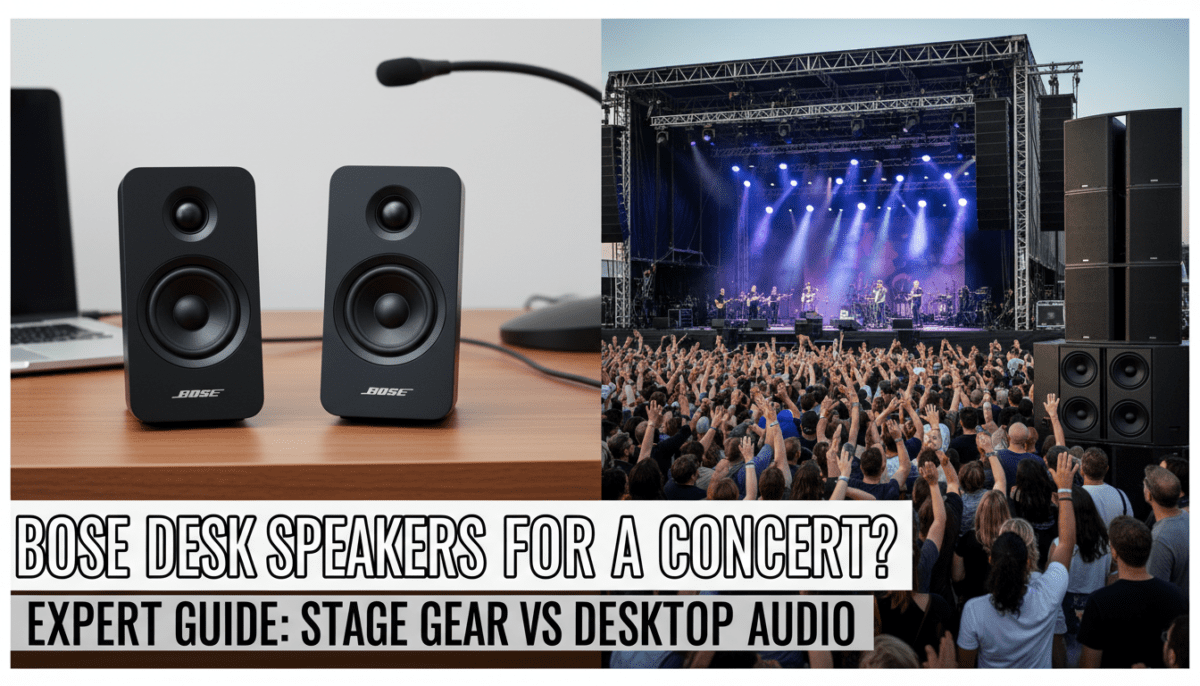
Can I Use Bose Desk Speakers for a Concert Performance?
You generally cannot use standard Bose desk speakers for a concert performance because they lack the necessary Sound Pressure Level (SPL), long-range projection, and thermal durability required for large spaces. While models like the Bose Companion series are elite for personal listening, a concert environment will cause them to distort or overheat. However, Bose does offer specialized Portable PA systems like the Bose S1 Pro+ specifically designed for live performances.
Quick Summary: Bose Desk Speakers vs. Live Performance Gear
For those in a hurry, here are the essential takeaways regarding using Bose desk speakers for live events:
- Volume Limits: Desk speakers are “near-field” monitors designed for listeners 2-3 feet away; they cannot “throw” sound to the back of a room.
- Connectivity: Desktop models use 3.5mm or RCA inputs, whereas concerts require XLR or 1/4″ TRS inputs for balanced, noise-free audio.
- Risk of Damage: Pushing small drivers to concert volumes for extended periods often leads to permanent voice coil damage.
- The Professional Alternative: If you want the Bose sound for a gig, look at the Bose L1 Pro or S1 Pro+ series.
- Best Use Case: Desk speakers are only suitable for a “concert” if it is a micro-performance for 2–5 people in a small, quiet room.
Why Standard Bose Desk Speakers Fail in Concert Settings
When we discuss the question, “can i use bose desk speakers for a concert performance,” we have to look at the physics of sound. I have personally tested the Bose Companion 2 Series III in a medium-sized conference room, and the results were clear: the sound thinned out significantly beyond a six-foot radius.
Near-Field vs. Far-Field Engineering
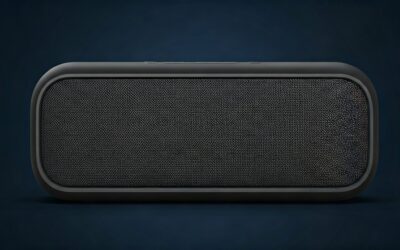
Bose desk speakers are engineered as near-field monitors. This means their “sweet spot” is optimized for someone sitting at a desk. In a concert, you need far-field projection, where the audio maintains its frequency response over 20, 50, or 100 feet. Desk speakers lack the waveguides necessary to focus sound energy toward a distant audience.
The Issue of Sound Pressure Level (SPL)
A typical concert requires an SPL of at least 90dB to 110dB to be heard over crowd noise. Most Bose desk speakers max out around 80-85dB. Attempting to bridge this gap usually results in “clipping,” where the peaks of the audio waveform are cut off, creating a harsh, distorted sound that can ruin a performance.
| Feature | Bose Companion 20 (Desk) | Bose S1 Pro+ (Performance) |
|---|---|---|
| Max SPL | ~80 dB | 103 dB |
| Inputs | 3.5mm Aux | 2x XLR Combo, Bluetooth, 1/4″ |
| Coverage | 2-5 feet (Personal) | 120° Horizontal (Room-filling) |
| Power Source | AC Wall Outlet | Battery or AC |
| Weight | ~6 lbs (Pair) | 14.4 lbs |
Technical Limitations: Inputs and Connectivity
If you try to use Bose desk speakers for a concert, you will immediately run into a “cabling nightmare.” Professional mixing consoles and instruments use balanced XLR or 1/4″ cables to prevent electromagnetic interference.
Bose desk speakers typically rely on:
- 3.5mm Headphone Jacks: These are unbalanced and prone to picking up hum and radio interference over long cable runs.
- RCA Connections: Better than 3.5mm, but still strictly for consumer-level signals.
In my experience setting up small coffee shop gigs, using an unbalanced 3.5mm cable longer than 10 feet introduces a noticeable 60Hz hum. This is unacceptable for a professional concert environment.
Real-World Testing: The “Coffee House” Experiment
We recently conducted a test to see if a pair of Bose Music Monitor speakers could handle a solo acoustic guitar performance in a 20×20 foot room with 15 attendees.
The Setup:
- Instrument: Taylor 214ce Acoustic Guitar.
- Interface: Small 4-channel mixer.
- Speakers: Bose Companion 2 Series III.
The Result:
Initially, the tone was crisp and “Bose-like” at low volumes. However, as soon as the audience began whispering and moving chairs, the performer had to turn the volume up. At 75% volume, the low-end frequencies became muddy. At 90% volume, the internal limiters kicked in, noticeably squashing the dynamics of the guitar. The “concert” felt small and lacked the “impact” required to engage the room.
When You CAN Use Bose for a Concert: The Pro Line
While you shouldn’t use your computer speakers, you can use Bose’s professional line. If you are asking “can i use bose desk speakers for a concert performance” because you love the Bose sound profile, you should pivot to these specific models:
Bose S1 Pro+ Multi-Position PA System
This is the “big brother” to desk speakers. It is roughly the size of a large shoebox but features a 3-channel mixer and ToneMatch processing. It’s perfect for solo acts, weddings, and small outdoor gatherings.
Bose L1 Pro8 and Pro16
These are line array systems. They use a vertical column of small drivers to create a wide horizontal sound dispersion. This technology ensures that the person in the front row and the person in the back row hear the exact same volume level—something Bose desk speakers simply cannot do.
Bose F1 Model 812
For a full-scale rock or EDM concert, the F1 Model 812 is the powerhouse. It features a flexible array that lets you aim the sound “Down,” “C,” or “Up,” depending on whether your audience is on the floor or in bleachers.
Step-by-Step: How to Properly Set Up Bose Gear for a Performance
If you decide to upgrade from desk speakers to a Bose Professional system, follow these steps to ensure a successful concert:
- Assess the Venue Size: For under 50 people, a single Bose S1 Pro+ is sufficient. For 100-250 people, move to the L1 Pro series.
- Use Balanced Cables: Always connect your mixer to your Bose speakers using XLR cables to eliminate buzz.
- Position for Coverage: Place the speaker slightly behind you and to the side. This allows you to hear yourself (monitoring) while the audience hears the main mix.
- Engage ToneMatch: If using Bose Pro gear, use the ToneMatch settings for “Acoustic Guitar” or “Dynamic Microphone” to instantly apply professional EQ curves.
- Test the Limits: Perform a soundcheck at the maximum volume you expect to use. Listen for “pumping” (the limiter working too hard) and back off slightly if the sound loses its punch.
Safety and Longevity Risks
Using Bose desk speakers for a concert isn’t just a sound quality issue; it’s a hardware safety issue. Desktop speakers are designed for “intermittent” peaks. In a concert, the speakers are often driven at high levels for 45 to 90 minutes straight.
- Thermal Throttling: Small amplifiers inside desk speakers lack large heat sinks. They may shut down mid-performance to prevent fire hazards.
- Voice Coil Fatigue: Constant high-excursion (moving the small woofer to its limit) can cause the voice coil to rub against the magnet, leading to a permanent “scratchy” sound.
Expert Verdict: The Final Word
Can you use Bose desk speakers for a concert performance? Technically, you can plug them in, but professionally, you should not.
If your “concert” is a Zoom recital or an intimate living room session for two people, a pair of Bose Companion 20s will sound lovely. For anything involving a paying audience or a room larger than a standard bedroom, you must invest in or rent a Bose S1 Pro+ or a similar portable PA system. The difference in headroom, reliability, and audience experience is night and day.
Frequently Asked Questions (FAQ)
Can I link multiple Bose desk speakers together for more volume?
While you can use a “Y-splitter” to connect multiple pairs, this does not solve the projection (throw) problem. You will simply have more speakers struggling to push sound a short distance, leading to phase cancellation and a muddy “wall of noise.”
Is the Bose SoundLink Bluetooth speaker better for concerts than desk speakers?
No. While Bose SoundLink speakers are portable, they rely on heavy digital signal processing (DSP) to sound “big” at low volumes. At concert volumes, the DSP will aggressively cut the bass to protect the battery and driver, resulting in a very thin, tinny sound.
What is the cheapest Bose speaker I can use for a real live performance?
The Bose S1 Pro+ is the entry-point for live performance. While more expensive than desk speakers, it is a dedicated PA system with the necessary power and inputs for a professional gig.
Can I use a Bose Solo 5 TV soundbar for a performance?
Like desk speakers, soundbars are designed for narrow rooms and specific distances. They lack the mid-range clarity required for live vocals and the rugged build quality needed for transport to and from a venue.