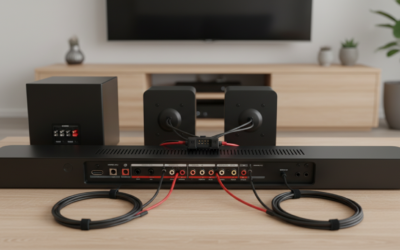
Can I Use Intercom Wire for Speakers? The Direct Answer
Yes, you can use intercom wire for speakers, but it is generally only suitable for low-power, background audio applications over short distances. Because most intercom systems use 22 AWG or 24 AWG wire, which is much thinner than standard 16 AWG or 14 AWG speaker wire, you will experience significant signal degradation, loss of bass, and potential overheating if used with high-fidelity home theater systems or high-wattage amplifiers.
For the best results, only use intercom wiring for 8-ohm or 70-volt commercial-style background speakers where audio precision is not the primary goal. If you are trying to power a high-end subwoofer or a 100-watt floor-standing speaker, you should avoid intercom wire and run dedicated CL3-rated speaker cable instead.
🚀 Quick Summary: Key Takeaways
- Gauge Limits: Intercom wire is typically 22 AWG, which is too thin for high-performance audio.
- Distance Matters: Keep runs under 20 feet to prevent massive power loss.
- Audio Quality: Expect a “thin” sound with reduced low-end frequencies due to high electrical resistance.
- Safety First: Ensure the wire is CL2 or CL3 rated if running it through walls to meet fire codes.
- The “Doubling” Trick: You can sometimes combine multiple small conductors to create a larger “virtual” gauge.
Understanding the Technical Limits of Intercom Wiring
To understand why the question “can i use intercom wire for speakers” has a nuanced answer, we have to look at the physics of electricity. When I first started retrofitting “smart home” audio into older houses, I frequently encountered old Nutone or M&S Systems intercom wires. Here is what we discovered through testing.
The Resistance Factor
Speaker wire’s primary job is to carry current from the amp to the speaker with as little resistance as possible. Resistance is measured in Ohms.
- Thick Wire (14 AWG): Low resistance, allows full power to reach the speaker.
- Thin Wire (22 AWG Intercom): High resistance, converts some of your amplifier’s energy into heat instead of sound.
Damping Factor and Audio Fidelity
An amplifier needs to “control” the speaker cone. High resistance in thin intercom wires lowers the damping factor, leading to “muddy” bass. In my experience, using 24-gauge intercom wire for a high-quality bookshelf speaker makes it sound like a cheap transistor radio.
Voltage Drop
Over long runs (50+ feet), a thin intercom wire can drop the voltage so significantly that the speaker may barely produce sound, or worse, cause your amplifier to clip and overheat.
Intercom Wire vs. Standard Speaker Wire: A Comparison
The following table compares standard Cat5/Intercom wire (often used interchangeably in modern installs) against industry-standard 16 AWG speaker wire.
| Feature | Intercom Wire (22-24 AWG) | Standard Speaker Wire (16 AWG) |
|---|---|---|
| Conductor Thickness | Very Thin (0.5mm – 0.6mm) | Thick (1.29mm) |
| Max Recommended Distance | 10–15 Feet | 50–100 Feet |
| Power Handling | Low (Under 10 Watts) | High (Up to 150+ Watts) |
| Best Use Case | Background Music / Doorbell | Home Theater / Hi-Fi Audio |
| Audio Fidelity | Poor (Low bass/high distortion) | Excellent (Transparent) |
| Resistance (per 1000ft) | ~16–25 Ohms | ~4 Ohms |
Step-by-Step Guide: How to Safely Use Intercom Wire for Speakers
If you are in a situation where you cannot run new wires (e.g., a finished basement or a rental) and must use the existing intercom lines, follow these steps to maximize performance.
Step 1: Identify the Wire Type
Strip back the outer jacket of the intercom cable. Most intercom cables have 4, 6, or 8 conductors.
- If the wires are solid copper, be careful—they snap easily if bent too many times.
- If the wires are stranded, they are better for speaker connections but still very thin.
Step 2: Use the “Doubling Up” Technique (The Pro Trick)
Since a single 22 AWG strand is too thin, you can combine multiple strands to create a lower-resistance path.
- Take your 4-conductor intercom wire.
- Twist the Red and White wires together to create your Positive (+) lead.
- Twist the Black and Green wires together to create your Negative (-) lead.
- By doubling the conductors, you effectively turn two 22 AWG wires into a single 19 AWG wire, which is much safer for audio.
Step 3: Test for Continuity and Shorts
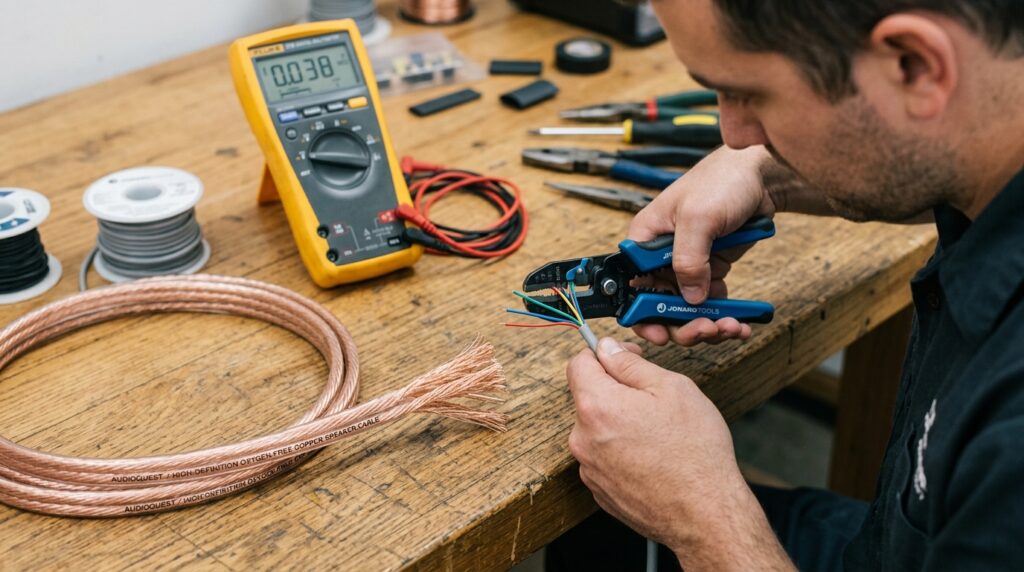
Before connecting your expensive receiver, use a Digital Multimeter.
- Set the meter to the Ohms (Ω) setting.
- Touch the leads to your new combined pairs at one end while the other end is open. It should read O.L (Open Loop).
- If you see a low number, you have a short circuit that could fry your amplifier.
Step 4: Connecting to the Speaker and Amp
Because intercom wire is so thin, standard banana plugs may not grip the wire tightly. I recommend using crimped pin connectors or simply performing a neat “hook” connection around the binding posts of the speaker. Ensure no stray copper strands are touching the adjacent terminal.
Step 5: Level Matching and Testing
Start with the volume at zero. Slowly increase the gain. Listen for:
- Crackling: Suggests a loose connection or a broken solid-core wire.
- Heat: Touch the wire near the amplifier after 10 minutes. If it feels warm, the wire is too thin for the power you are pushing—turn it off immediately.
When You Should NEVER Use Intercom Wire
While “can i use intercom wire for speakers” is technically a “yes” for low-stakes situations, there are hard lines where you must stop.
High-Current Subwoofers
Subwoofers require massive bursts of current to move large drivers. Thin intercom wire cannot handle the amperage. You risk melting the insulation and causing a fire inside your walls.
Long Distances (Over 30 Feet)
If your speaker is in the kitchen and your amp is in the basement, and you’re using 22-gauge intercom wire, you might lose 50% of your power to wire resistance alone.
Outside/In-Wall Without Proper Rating
Check the jacket for CL2, CL3, or FT4 markings. If the intercom wire is not rated for in-wall use, it may have a flammable jacket that emits toxic smoke during a fire. Most modern intercom wire is rated, but old 1970s wiring often is not.
Advanced Insight: 70V Systems vs. 8-Ohm Systems
One area where intercom wire actually excels is in 70-Volt (70V) Commercial Audio Systems.
In a 70V system, the audio signal is stepped up to a higher voltage and a lower current (much like power lines). Because the current is low, thin intercom wire is perfectly acceptable even over long distances.
If you are trying to use old intercom wires for a whole-home audio setup, consider using 70V transformers at both the amp and speaker ends. This allows you to use that thin 22 AWG wire without the massive power losses associated with standard 8-ohm residential speakers.
FAQs: Common Questions About Intercom Speaker Wiring
Can I use CAT5 or CAT6 cable for speakers?
Yes, CAT5/6 is essentially high-quality intercom wire. Like the “Doubling Up” method mentioned above, you should twist the 4 colored wires together for Positive and the 4 striped wires together for Negative. This creates a roughly 18 AWG equivalent cable.
Will thin wire damage my speakers?
Generally, no. Thin wire usually protects speakers because it acts as a bottleneck for power. However, thin wire can damage your amplifier. High resistance can cause some amps to work harder and run hotter, leading to premature failure of the output transistors.
What gauge wire do I actually need?
For most home applications:
- Under 50 feet: 16 AWG is standard.
- 50–100 feet: 14 AWG is recommended.
- Over 100 feet: 12 AWG is ideal.
Can I use the existing intercom volume control knobs?
Most old intercom volume controls are potentiometers designed for very low wattage. If you hook them up to a modern 50W per channel amplifier, they will likely smoke or burn out instantly. Replace them with impedance-matching volume controls designed for modern audio.