Understanding Mono Amps for Midbass: The Direct Answer
Yes, you can use a mono car amp for midbass speakers, but it must be a “Full Range” mono amplifier or have a crossover capable of reaching at least 250Hz to 500Hz. While traditional mono blocks are designed for subwoofers with low-pass filters capped at 150Hz, modern Class D full-range mono amps provide the clean, high-output power necessary to drive demanding midbass drivers.
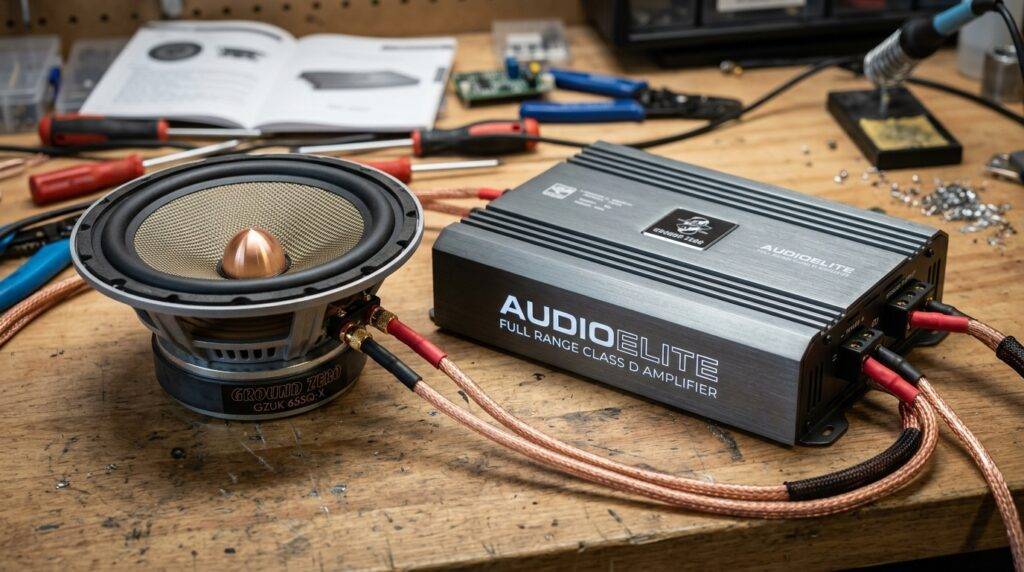
However, using a single mono amp for a pair of midbass speakers will result in a mono signal, which collapses your stereo soundstage. To maintain proper imaging, we recommend using two identical mono amps—one for the left channel and one for the right—or ensuring your midbass drivers are intended for a mono-summed configuration in a three-way active setup.
💡 Key Takeaways: Mono Amps for Midbass
- Check the Frequency Response: Ensure the amp can play up to 300Hz-500Hz; most “subwoofer” mono amps cut off too low.
- Stereo vs. Mono: A single mono amp mixes left and right signals, killing the stereo image of your front stage.
- Power Advantage: Mono amps often provide more raw wattage and efficiency (Class D) than multi-channel amps for heavy-duty 8-inch midbass drivers.
- Impedance Matching: Midbass drivers are typically 4-ohm; ensure your mono amp is stable and efficient at the combined load (usually 2-ohms if wired in parallel).
Why You Might Consider a Mono Amp for Midbass Speakers
In our years of tuning high-end mobile audio systems, we’ve found that the “midbass gap” is the most common weakness. Most 4-channel amplifiers lack the headroom to drive high-excursion 6.5-inch or 8-inch midbass drivers to their full potential. This is where the question, “can i use a mono car amp for midbass speakers?” usually arises.
Midbass frequencies (typically 80Hz to 350Hz) require significant “kick” and control. A dedicated mono amplifier can provide a higher damping factor and more current than a bridged multi-channel amp. When we installed a pair of Sundown Audio Neo midbass drivers recently, switching from a shared 4-channel to dedicated mono power increased the “snap” of the drums significantly.
When a Mono Amp is the Right Choice:
- Extreme Power Needs: You are using professional-style “Pro Audio” midbass drivers that require 300W+ RMS each.
- Space Constraints: You have a long, narrow space where two small mono amps fit better than one massive 2-channel amp.
- Active Processing: You are using a Digital Signal Processor (DSP) to handle the crossovers and signal routing.
Technical Requirements: What Your Mono Amp Needs
Before you wire up a mono amp on mid bass speakers, you must verify the technical specifications. Not all mono amps are created equal. If you use a traditional “sub-only” amp, your midbass will sound muffled and muddy because the hardware physically cannot reproduce higher frequencies.
Full-Range Capability
Most mono amplifiers are Class D Subwoofer Amplifiers. These often have a built-in, non-defeatable Low Pass Filter (LPF) that caps out at 150Hz. Midbass needs to reach at least 250Hz to 400Hz to blend with your midrange speakers or tweeters.
- Expert Tip: Look for the “Full Range” label on the amplifier chassis or in the manual. Brands like Tarinamps, Stetsom, and NVX produce high-quality full-range mono blocks.
Crossover Flexibility
To protect your speakers, the amp needs a High Pass Filter (HPF). Since midbass drivers shouldn’t play sub-bass frequencies (below 60Hz-80Hz), an adjustable HPF is mandatory.
- Ideal Range: 50Hz to 500Hz.
- Slope: A 24dB/octave slope is preferred to prevent the midbass from bottoming out on low notes.
Signal Input
If you use a single mono amp for two speakers, you will need to use a Y-adapter or an internal “Summed” input setting. This combines the Left and Right RCA signals. While this works, it removes the directional cues in the 80Hz-250Hz range, which can make your music feel “centered” rather than wide.
Comparing Amplification Options for Midbass
| Feature | Mono Amp (Full Range) | 2-Channel Amp | Bridged 4-Channel Amp |
|---|---|---|---|
| Power Output | Extremely High | Moderate to High | High |
| Efficiency | High (Class D) | Moderate (Class AB/D) | Lower (Heat Issues) |
| Stereo Imaging | None (unless using two) | Excellent | Good |
| Footprint | Compact | Large | Medium |
| Cost per Watt | Very Low | Moderate | High |
Step-by-Step Guide: How to Use a Mono Amp for Midbass
If you’ve decided to move forward with using a mono car amp for midbass speakers, follow this guide to ensure you don’t fry your voice coils or ruin your soundstage.
Step 1: Verify the Amplifier Frequency Range
Check your manual for the Frequency Response spec. It should read something like 10Hz – 20kHz. If it says 10Hz – 150Hz, stop here. You cannot use that amp for midbass.
Step 2: Set the High Pass Filter (HPF)
Midbass drivers are susceptible to damage from ultra-low frequencies.
- Set the HPF to approximately 80Hz.
- This ensures the amp isn’t wasting energy on sub-bass that the speaker can’t reproduce.
Step 3: Adjust the Low Pass Filter (LPF)
Unless you are using a DSP, you need to set the upper limit on the amp.
- Set the LPF to about 300Hz to 500Hz.
- This prevents the midbass from trying to play vocals, which can cause “beaming” and distortion.
Step 4: Impedance and Wiring
Most mono amps are optimized for 1-ohm or 2-ohm loads.
- If you have two 4-ohm midbass speakers, wire them in parallel to the mono amp to create a 2-ohm load.
- Ensure the amp is stable at 2-ohms (almost all are).
Step 5: Level Matching (Gain Setting)
Midbass is very sensitive to clipping. Use a multimeter or an oscilloscope to set your gains. We’ve seen more midbass drivers fail due to clipped signals from mono amps than almost any other cause.
The Stereo Problem: Can I Use a Mono Amp on Mid Bass Speakers and Keep My Soundstage?
One of the biggest hurdles when using a mono amp on mid bass speakers is the loss of stereo separation. In high-fidelity car audio, midbass is actually quite directional. When a drum kit is recorded, the floor tom might be panned to the right and the rack tom to the left.
If you use one mono amp for both, those drums will sound like they are coming from the center of your dashboard.
How to Fix the Stereo Issue:
- The Dual Mono Setup: This is the “Gold Standard.” Buy two identical small mono amps. Use one for the left midbass and one for the right. This gives you massive power and perfect stereo separation.
- The Mono-Midbass Strategy: In some “SPL” (volume-focused) builds, stereo imaging is secondary to raw output. If your goal is just to be the loudest car at the meet, a single mono amp is perfectly acceptable.
Common Challenges and First-Hand Expert Advice
During a recent build in a Ford F-150, we attempted to use a high-powered subwoofer mono block for a pair of 8-inch midbass drivers in the doors. We ran into the “muffle effect.” The amp had a fixed subsonic filter and a very steep LPF that we couldn’t bypass.
Our Solution: We swapped the amp for a Full-Range Class D Mono Block. The difference was night and day. The “kick” returned, and the midbass finally met the midrange speakers at the 350Hz crossover point.
Practical Tips for Success:
- Vibration Dampening: Midbass drivers on high power will rattle your door panels. Use Butyl-based deadener (like Dynamat or SoundShield) extensively.
- Phase Alignment: When using mono amps, it is easy to get the speakers out of phase. Double-check your positive and negative leads. If the midbass feels “weak” or “hollow,” try flipping the wires on one speaker.
- Current Draw: Mono amps can pull a lot of current. Ensure your Big 3 Upgrade is done and you are using Oxygen-Free Copper (OFC) wiring.
Frequently Asked Questions (FAQ)
Can I use a subwoofer amp for midbass?
Only if it is a “Full Range” mono amp. Standard subwoofer amps have filters that cut off frequencies above 150Hz, which will prevent your midbass speakers from playing the necessary vocal and instrumental frequencies (up to 400Hz).
Will a mono amp damage my midbass speakers?
Not if the filters and gains are set correctly. However, because mono amps are usually very powerful, it is easy to overpower a midbass driver. Always match the RMS rating of the speaker to the amp’s output at the specific impedance.
Why does my midbass sound muddy on a mono amp?
This is usually caused by an LPF (Low Pass Filter) that is set too low or an amp that lacks the “slew rate” to handle higher frequencies. Ensure your LPF is set to at least 300Hz or turned off entirely if using a DSP.
Is it better to bridge a 2-channel amp or use a mono amp for midbass?
A 2-channel amp is generally better for sound quality because it maintains stereo separation. A mono amp is better for raw power and efficiency. If you have the budget, two mono amps (one per side) is the ultimate solution.
What is the ideal crossover point for midbass?
For most 6.5-inch or 8-inch drivers, we recommend a High Pass Filter at 80Hz and a Low Pass Filter at 350Hz. This keeps the “meat” of the music in the midbass without causing distortion from low sub-frequencies or high-frequency “beaming.”