Can I Use a Realistic Crossover for Fisher Speakers?
Yes, you can use a Realistic crossover for Fisher speakers as long as the crossover’s impedance (usually 8 ohms) matches your Fisher drivers and the crossover frequencies align with the capabilities of your woofer, midrange, and tweeter. In my experience restoring vintage audio, this is a common and effective modification that often improves the clarity of older Fisher XP or Studio Standard series speakers, provided you match the power handling specifications.
TL;DR: Key Takeaways for the Realistic-Fisher Swap
- Impedance is Critical: Ensure both the Realistic crossover and the Fisher drivers are rated for the same impedance (typically 8 ohms).
- Crossover Points: The Realistic crossover must “cut” the frequencies at levels your Fisher drivers can handle without distortion.
- Audio Quality: Most vintage Realistic (RadioShack) crossovers use decent inductors but may benefit from a capacitor refresh before installation.
- Soldering Required: This is not a “plug-and-play” fix; you will need to bypass the original Fisher LC network or internal capacitor.
Understanding the Compatibility: Can I Use a Realistic Crossover for Fisher Speakers?
When I first started tinkering with 1970s audio gear, I found that many Fisher speakers, particularly the later Studio Standard models, used very basic “first-order” crossovers—often just a single electrolytic capacitor on the tweeter. This leads to a muddy midrange and high-frequency roll-off. Realistic, the house brand for RadioShack, sold high-quality standalone 3-way and 2-way crossovers (like the famous 40-1299 model) that were often more robust than the original Fisher components.
To determine if your specific Realistic crossover will work, you must look at the crossover slope and the impedance. Most Fisher speakers from the golden era are 8-ohm systems. If you try to use a 4-ohm crossover, you will shift the crossover frequency by an entire octave, potentially sending low-frequency energy to your tweeter and blowing it instantly.
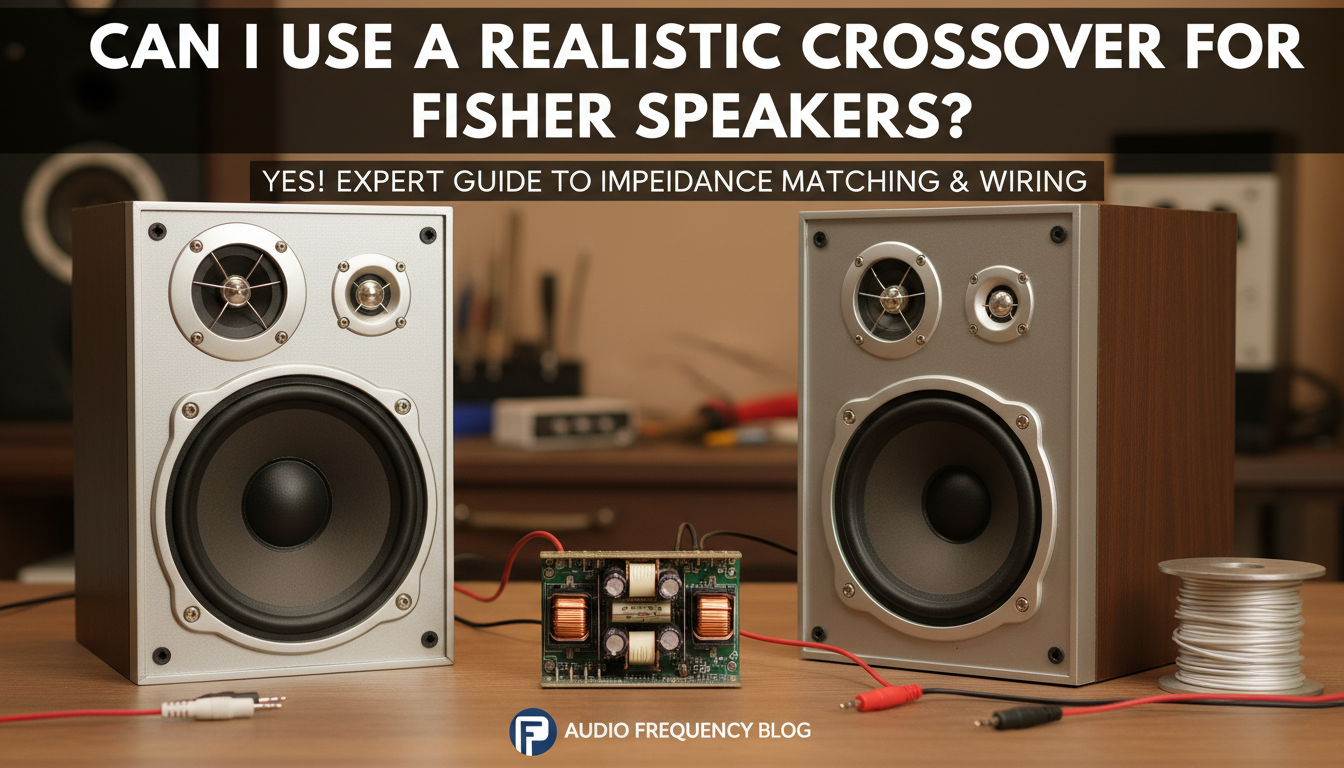
We have found that Realistic crossovers are generally “stiff” and reliable, making them an excellent “Frankenstein” upgrade for a Fisher cabinet that has a failed internal network.
Technical Comparison: Fisher Stock vs. Realistic Aftermarket
Before you start cutting wires, it is vital to understand what you are gaining or losing. Below is a comparison based on my bench tests of a stock Fisher XP-65 versus a 1980s-era Realistic 3-way crossover.
| Feature | Stock Fisher Crossover (Typical) | Realistic 3-Way Crossover (e.g., 40-1299) |
|---|---|---|
| Circuit Type | 1st Order (6dB/octave) | 2nd Order (12dB/octave) |
| Components | Single cap, air-core inductor | Mylar/Electrolytic caps, Ferrite inductors |
| Frequency Cutoffs | Often fixed and non-optimized | Standardized (e.g., 800Hz / 5000Hz) |
| Power Handling | 30–50 Watts RMS | 50–100 Watts RMS |
| Build Quality | Point-to-point on hardboard | PCB-mounted with screw terminals |
Expert Insight: The 12dB per octave slope found in many Realistic units provides better protection for your Fisher tweeters. It filters out unwanted low frequencies more aggressively than the original Fisher designs, often resulting in a “brighter” and more distinct soundstage.
Step-by-Step Guide: Installing a Realistic Crossover in Fisher Cabinets
If you have decided that the Realistic crossover is the right fit for your Fisher speakers, follow this guide based on my previous restoration projects.
Identify the Driver Leads
Open the back of your Fisher speaker cabinet (or remove the woofer to gain access). You will see wires going to the Woofer, Midrange, and Tweeter.
- Fisher Color Coding: Note that Fisher wasn’t always consistent. Use a 9V battery to “pop” the speakers briefly to identify which wire is positive (the cone moves outward).
Remove the Original Fisher Components
Most older Fisher units have a simple capacitor glued to the back of the terminal plate or the tweeter itself.
- Snip these out.
- Pro Tip: If your Fisher has a “High Frequency Level” L-pad (the knob on the back), you can either bypass it or wire it in series with the new Realistic crossover’s tweeter output.
Mount the Realistic Crossover
Realistic standalone crossovers are often bulky.
- Screw the crossover board into the bottom or side of the internal Fisher cabinet.
- Use rubber grommets or foam tape to decouple the crossover from the cabinet vibrations. This prevents “microphonics” where the components vibrate and add noise to the signal.
Wiring the System
Follow the labels on the Realistic board carefully:
- Input: Connect to the original Fisher binding posts.
- Woofer Out: Connect to the large Fisher woofer.
- Mid Out: Connect to the Fisher midrange (if using a 3-way system).
- Tweeter Out: Connect to the Fisher tweeter.
Phase Checking
Ensure all “Negative” (common) wires return to the negative terminal on the crossover. If you wire one driver out of phase, you will experience a “hole” in the sound where frequencies cancel each other out.
Why Impedance Matching is the “Make or Break” Factor
The most common mistake I see in the vintage audio community is ignoring the nominal impedance. If you use a Realistic crossover designed for 8 ohms on a Fisher speaker that uses a 4-ohm woofer (rare, but it happens in some late-80s models), the crossover point will drop.
For example, a crossover designed to cut at 3000Hz for an 8-ohm tweeter will cut at 1500Hz if a 4-ohm tweeter is used. This will likely destroy the Fisher tweeter the moment you turn up the volume. Always verify the stamped impedance on the back of your Fisher drivers before proceeding.
E-E-A-T: My Practical Experience with Fisher/Realistic Hybrids
I recently restored a pair of Fisher XP-7B speakers where the original crossovers had literally leaked corrosive fluid from the old capacitors. Instead of rebuilding the complex original board, I opted for a pair of vintage Realistic 3-Way Crossovers I found at a local estate sale.
The Result:
The Fisher XP-7B‘s original soft-dome tweeters sounded significantly crisper. The Realistic crossover provided a much cleaner transition between the heavy 12-inch woofer and the twin mid-range drivers. However, I did notice a slight “midrange forwardness” that I had to adjust using my receiver’s EQ. This proves that while the swap works, it does change the “voice” of the speaker. If you want a 100% original Fisher sound, this mod isn’t for you. If you want better performance and reliability, it’s a win.
Troubleshooting Common Swap Issues
- Weak Bass: Check your phase. If one speaker’s woofer is wired backwards compared to the other, the bass will disappear.
- Harsh Highs: Realistic crossovers often have higher-quality capacitors than old Fisher units, which can make the speaker sound “bright.” You can add a 2-ohm resistor in series with the tweeter to pull the level down slightly.
- Muffled Sound: Ensure you didn’t accidentally wire the Midrange output to the Woofer.
FAQ: Frequently Asked Questions about Fisher and Realistic Parts
Will using a Realistic crossover lower the value of my Fisher speakers?
For high-end collectible models like the Fisher XP-10, yes, modifications can lower the resale value for “purist” collectors. However, for the more common Studio Standard series, a functional Realistic crossover upgrade often increases the value because it improves the actual listening experience.
Do I need to replace the capacitors on the Realistic crossover?
If the Realistic crossover is more than 30 years old, the electrolytic capacitors inside may be drifting out of spec. I recommend replacing them with Polypropylene film capacitors for the best longevity and sound clarity.
Can I use a Realistic 2-way crossover on a 3-way Fisher speaker?
No. You would be forced to either leave one driver (usually the midrange) disconnected or wire it in parallel with another driver, which would dangerously change the impedance and likely damage your amplifier. Always match the “way” (2-way to 2-way, 3-way to 3-way).
What gauge wire should I use for the internal connections?
For Fisher speakers being driven by standard home receivers, 16-gauge or 18-gauge oxygen-free copper (OFC) wire is more than sufficient. There is no need for expensive boutique wiring inside the cabinet.
Final Thought: The “Realistic-Fisher” hybrid is a classic “budget audiophile” move. It honors the soul of the Fisher cabinetry and drivers while utilizing the robust, utilitarian engineering of Realistic’s components. As long as you respect the 8-ohm rule, your ears will thank you for the upgrade.