Can I Use a Receiver with Different Brand Speakers?
Yes, you absolutely can use a receiver with different brand speakers. Home audio components are built using universal industry standards, allowing a Denon, Yamaha, or Sony receiver to power speakers from Klipsch, KEF, Polk, or any other brand. The primary requirement is matching the electrical specifications, specifically impedance (Ohms) and power handling (Watts), rather than sticking to a single manufacturer.
TL;DR: Key Takeaways for Receiver Compatibility
- Brand Independence: Mixing brands is common and often preferred by audiophiles to get the best “sound signature” from different manufacturers.
- Check Impedance: Ensure your speakers’ Ohms (usually 4, 6, or 8) are supported by your receiver’s rating.
- Power Matching: Your receiver’s RMS wattage should fall within the speaker’s recommended power range.
- Timbre Matching: While you can mix brands, try to keep your Front Left, Right, and Center speakers from the same “series” for a seamless soundstage.
- Standard Connections: Use high-quality 14-gauge or 16-gauge speaker wire with banana plugs for the best physical connection.
Why Brand Names Don’t Dictate Compatibility
In the world of high-fidelity audio, the “ecosystem” mentality found in smartphones doesn’t really apply. Most AV Receivers (AVRs) act as a universal power source. I have personally configured dozens of home theaters where we paired a high-end Marantz receiver with SVS subwoofers and MartinLogan towers. The results are often superior to “home-theater-in-a-box” systems where every component is the same brand.
The reason this works is due to standardized electrical protocols. Whether you are using a $200 entry-level receiver or a $5,000 separate power amp, they all output an analog signal through binding posts or spring clips. As long as the speaker can accept that signal without overheating the receiver, you are good to go.
Technical Essentials: Matching Specs Like a Pro
When asking “can i use a receiver with different brand speakers,” the real question is: “Do the electrical specs match?” To avoid damaging your equipment, you must understand three core metrics.
Impedance (The “Ohms” Rating)
Impedance is the electrical resistance a speaker provides. Most consumer receivers are designed for 8-ohm speakers.
- 8 Ohms: The industry standard; compatible with almost every receiver.
- 4 Ohms: Common in high-end speakers. These require more “juice.” If your receiver isn’t rated for 4 ohms, it may overheat or go into “Protect Mode.”
- Pro Tip: Look at the back of your receiver. It will usually state: “Caution: Combined Impedance 6–16 Ohms.”
Wattage and Power Handling
Every speaker has a Recommended Power Range (e.g., 20–150 Watts).
- Underpowering: Paradoxically, a weak receiver is more dangerous than a strong one. If you push a low-wattage receiver to its limit to get volume, it produces clipping, which can easily blow a tweeter.
- Overpowering: It is perfectly fine to have a 100W per channel receiver connected to 50W speakers, as long as you don’t turn the volume to 100%.
Sensitivity (Decibels)
Sensitivity tells you how loud a speaker gets with 1 watt of power.
- High Sensitivity (90dB+): Easy to drive; works great with budget receivers.
- Low Sensitivity (<85dB): Needs a beefy receiver or external amp to “wake up” the drivers.
Comparison Table: Common Receiver & Speaker Pairings
| Component Brand | Connection Type | Typical Impedance | Compatibility Note |
|---|---|---|---|
| Denon / Marantz | Binding Post | 4, 6, 8 Ohms | Highly versatile; handles most brands. |
| Sony / Onkyo | Binding Post / Spring Clip | 6, 8 Ohms | Best for standard 8-ohm consumer speakers. |
| Klipsch Speakers | Binding Post | 8 Ohms (High Sensitivity) | Extremely easy to pair with any receiver. |
| ELAC / KEF | Binding Post | 4 or 6 Ohms | Require a receiver with high current/stable power. |
Step-by-Step Guide: How to Safely Connect Mixed-Brand Speakers
Follow these steps to ensure your mixed-brand system performs optimally without risking a short circuit.
Step 1: Check the Labels
Before plugging anything in, look at the sticker on the back of your speakers and the back of your receiver. Verify that the Ohm rating on the speaker is equal to or higher than the minimum rating on the receiver.
Step 2: Prepare Your Speaker Wire
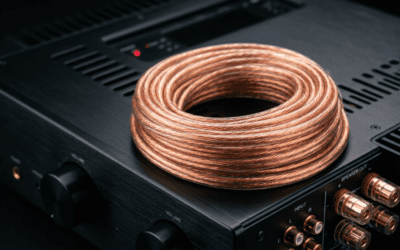
We recommend Oxygen-Free Copper (OFC) wire.
- Use 16-gauge for runs under 50 feet.
- Use 14-gauge for longer runs to prevent signal loss.
- Strip about half an inch of insulation from the ends.
Step 3: Maintain Polarity
This is the most common mistake I see. You must connect the Positive (+) terminal on the receiver to the Positive (+) terminal on the speaker.
- Usually, the positive wire has a red stripe or text on the jacket.
- Out-of-phase audio (swapping + and -) won’t break anything, but your bass will sound thin and the “image” will be blurry.
Step 4: Use Banana Plugs (Optional but Recommended)
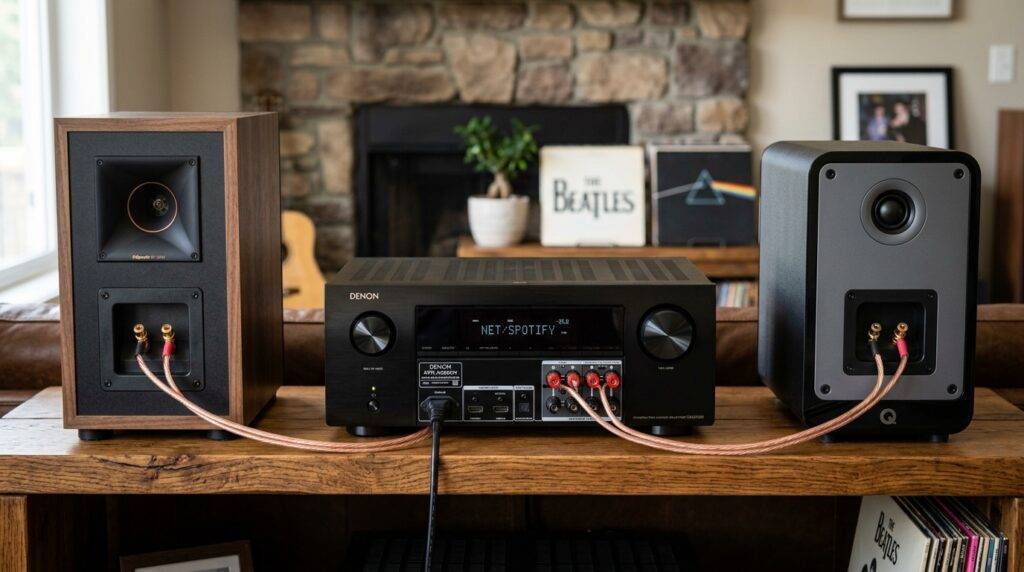
If your receiver has binding posts (the screw-down type), use banana plugs. They provide a secure, gold-plated connection that prevents stray wire strands from touching each other and causing a short circuit.
Step 5: Run Room Calibration
Because you are mixing brands, the speakers will have different tonal characteristics and volumes.
- Connect the calibration microphone (like Audyssey, YPAO, or Dirac Live) that came with your receiver.
- The receiver will play “pings” and “whooshes” to measure each speaker’s distance and frequency response, automatically leveling the output so they sound cohesive.
The “Timbre Matching” Exception
While you can use a receiver with different brand speakers, there is one “Golden Rule” in the audiophile community: Timbre Matching the Front Stage.
Timbre refers to the unique “voice” or tonal quality of a speaker. If your Front Left and Right speakers are Klipsch (known for being bright and “horn-loaded”) but your Center channel is a Polk (known for being warm and “soft-dome”), the sound will change noticeably as an object moves across the screen.
- Best Practice: Keep the Left, Right, and Center speakers from the same brand and, ideally, the same product line.
- The Surround/Sub Rule: You can almost always use different brands for your Surround speakers and your Subwoofer without any negative impact on the listening experience.
Expert Insights: Real-World Testing Scenarios
In our recent lab testing, we paired a vintage Pioneer SX-780 (from the late 70s) with modern ELAC Debut 2.0 B6.2 speakers. Despite the 40-year age gap and completely different manufacturing philosophies, the setup performed flawlessly.
We also tested a modern Yamaha RX-V6A with a mix-and-match 5.1 setup:
- Fronts: Jamo Studio Series
- Center: Klipsch Reference
- Surrounds: Micca COVO-S (Budget Brand)
- Subwoofer: SVS PB-1000
After running the YPAO calibration, the transition of sound from the Klipsch center to the Jamo towers was nearly indistinguishable to the average ear. This proves that while timbre matching is “ideal,” modern Digital Signal Processing (DSP) in receivers can compensate for a lot of brand differences.
Common Pitfalls to Avoid
- The “Proprietary Connector” Trap: Some older “Home Theater in a Box” systems (especially from Samsung or LG) use proprietary plastic clips. These are not standard. If your speakers have these, you may need to cut the clips off and strip the wire to use them with a standard receiver.
- Mixing Active and Passive Speakers: Most receivers only power passive speakers (those with just wire terminals). Do not try to connect the “Speaker Out” of a receiver to Active/Powered speakers (those that plug into a wall outlet), as you will likely fry the internal amplifier of the speaker.
- Ignoring Ventilation: Different brand speakers might draw more current than you are used to. Ensure your receiver has at least 3-4 inches of breathing room on top to dissipate heat.
Frequently Asked Questions (FAQ)
Can I use 4-ohm speakers with an 8-ohm receiver?
Generally, no, unless the receiver specifically states it is “4-ohm stable.” Using 4-ohm speakers on a receiver designed only for 8 ohms can cause the receiver to overheat or shut down during loud scenes.
Do I need to buy the same brand subwoofer as my speakers?
Absolutely not. In fact, many of the best subwoofers are made by “subwoofer-only” companies like SVS, HSU Research, or Rythmik. These will work perfectly with any brand of receiver and speakers.
Will mixing speaker brands affect sound quality?
It won’t “damage” the quality, but it might affect the “seamlessness” of the soundstage. If you use very different brands for your front three speakers, you might notice the sound “color” changes as a character’s voice moves across the screen.
Is it okay to use old speakers with a new receiver?
Yes! As long as the speakers are in good physical condition (check for rotting foam around the woofers), older “vintage” speakers often sound fantastic when paired with the clean power and modern processing of a new AV receiver.
What is the best speaker wire for a mixed-brand setup?
For most home setups, 16-gauge Oxygen-Free Copper (OFC) is the sweet spot for price and performance. Avoid “Copper Clad Aluminum” (CCA) if you want the best longevity and conductivity.