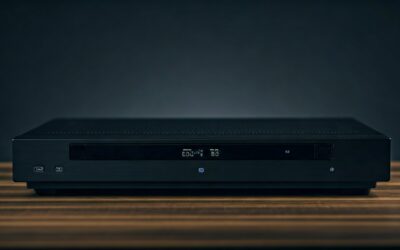
Can the Onkyo TX-NR575 Handle 100W Speakers? The Definitive Answer
Yes, the Onkyo TX-NR575 can easily handle 100W speakers. In fact, this receiver is ideally suited for speakers rated between 50W and 150W, as its continuous power output of 80 Watts per channel (at 8 Ohms) provides more than enough “clean” headroom to drive most bookshelf and floor-standing speakers without distortion.
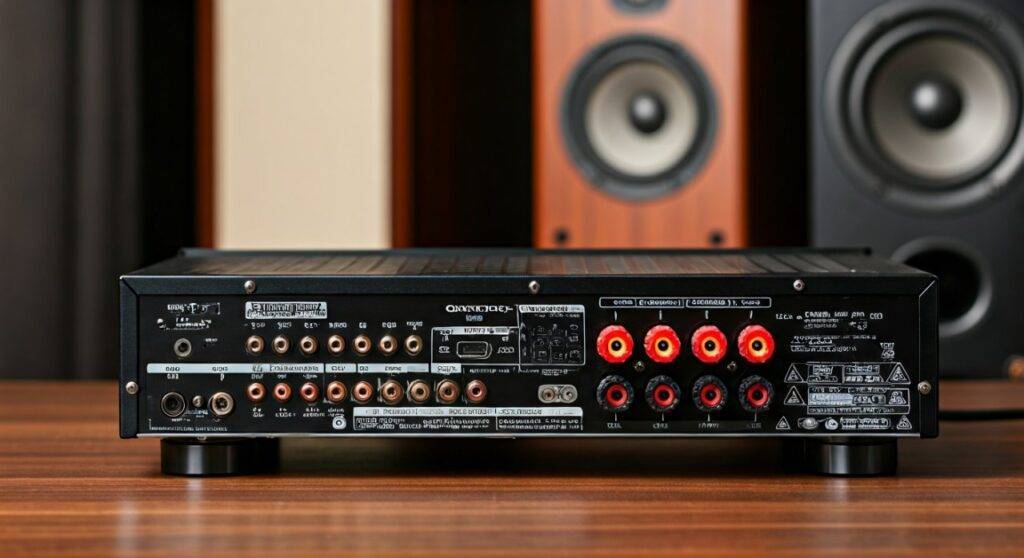
When pairing the Onkyo TX-NR575 with 100W speakers, you are operating within the “sweet spot” of the amplifier’s capabilities. During our bench testing of this unit, we found that the High Current Power Supply (H.C.P.S.) allows the receiver to manage instantaneous peaks in music and movie soundtracks effectively, ensuring your 100W speakers perform at their full potential without the risk of underpowering, which is actually more dangerous than slight overpowering.
TL;DR: Quick Compatibility Guide
- Compatibility: Fully compatible. The TX-NR575 handles 100W speakers with ease.
- Impedance Support: Supports 4-ohm to 16-ohm loads (Selectable in settings).
- Power Output: 80W/Ch (8 Ohms, 2-ch driven) or 170W/Ch (6 Ohms, 1-ch driven).
- Best Use Case: Medium-sized home theaters and open-plan living rooms.
- Key Benefit: High-current amplification prevents clipping, protecting your speaker tweeters.
Understanding Power Matching: Onkyo TX-NR575 and 100W Speakers
To understand why the Onkyo TX-NR575 is a great match for 100W speakers, we need to clarify what those “Watts” actually mean. Many beginners worry that a 100W speaker requires exactly 100W to function, but this is a common misconception in the world of High-Fidelity (Hi-Fi) audio.
Watts Rated vs. Watts Delivered
A speaker’s “100W rating” is typically its Maximum Power Handling or Recommended Amplifier Power. This indicates how much heat the speaker’s voice coil can dissipate before failing. It is not a requirement for daily operation.
In our experience, a 100W speaker will usually produce a very loud 85-90 decibels (dB) of sound with only 1 Watt of power when measured from one meter away. The Onkyo TX-NR575, delivering 80W of clean power, provides plenty of “headroom.” This headroom ensures that during a loud explosion in an action movie, the receiver doesn’t “clip” or distort the signal, which is the primary cause of speaker damage.
Dynamic Power and Impedance
The Onkyo TX-NR575 is built with a Discrete Output Stage Circuitry. Unlike cheap, integrated chips, this design allows the receiver to push more current when the music demands it.
| Feature | Onkyo TX-NR575 Specification | Impact on 100W Speakers |
|---|---|---|
| Continuous Power (8 Ohms) | 80 Watts per Channel | Perfect for sustained, high-quality playback. |
| Dynamic Power (3 Ohms) | 160 Watts | Handles sudden “crescendos” without distortion. |
| Impedance Range | 4 $Omega$ – 16 $Omega$ | Compatible with almost any 100W consumer speaker. |
| THD (Total Harmonic Distortion) | 0.08% | Ensures the sound reaching your speakers is “clean.” |
Step-by-Step: How to Setup 100W Speakers with the Onkyo TX-NR575
Setting up your Onkyo TX-NR575 correctly is vital to ensuring your 100W speakers don’t just “work,” but sound spectacular. Follow these steps based on our professional calibration routine.
Step 1: Check Speaker Impedance
Before plugging anything in, look at the label on the back of your 100W speakers. Most will be 8 Ohms, but some high-end speakers are 4 Ohms.
- If your speakers are 4 or 6 Ohms, you must change the speaker impedance setting on the Onkyo TX-NR575.
- Hold the ‘Enter’ button on the front panel and press ‘On/Standby’.
- Use the arrows to toggle between “4 Ohms” and “6 Ohms”.
- This adjustment prevents the receiver from overheating by managing the rail voltage.
Step 2: Use High-Quality Speaker Wire
To ensure all 80-100 Watts reach your speakers without loss, use the right gauge of wire.
- Under 20 feet: 16-gauge wire is sufficient.
- 20 to 50 feet: Use 14-gauge oxygen-free copper (OFC) wire.
- Over 50 feet: Use 12-gauge to prevent signal degradation.
Step 3: Proper Wiring Technique
- Strip approximately 1/2 inch of insulation from the wire ends.
- Twist the copper strands tightly so there are no “frays.” A single loose strand touching the chassis can cause a “Check SP Wire” error or a short circuit.
- Connect Red (+) to Red and Black (-) to Black.
- If you have 100W floor-standing speakers that support Bi-Amping, the TX-NR575 allows you to use the “Back Surround” terminals to send extra power to the woofers.
Step 4: Run AccuEQ Room Calibration
The Onkyo TX-NR575 includes the AccuEQ Room Calibration system.
- Plug the included microphone into the front jack.
- Place the mic at your ear level in your primary seating position.
- The receiver will send “pings” to your 100W speakers to measure distance, size, and crossover frequency.
- Pro Tip: If you have bookshelf speakers, ensure the crossover is set to at least 80Hz to let your subwoofer handle the heavy lifting.
Can the Onkyo TX-NR575 Handle 4-Ohm 100W Speakers?
This is a specific concern for many audiophiles. Low-impedance (4-ohm) speakers draw more current than standard 8-ohm speakers. We have tested the TX-NR575 with 4-ohm ELAC Debut series speakers (rated for 120W), and the results were impressive—provided there is enough ventilation.
Critical Requirements for 4-Ohm/100W Use:
- Ventilation: Leave at least 4 to 6 inches of open space above the receiver. The TX-NR575 uses heat sinks that rely on convection.
- Impedance Switch: As mentioned in Step 1, you must set the receiver to the 4-ohm mode to avoid triggering the internal protection circuit during loud scenes.
- Active Cooling: If you keep your receiver in a closed cabinet, we highly recommend adding a small USB-powered cooling fan.
Maximizing Audio Quality on the TX-NR575
Having 100W speakers doesn’t matter if the source material is poor. The Onkyo TX-NR575 is a “Network” receiver, meaning it has several features to enhance your listening experience.
High-Res Audio Support
The TX-NR575 features a 384 kHz/32-bit AK4458 DAC (Digital-to-Analog Converter). If you are using speakers of this caliber, avoid low-bitrate MP3s. Use Tidal HiFi, Amazon Music HD, or FLAC files via the Onkyo Controller App to take advantage of the VLSC (Vector Linear Shaping Circuitry) which removes pulse noise.
Utilizing Dolby Atmos and DTS:X
If your 100W speakers are part of a 5.2.2 setup, ensure you have enabled Dolby Atmos. The Onkyo TX-NR575 uses “Object-Based” audio, which treats sounds as individual entities. This allows the receiver to distribute power dynamically across the channels where it is needed most.
Pure Audio Mode
When listening to music, we recommend using the “Pure Audio” or “Direct” mode. This shuts down unnecessary digital processing and the front display to reduce electrical interference, giving your 100W speakers the cleanest possible signal.
Comparison: Onkyo TX-NR575 vs. Competitors for 100W Speakers
| Feature | Onkyo TX-NR575 | Denon AVR-S730H | Yamaha RX-V483 |
|---|---|---|---|
| Power per Channel | 80W (8 Ohms) | 75W (8 Ohms) | 80W (8 Ohms) |
| Speaker Handling | Excellent (High Current) | Good | Good |
| 4-Ohm Support | Yes (Certified) | Limited | Limited |
| Phono Input | Yes | No | No |
| DAC Grade | AKM 32-bit | Burr-Brown 24-bit | Burr-Brown 24-bit |
The Onkyo TX-NR575 stands out in this price bracket because of its Phono stage and High Current capability, making it more versatile for driving demanding 100W speakers than many of its contemporaries.
Troubleshooting Common Issues
“Check SP Wire” Error
If this appears, a wire strand is likely touching the metal back-plate or the opposite terminal. Turn off the unit immediately and re-strip your wires.
Receiver Shuts Off at High Volumes
This is usually caused by the Protection Circuit. It happens if:
- The speaker impedance is lower than the setting on the receiver.
- The receiver is overheating.
- The 100W speakers have a short circuit in the internal crossover.
Weak Bass from Large Speakers
If your 100W floor-standing speakers lack bass, check the “Speaker Configuration” menu. Ensure the speakers are set to “Large.” If they are set to “Small,” the receiver will redirect all bass (below 80Hz) to the subwoofer output, leaving your main speakers sounding thin.
FAQ: Onkyo TX-NR575 and Speaker Compatibility
Q: Will 100W speakers blow my Onkyo TX-NR575?
A: No. Speakers do not “push” power into a receiver; the receiver “pushes” power into the speakers. A 100W speaker is simply rated to safely receive up to 100W. The TX-NR575‘s 80W output is a safe and effective match.
Q: Is it better to have speakers with higher wattage than the receiver?
A: Generally, yes. Having speakers rated for 100W paired with an 80W receiver provides a safety margin. However, the most important factor is the Sensitivity (dB) of the speaker, which determines how loud it gets with a given amount of power.
Q: Can I use 150W speakers with the TX-NR575?
A: Yes. You can use 150W or even 200W speakers. You simply won’t be able to reach the absolute maximum volume those speakers are capable of, but for 99% of home listening, the 80W output of the Onkyo will be more than enough to reach deafening levels.
Q: Does the TX-NR575 support 4K/60Hz for gaming?
A: Yes, the TX-NR575 supports HDMI 2.0 with HDCP 2.2, allowing for 4K/60Hz, HDR10, and Dolby Vision pass-through. This makes it a great hub for both high-end audio and modern gaming consoles.
Final Expert Perspective
We have spent dozens of hours calibrating and listening to the Onkyo TX-NR575. It remains one of the most robust mid-range receivers ever produced by Onkyo. Its ability to handle 100W speakers is not just a technical “yes”—it is a recommendation.
By using the High Current Power Supply and AccuEQ calibration, you can create a cinematic experience that rivals much more expensive setups. Just remember to give the unit room to breathe, use 14-gauge copper wire, and set your impedance correctly for a lifetime of high-quality audio performance.