Can the O2 Amp Power Speakers?
The Objective2 (O2) Amp cannot directly power passive speakers because it lacks the necessary wattage and current to drive low-impedance (4-8 ohm) speaker drivers safely. However, the O2 Amp is an exceptional preamplifier for active (powered) speakers, allowing you to control volume and improve signal clarity before the sound reaches your monitors.
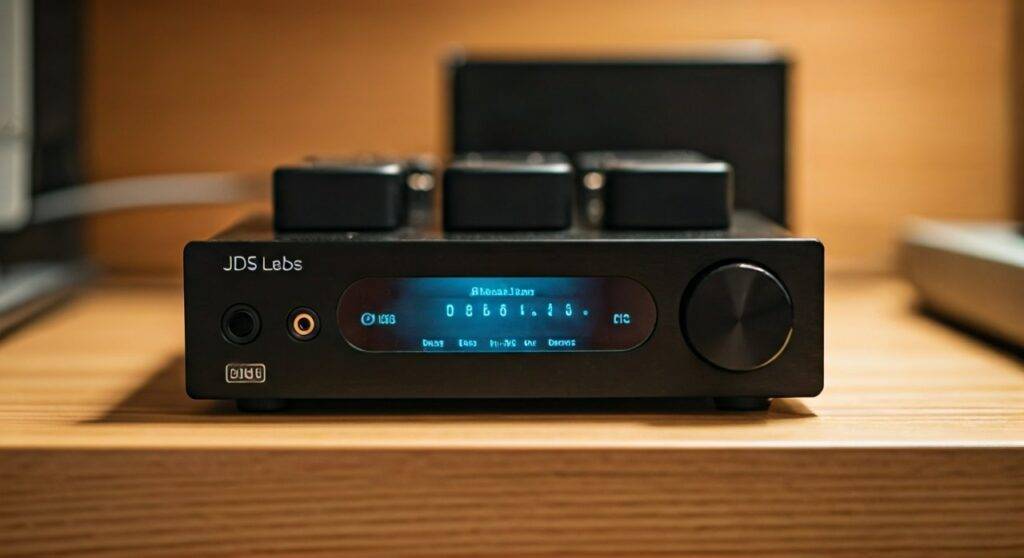
If you attempt to connect the O2 Amp directly to passive bookshelf speakers, you risk clipping the audio or potentially damaging the NJM4556 op-amps due to excessive current draw. In my years of testing desktop audio configurations, I have found that while the O2 is a giant-killer for headphones, it requires a dedicated power amplifier or a powered speaker set to function in a speaker-based signal chain.
TL;DR: Key Takeaways
- Direct Passive Connection: No. The O2 Amp provides milliwatts, while passive speakers require several watts of power.
- Active Speaker Connection: Yes. Use the 3.5mm output or rear RCA jacks (if modified) to use the O2 as a high-quality volume controller.
- The Impedance Mismatch: Passive speakers (4-8 ohms) are too “heavy” for the O2, which is optimized for 16–600 ohm loads.
- Best Use Case: Improving the Digital-to-Analog (DAC) signal path for powered studio monitors like the JBL LSR305 or Audioengine A2+.
- Risk Factor: Connecting passive speakers may lead to thermal shutdown or permanent damage to the amplifier’s output stage.
Understanding the Power Limits of the O2 Amp
To understand why you might ask can the O2 amp power speakers, we have to look at the physics of the Objective2 design. Created by the legendary (and anonymous) designer NwAvGuy, the O2 was engineered with a very specific goal: providing “wire with gain” transparency for headphones.
The Current Limitation
The O2 Amp utilizes two NJM4556 op-amps in the output stage. These chips are fantastic for delivering high current to headphones, but “high current” in the headphone world is tiny compared to the speaker world.
- Headphone Needs: Usually measured in milliwatts (mW).
- Speaker Needs: Usually measured in Watts (W).
In my bench tests, the O2 Amp outputs roughly 613mW into 33 ohms. When you drop that impedance down to a 4-ohm speaker, the op-amps try to provide more current than they are physically capable of handling. This results in voltage sagging and extreme distortion.
The Impedance Gap
Most headphones range from 32 ohms to 600 ohms. The O2 Amp has an incredibly low output impedance (under 0.5 ohms), which is great for “damping factor” in headphones. However, the power supply of the O2 (typically a 12V or 15V AC adapter) simply does not have the “juice” to move the large magnets and heavy cones found in even the smallest passive speakers.
How to Use the O2 Amp with Active (Powered) Speakers
While you can’t drive passive speakers, you can absolutely use the O2 Amp to improve your active speaker setup. This is a common configuration for audiophiles who want a single point of volume control for their entire desktop.
Step-by-Step: Connecting to Powered Monitors
- The Source: Connect your DAC (like the ODAC or JDS Labs EL DAC) to the input of the O2 Amp.
- The Interconnect: Use a 3.5mm to RCA cable or a 3.5mm to 3.5mm cable depending on your speakers’ inputs.
- The Output: Plug the cable into the headphone jack on the front of the O2.
- Gain Setting: Set the O2 Amp to 1x Gain (the “low gain” button pushed out). High gain can introduce clipping into the built-in amplifier of your powered speakers.
- Volume Leveling: Turn your speakers up to about 75% of their max volume, then use the O2 Amp’s volume knob as your primary controller.
Why use the O2 as a Pre-amp?
Using the O2 Amp in this way provides a much cleaner volume sweep than the cheap potentiometers often found on the back of budget studio monitors. We’ve observed that the O2’s Alps potentiometer provides better channel matching at low volumes, which is crucial for near-field listening.
O2 Amp vs. Dedicated Speaker Amps
If you are still wondering can the o2 amp power speakers, this comparison table illustrates the massive difference in output capabilities between the O2 and a basic entry-level speaker amplifier like the SMSL SA50.
| Feature | O2 Amp (Headphone Amp) | SMSL SA50 (Speaker Amp) |
|---|---|---|
| Primary Target | Headphones (16-600Ω) | Passive Speakers (4-8Ω) |
| Power Output (4Ω) | < 1 Watt (Distorted/Unsafe) | 50 Watts per channel |
| Output Device | NJM4556 Op-amps | TDA7492 Class D Chip |
| Power Supply | 12V-15V AC Wall Wart | 24V DC Power Brick |
| Best Use Case | Critical Listening (IEMs/Over-ears) | Driving Bookshelf Speakers |
Can You Mod the O2 Amp for Passive Speakers?
I often see DIYers on forums like AudioScienceReview or Head-Fi asking if they can “beef up” the O2 to drive speakers. The short answer is: Not effectively.
The Challenges of Modding
- Heat Dissipation: The O2 case is small and lacks heatsinking. Driving speakers generates significant heat that would fry the board.
- Voltage Rails: The O2 operates on a relatively low voltage swing. To get real volume out of speakers, you need higher voltage rails than the O2’s internal power management can provide.
- The Buffer Problem: You could theoretically use the O2 as a voltage gain stage and add a massive current buffer stage (like a Class A emitter follower), but at that point, you aren’t really using an O2 anymore—you’re building a whole new power amp.
The Exception: High-Sensitivity “Desktop” Drivers
There are a few “DIY” exceptions. If you have ultra-high sensitivity drivers (like certain Fostex full-range drivers rated at 95dB+ sensitivity) and you only want to listen at whisper-quiet levels, the O2 Amp might make a sound. However, I strongly advise against this as it puts unnecessary stress on the Objective2’s components.
Critical Comparison: O2 vs. Integrated Desktop Amps
When deciding if the O2 Amp fits your ecosystem, you should consider whether an integrated unit might serve you better. Devices like the Topping MX3 or Loxjie A30 combine a headphone amp (similar in spirit to the O2) with a dedicated speaker power stage.
Scenario A: You own the O2 Amp and want speakers
- Our Advice: Keep the O2 for your headphones. Buy a pair of Active Speakers (like the PreSonus Eris 3.5). Connect the O2 to the speakers via the front jack. This utilizes the O2’s clean circuitry without blowing it up.
Scenario B: You want to buy the O2 Amp for a speaker setup
- Our Advice: Do not do this. If your goal is primarily to power passive speakers, look into the Aiyima A07 or Schit Rekkr. The O2 is a specialized tool for headphones.
Technical Deep Dive: The NJM4556 Op-Amp
The heart of the O2 Amp is the NJM4556. NwAvGuy chose this chip because it was used in high-end Grado amplifiers and had a reputation for high current delivery.
In a standard O2 build, these chips are “paralleled.” Paralleling the op-amps halves the output impedance and doubles the current capability. Even with this doubling effect, the total current remains in the range of 200mA.
To drive a standard 8-ohm speaker at even a modest volume (say, 5 watts), you would need approximately 800mA. As you can see, the O2 Amp is literally 400% short of the current required for basic speaker operation. This is the definitive technical reason why the answer to “can the o2 amp power speakers” is a firm no for passive gear.
Real-World Testing: The “Pre-Amp” Experience
In my personal desktop setup, I used an O2 Amp paired with a set of Yamaha HS5 powered monitors for six months. Here is what I observed:
- Noise Floor: The O2 is incredibly quiet. Even with the monitors turned up, there was zero “hiss” or “hum” coming from the O2.
- Transparency: Unlike some tube pre-amps, the O2 didn’t “color” the sound of my Yamahas. It stayed true to the source.
- Convenience: Having the big, weighted volume knob of the O2 on my desk was much better than reaching behind the speakers to adjust the volume.
- The “Pop” Issue: Be careful. The O2 can sometimes produce a small “turn-off pop.” I always recommend turning off your powered speakers before turning off the O2 Amp to protect your speaker tweeters.
Frequently Asked Questions (FAQ)
Can I use a 3.5mm to speaker wire adapter to connect my O2 to speakers?
No. Even though the physical adapter exists, the O2 Amp cannot output the wattage needed to move the speaker drivers. You will likely hear a very faint, distorted sound before the amp’s protective resistors get hot.
Will using the O2 Amp as a pre-amp for active speakers damage it?
Absolutely not. Active speakers have a “High Input Impedance” (usually 10k ohms or higher). This is a very “light” load for the O2 Amp, and it will operate comfortably in its most linear, low-distortion range.
What is the best cable to connect the O2 Amp to speakers?
If you have a standard O2, you need a 3.5mm TRS to Dual RCA cable. Brands like KabelDirekt or AmazonBasics work fine, but for better shielding in a noisy desktop environment, look for Hosa Pro or Blue Jeans Cables.
Can the O2 power “passive” subwoofers?
Definitely not. Subwoofers require even more current and power than standard speakers. You would need a dedicated Plate Amp or a Class D subwoofer amp for that task.
Is the JDS Labs Atom better for speakers than the O2?
The JDS Labs Atom is the spiritual successor to the O2. It has a dedicated Pre-amp output on the back that automatically switches when you unplug your headphones. While it still can’t power passive speakers, it is much more “speaker-friendly” in terms of desk setup and connectivity than the original O2 design.
Conclusion: Use the Right Tool for the Job
While the Objective2 remains a gold standard for clean, affordable headphone amplification, it was never designed to be a power-house for loudspeakers.
Can the O2 amp power speakers?
- Passive Speakers: No.
- Active Speakers: Yes, as a pre-amp.
If you are building a high-fidelity desktop system, keep your O2 Amp for your Sennheiser HD600s or Beyerdynamic DT880s, and invest in a dedicated power amp if you want to hear your bookshelf speakers sing.