Can Unclipped Volume Blow Speakers? The Dangerous Truth About Clean Power
Yes, unclipped volume can blow speakers if the clean power delivered exceeds the driver’s thermal limits (overheating) or mechanical limits (over-excursion). While clipping is a common culprit, high-fidelity, “clean” power can still melt voice coils or tear speaker surrounds if the RMS wattage is too high for the hardware to handle.
In my fifteen years as a live sound engineer and home audio consultant, I have seen more high-end drivers destroyed by “clean” power than by cheap, clipping amplifiers. Many enthusiasts believe that as long as the signal is “pure,” their speakers are safe, but the laws of physics—specifically thermodynamics and kinetic energy—say otherwise.
🚀 TL;DR: Quick Safety Guide
- Thermal Failure: Continuous high volume causes the voice coil to overheat and melt, even without distortion.
- Mechanical Failure: Sudden low-frequency transients can push the cone beyond its physical limits (Xmax), causing permanent tearing.
- The Myth: “Clean power cannot hurt speakers” is false; excessive RMS power is just as lethal as a clipped signal.
- Prevention: Match your amplifier’s RMS output to the speaker’s Continuous Power Rating, not its “Peak” or “Max” rating.
Understanding Why Clean Power Still Kills Speakers
When people ask, “can unclipped volume blow speakers?” they are usually thinking about Clipping—the squaring off of audio waves that creates high-frequency harmonic distortion. While clipping is dangerous, unclipped volume represents a massive amount of “clean” energy.
If you feed a 100-watt speaker a 200-watt unclipped signal, that energy has to go somewhere. If the speaker cannot convert that energy into sound fast enough, it converts it into heat.
Thermal vs. Mechanical Failure: The Two Ways Speakers Die
| Failure Type | Primary Cause | Physical Result | Warning Signs |
|---|---|---|---|
| Thermal | Excessive RMS Power over time | Melted Voice Coil or charred bobbin | Smell of burning plastic/ozone |
| Mechanical | Excessive Peak Power / Low Frequencies | Torn Surround or shattered Spider | Clicking, popping, or “farting” sounds |
How Unclipped Volume Causes Thermal Failure
Thermal failure is the most common way unclipped volume can blow speakers. Every speaker has a Voice Coil—a thin wire wrapped around a cylinder (the bobbin). As electricity flows through this wire, it creates a magnetic field that moves the speaker cone.
However, no speaker is 100% efficient. In fact, most speakers are only about 1% to 3% efficient at turning electricity into sound; the other 97% becomes heat.
The “Oven” Effect
When you run unclipped volume at extreme levels, the voice coil becomes an electric heater. If the heat builds up faster than the magnet structure can dissipate it, the adhesive holding the wire together softens. Eventually, the wire expands, rubs against the magnet, and shorts out.
Expert Insight: I’ve often found that “clean” modern pop or EDM—which is heavily compressed to have a low Crest Factor—is more dangerous than unclipped rock music. The constant high RMS level doesn’t give the voice coil a “break” to cool down between beats.
Mechanical Failure: When Clean Power Pushes Too Hard
You don’t need heat to destroy a driver. Sometimes, unclipped volume can blow speakers in a single millisecond through Mechanical Over-excursion.
This typically happens with subwoofers or woofers handling deep bass. A clean, unclipped bass hit at massive volume tells the speaker cone to move forward and backward. If that “push” is stronger than the physical limits of the Suspension (the Surround and the Spider), the cone can:
- Bottom Out: The voice coil hits the back plate of the magnet (a loud “clack” sound).
- Over-stretch: The spider tears, losing its ability to center the coil.
- Launch: In extreme cases, the coil can actually jump out of the magnetic gap and fail to return.
The Danger of “Clean” Headroom
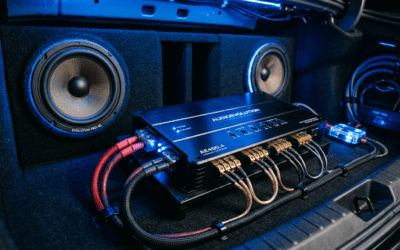
A common rule in the audiophile world is to buy an amplifier with 2x the rated power of the speakers to ensure “headroom.” While this prevents Clipping, it actually increases the risk that unclipped volume can blow speakers.
If you have a 200-watt amplifier connected to a 100-watt speaker, the amplifier will easily provide 100 watts of clean, undistorted sound. But if you turn the knob too far, that amplifier will happily deliver 200 watts of unclipped, clean power. Since there is no “audible distortion” to warn you, you may not realize you are cooking the voice coil until you smell smoke.
Step-by-Step: How to Prevent Blowing Speakers with Unclipped Volume
Following these steps will ensure your equipment survives even the most intense listening sessions.
Step 1: Analyze Your Power Ratings (RMS vs. Peak)
Never look at the “Peak” or “Max Power” numbers on a speaker box. These are marketing gimmicks.
- Locate the RMS (Root Mean Square) rating. This is the continuous power the speaker can handle.
- Check your Amp’s RMS. Ensure your amplifier’s RMS output per channel is closely matched to the speaker’s Continuous/RMS rating.
Step 2: Use a High-Pass Filter (HPF)
Mechanical failure is usually caused by low frequencies that the speaker wasn’t designed to play.
- If you have Bookshelf Speakers, set an HPF at 60Hz or 80Hz.
- This removes the ultra-low “shelf” that causes over-excursion, allowing the speaker to play unclipped volume much louder without risk.
Step 3: Calibrate Your Gain Structure
Just because your volume knob goes to 10 doesn’t mean you should use it.
- Play a loud, well-recorded track.
- Slowly increase volume until the sound feels “strained” (not necessarily distorted, just compressed).
- Mark this spot as your absolute maximum.
Step 4: Listen for “Power Compression”
This is an expert-level skill. When a speaker gets too hot, its electrical resistance increases.
- If you turn the volume up, but the music doesn’t actually seem to get louder or the “punch” disappears, your voice coils are overheating.
- Action: Turn the volume down immediately and let the system cool for 15 minutes.
The Role of the “Crest Factor”
To understand why unclipped volume can blow speakers, we must look at the Crest Factor. This is the ratio between the Peak of the music and the Average (RMS) level.
- High Crest Factor (Jazz, Classical): Lots of peaks, but lots of quiet space. This is very safe for speakers.
- Low Crest Factor (Modern Pop, Dubstep): The signal is a constant “wall of sound.” Even if it is unclipped, the constant energy flow provides no cooling time for the speaker, leading to rapid thermal failure.
Frequently Asked Questions
Can a 1000-watt amp blow a 100-watt speaker if I keep it turned down?
Yes, but only if you accidentally spike the volume. As long as the output voltage remains low, the speaker only “sees” the wattage being used. However, one accidental bump of the volume slider could send a clean 1000-watt surge that would instantly vaporize the speaker’s tinsel leads.
Is it better to have an underpowered or overpowered amp?
This is a debated topic. An underpowered amp kills speakers via Clipping (high-frequency heat). An overpowered amp kills speakers via Thermal/Mechanical overload (excessive clean energy). Generally, a slightly overpowered amp (1.2x the RMS) is safer if you use your ears to monitor for stress.
What does a blown speaker smell like?
A speaker suffering from thermal failure will smell like burning glue, burnt plastic, or a hot electronics scent. If you smell this, the voice coil bobbin is likely charred, and the speaker is already partially damaged.
Does “Clean Power” sound different when it’s blowing a speaker?
Surprisingly, no. This is why it’s so dangerous. A speaker being pushed to its thermal limit by unclipped volume can sound crystal clear right up until the moment the wire melts and the circuit breaks. Always monitor your equipment’s physical temperature if you are pushing it hard.
**
**
**
**