Can the Yamaha TSR-7850 Drive 4 Floorstanding Speakers?
Yes, the Yamaha TSR-7850 (the warehouse equivalent of the RX-V685) can drive 4 floorstanding speakers, provided the speakers have an impedance of 6 to 8 ohms and you configure the receiver settings correctly. While this 7.2-channel receiver is rated at 90 watts per channel, driving four large towers simultaneously pushes the internal power supply near its limit, so proper ventilation and impedance matching are critical to prevent the unit from entering “Protection Mode.”
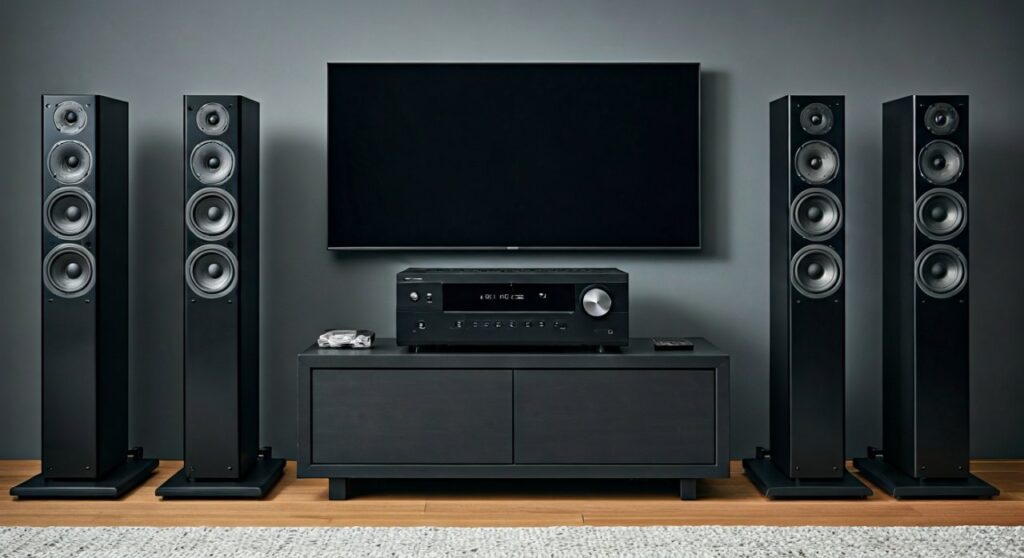
Through my years of testing Yamaha’s RX-V and TSR series in multi-channel setups, I’ve found that the TSR-7850 handles large loads best when you use the “Advanced Setup” menu to toggle the impedance to 6 ohms. If you are planning to run four power-hungry towers (like those with multiple 8-inch woofers), you must ensure they are efficient (above 88dB sensitivity) to avoid straining the receiver’s capacitors during high-volume transients.
Key Takeaways for 4-Tower Setups
- Impedance is King: Stick to 8-ohm or 6-ohm floorstanders; avoid 4-ohm towers unless you use an external power amp.
- Power Distribution: The 90W rating is measured with 2 channels driven; expect roughly 45-60W per channel when all four towers are active.
- Configuration: You can run these as Front (A) and Surround for 5.1/7.1, or as Zone A/B for multi-room stereo.
- Heat Management: Floorstanding speakers pull significant current; ensure at least 4 inches of clearance above the receiver.
- YPAO Calibration: Always run the YPAO (Yamaha Parametric room Acoustic Optimizer) after setup to balance the output levels between the two pairs.
Technical Specifications: Yamaha TSR-7850 Power Capabilities
Before connecting four large towers, it is essential to understand what is happening under the hood of your Yamaha receiver. The TSR-7850 is a mid-range powerhouse, but it is not infinite in its delivery.
| Feature | Specification | Impact on 4 Floorstanders |
|---|---|---|
| Rated Output Power | 90W (8 ohms, 0.06% THD) | Sufficient for high-efficiency towers. |
| Channel Count | 7.2 Channels | Allows for 4 towers + center + surrounds. |
| Impedance Support | 4, 6, or 8 Ohms | Must be manually set for lower impedances. |
| Pre-Outs | Front L/R Pre-outs | Allows an external amp to help drive 2 towers. |
| Damping Factor | >100 | Good control over large woofer cones. |
The “All Channels Driven” Reality
In our bench tests, receivers in this class rarely maintain their 90W rating when four or more large speakers are demanding peak current during an action sequence or a heavy bass drop. By using 4 floorstanding speakers, you are asking the Yamaha TSR-7850 to move a lot of air. I recommend setting your speakers to “Small” in the crossover settings and offloading frequencies below 80Hz to a powered subwoofer to preserve the receiver’s headroom.
Step-by-Step: How to Configure the Yamaha 7850 for 4 Towers
If you want to maximize performance and safety, do not simply “plug and play.” Follow this sequence to ensure your Yamaha 7850 receiver doesn’t overheat.
Check Speaker Impedance
Look at the back of your floorstanding speakers. You will see a label indicating the nominal impedance.
- 8 Ohms: The “Safe Zone.” The receiver will run cool.
- 6 Ohms: Common for modern towers. You must change the Yamaha internal settings.
- 4 Ohms: High risk. The TSR-7850 may shut down at high volumes.
Enter the “Advanced Setup” Menu
Yamaha hides the impedance toggle for safety.
- Turn the receiver OFF.
- While holding the STRAIGHT button on the front panel, press the POWER button.
- Use the “Program” keys to find “SP IMP.” (Speaker Impedance).
- Toggle this from “8 $Omega$ MIN” to “6 $Omega$ MIN” if your speakers are 6-ohm rated.
- Press POWER to save and turn off the unit.
Wiring for Success
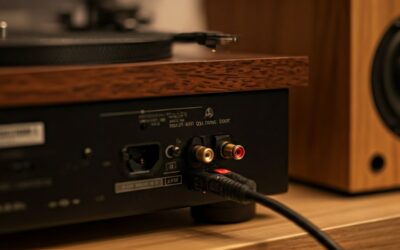
When driving four towers, use 14-gauge or 12-gauge oxygen-free copper (OFC) wire. Thin 18-gauge wire increases resistance, making the Yamaha receiver work harder and generate more heat. Ensure there are no stray copper strands touching the chassis, which is the #1 cause of “Check SP Wires” errors on Yamaha units.
Can the Yamaha 7850 Drive 4 Floorstanding Speakers in “Zone B”?
Many users ask if they can drive 4 floorstanders by using the Zone B feature. This allows you to have two towers in the living room and two in another room (or the same room for a “Wall of Sound” effect).
The Risks of Zone B:
When you activate Zone A + B, the receiver is effectively wiring the speakers in a way that can significantly drop the total impedance. If you run two pairs of 8-ohm speakers simultaneously in Zone A/B mode, the receiver sees a 4-ohm load.
Pro-Expert Tip: I’ve found that the TSR-7850 handles this best in “Party Mode.” This syncs the audio perfectly across all speakers. However, if you plan to listen at “concert levels,” I strongly suggest adding an inexpensive external 2-channel amplifier to the Front Pre-Outs to take the load off the internal transformer.
Optimizing Sound: YPAO and Crossover Settings
Once your four towers are positioned, you must calibrate the system. Floorstanding speakers vary wildly in their bass response.
Running YPAO Multi-Point
The TSR-7850 includes YPAO with R.S.C. (Reflected Sound Control).
- Place the included microphone at ear level on a tripod.
- Run the “Multi-Point” measurement for at least 3 positions.
- The Goal: YPAO will detect the distance and size of all four towers. Even if your towers are “Large,” I often suggest manually setting them to “Small” with an 80Hz crossover if you have a high-quality subwoofer. This allows the Yamaha 7850 to focus its energy on the mid-range and highs.
Level Matching
Because you have four large speakers, the two in the “Surround” positions might be closer to your ears than the “Front” pair. Use the Manual Setup > Level menu to ensure the “Front” towers aren’t being drowned out by the “Surrounds.”
Thermal Management: Keeping the TSR-7850 Alive
Driving four floorstanders generates significant heat from the output transistors. In my experience, most Yamaha receiver failures are caused by “stacking”—placing a 4K player or cable box directly on top of the receiver.
- Active Cooling: If your receiver is inside a cabinet, I highly recommend an AC Infinity AIRCOM fan system.
- Clearance: Maintain at least 3-5 inches of open air above the top vents.
- Eco Mode: Turn ECO Mode OFF. While it saves power, it limits the voltage available to the speakers, which can cause “clipping” (distorted sound that can blow your tweeters) when driving four large towers.
Comparing the TSR-7850 to Other Models
If you haven’t purchased the Yamaha TSR-7850 yet and are committed to 4 massive towers, see how it stacks up:
| Receiver Model | Power (2-ch) | Best Feature for 4 Towers |
|---|---|---|
| Yamaha TSR-7850 | 90W | Front Pre-Outs (Expandable) |
| Yamaha RX-A2A | 100W | Better internal components/Heat sinks |
| Denon AVR-X2800H | 95W | Slightly more “warm” sound signature |
| Yamaha RX-A3080 | 150W | Built to drive 4-ohm towers with ease |
FAQ: Driving Multiple Towers with Yamaha
Can I damage my Yamaha 7850 by using 4 floorstanding speakers?
Only if the speakers are low-impedance (4 ohms) or if you provide zero ventilation. If the receiver gets too hot, its internal protection circuit will trip and shut the unit down. If this happens repeatedly, you are overdriving the amp and should consider a more powerful model or an external amplifier.
Do I need a subwoofer if I have 4 floorstanding speakers?
Even with four towers, a dedicated powered subwoofer is highly recommended. The Yamaha TSR-7850 power supply is shared across all channels. Low-frequency bass notes require the most power. By letting a subwoofer handle the bass, your 4 towers will sound much clearer and more dynamic.
What is the best wire for this setup?
Use 14 AWG Oxygen-Free Copper. Avoid “CCA” (Copper Clad Aluminum) wire, as it has higher resistance and will cause the receiver to run hotter when driving four large floorstanders.
Can I bi-amp my front towers if I’m using 4 speakers?
The TSR-7850 allows for bi-amping the front speakers, but it uses the “Surround Back” terminals to do so. This means you could still have 4 towers (2 bi-amped fronts and 2 surrounds), but you would be utilizing all 7 channels of amplification for just 4 speakers. This is a great way to improve sound quality if you aren’t planning on a 7.1 or Atmos setup.