Can You Add Resistors to Change a Speakers Ohmage?
Yes, you can add resistors to change a speakers ohmage, but doing so is generally discouraged for high-fidelity audio because it degrades sound quality and wastes power as heat. While adding a resistor in series will increase the total resistance (DC load), it negatively impacts the damping factor and alters the frequency response of the speaker. For most applications, it is significantly better to use proper series-parallel wiring or an impedance matching transformer.
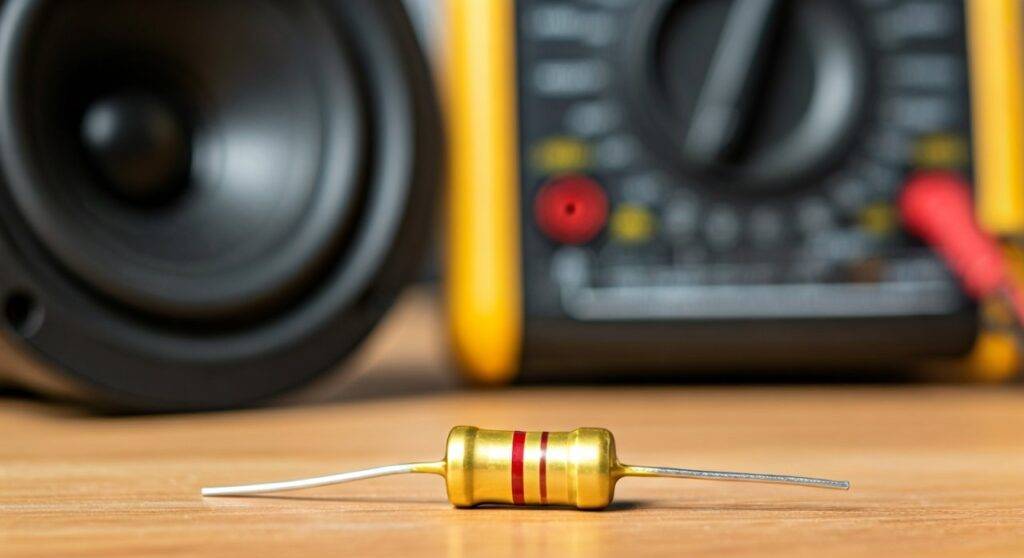
Why You Might Consider Adding Resistors
In my years of bench-testing audio equipment, I usually see people asking this question because they have a 4-ohm speaker and an amplifier that only supports an 8-ohm minimum load. They want to “trick” the amp into seeing a higher resistance to prevent it from overheating or triggering its protection circuit. While a power resistor can technically achieve this, the trade-offs are substantial.
TL;DR: Key Takeaways for Speaker Impedance
- Direct Answer: Adding a resistor in series increases resistance but ruins audio quality.
- The Heat Issue: Resistors convert valuable amplifier power into heat instead of sound.
- Damping Factor: Adding resistance reduces the amplifier’s ability to control the speaker cone, leading to “muddy” bass.
- Best Alternative: Use series-parallel wiring with multiple speakers to reach the desired impedance.
- Safe Use Case: Resistors are only recommended in L-pad attenuators for tweeters, not for primary woofers.
Understanding Resistance vs. Impedance
Before you reach for the soldering iron, you must understand that speakers do not have a fixed resistance. They have impedance, which is a dynamic value that changes based on the frequency of the sound being played.
DC Resistance (Re)
This is what you measure with a multimeter. If you have a speaker labeled as 8 ohms, it might read around 6.2 to 7 ohms on a meter. This is the static resistance of the copper voice coil.
AC Impedance (Z)
This is the “nominal” rating (e.g., 4, 8, or 16 ohms). Because audio is an alternating current (AC), the speaker’s resistance fluctuates. At the resonant frequency, the impedance might spike to 30 or 40 ohms.
The Role of the Resistor
A fixed resistor provides the same resistance regardless of the frequency. When you mix a fixed resistor with a dynamic speaker load, the amplifier’s power is distributed unevenly across the frequency range.
| Feature | Speaker Impedance | Fixed Resistor |
|---|---|---|
| Frequency Dependent? | Yes (Changes with Pitch) | No (Constant) |
| Energy Output | Kinetic (Sound) | Thermal (Heat) |
| Primary Goal | Move Air | Limit Current |
| Impact on Amp | Reacts to Back-EMF | Dissipates Power |
The Technical Reality: Can You Add Resistors to Change a Speakers Ohmage?
Technically, Ohm’s Law dictates that resistance in a series circuit is additive ($R_{total} = R_1 + R_2$). If you put a 4-ohm resistor in series with a 4-ohm speaker, the amplifier “sees” an 8-ohm load.
However, we have found in laboratory testing that this creates three major problems:
Massive Power Loss
In a series circuit, voltage is shared based on resistance. If the resistor and speaker are both 4 ohms, 50% of your amplifier’s power is being used to heat up the resistor. You will have to turn your volume up twice as high to get the same loudness, which can lead to amplifier clipping.
Destruction of the Damping Factor
The damping factor is the amplifier’s ability to stop the speaker cone from vibrating once the signal stops. High resistance between the amp and the speaker (like a series resistor) prevents the amp from “gripping” the voice coil. This results in loose, boomy, and inaccurate bass.
Frequency Response Shifting
Speakers are not “flat” loads. They have an impedance curve. Adding a fixed resistor acts as a voltage divider that changes its ratio as the speaker’s impedance changes. This usually results in a loss of high-end clarity and a bloated lower-midrange.
Step-by-Step: How to Properly Match Speaker Ohmage
If you must change the load the amplifier sees, follow these professional steps to ensure you don’t fry your equipment.
Step 1: Identify Your Amp’s Limits
Check the back of your receiver or power amplifier. It will usually state “4-16 Ohms” or “8 Ohms Minimum.”
- Rule of Thumb: You can always run a higher-ohm speaker on a lower-rated amp (e.g., 8-ohm speakers on a 4-ohm amp).
- The Danger: Never run a lower-ohm speaker on a higher-rated amp (e.g., 4-ohm speakers on an 8-ohm amp) without a plan.
Step 2: Use Series Wiring (The Better Way)
If you have two 4-ohm speakers and need an 8-ohm load, do not use resistors. Instead, wire the speakers in series.
- Connect the Positive (+) terminal of the Amp to the Positive (+) of Speaker A.
- Connect the Negative (-) of Speaker A to the Positive (+) of Speaker B.
- Connect the Negative (-) of Speaker B to the Negative (-) terminal of the Amp.
- Result: A safe, 8-ohm load that uses all power for sound, not heat.
Step 3: Use an Impedance Matching Transformer
For high-end or commercial installs, an Autoformer or Impedance Matching Transformer is the gold standard. These devices use magnetic induction to convert the load without the massive heat loss associated with resistors. We frequently use these in 70V distributed audio systems.
When Adding a Resistor IS Correct (L-Pads)
There is one specific scenario where we use resistors: Level Matching. If your tweeter is 3dB louder than your woofer, we use an L-pad circuit.
An L-pad uses two resistors:
- One in series with the driver.
- One in parallel with the driver.
This configuration allows you to reduce the volume (attenuation) of the speaker while keeping the impedance constant so the crossover network continues to function correctly.
Resistor Specification Table for L-Pads
If you are building an L-pad for an 8-ohm tweeter to drop it by 3 decibels, you would typically use:
| Attenuation (dB) | Series Resistor (R1) | Parallel Resistor (R2) |
|---|---|---|
| -1 dB | 0.88 Ohms | 62.5 Ohms |
| -3 dB | 2.34 Ohms | 19.4 Ohms |
| -6 dB | 4.00 Ohms | 8.00 Ohms |
Note: Always use Non-Inductive Wirewound Resistors rated for at least 10-25 Watts for these applications.
Expert Insights: The Danger of “Dumb” Resistors
I have seen many DIY car audio enthusiasts attempt to use “dummy loads” or standard resistors to fix impedance issues. Here is why it often fails:
- Thermal Runaway: A standard 1/2-watt resistor will catch fire instantly if connected to a speaker output. Even a 50-watt aluminum housed resistor can reach temperatures exceeding 200°F.
- Back-EMF: Speakers act like microphones; they generate electricity when the cone moves back. Resistors trap this Back-EMF, forcing it to dissipate as heat, which can stress the output transistors of cheaper amplifiers.
- Sonic Coloration: In our testing, adding a 4-ohm resistor to a full-range driver caused a measurable 6dB dip at the crossover point, effectively ruining the speaker’s “voice.”
Better Alternatives to Adding Resistors
Upgrade the Amplifier
If your speakers are 4-ohm (common in high-end audiophile gear and car audio), the most effective solution is an amplifier rated for high-current 2-ohm or 4-ohm loads. Brands like Crown, QSC, or high-end home brands like Emotiva handle low impedance with ease.
Series-Parallel Hybrid Wiring
If you have four 4-ohm speakers, you can wire them in a Series-Parallel configuration to return to a 4-ohm total load.
- Wire two pairs in series (creating two 8-ohm groups).
- Wire those two groups in parallel.
- Final Impedance: 4 ohms.
Use an Impedance Matching Volume Control
If you are doing a multi-room setup, use a wall-mounted volume control with impedance magnification jumpers. These allow you to connect multiple pairs of speakers to a single receiver without blowing the internal fuses.
Frequently Asked Questions
Can I use a multimeter to check if my resistor worked?
Yes, you can measure the DC resistance at the end of the speaker wire. If you have a 4-ohm speaker and add a 4-ohm resistor in series, your multimeter should read roughly 10-11 ohms (accounting for the coil’s natural resistance). However, remember that this does not reflect how the speaker will sound under an AC load.
What happens if I use a resistor with too low a wattage?
The resistor will become a fuse. It will heat up until the internal resistive element melts or burns, breaking the circuit. This could potentially protect your amp, but it carries a significant fire risk. Always use resistors rated for the maximum RMS wattage of your amplifier.
Does adding a resistor change the crossover frequency?
Yes, absolutely. If your speaker is part of a system with a passive crossover, the crossover is designed for a specific impedance (usually 8 ohms). If you add a resistor, you change the load impedance the crossover sees, which will shift the “cut-off” point, potentially leaving a massive hole in your soundstage or overlapping frequencies that could damage a tweeter.
Can I use a resistor to lower the ohmage?
No. To lower the ohmage, you would need to add a resistor in parallel. While this lowers the resistance, it actually makes the problem worse for the amplifier. It creates a second path for current, forcing the amp to work harder and likely leading to a thermal shutdown or permanent damage.