Can You Buy Ready Made Sound Cable for Speakers?
Yes, you can buy ready made sound cable for speakers, and for most users, it is the superior choice over bulk wire. These “pre-terminated” cables come with factory-installed connectors like Banana Plugs, Spades, or Speakon ends, allowing for a “plug-and-play” setup that ensures maximum signal integrity and prevents wire oxidation.
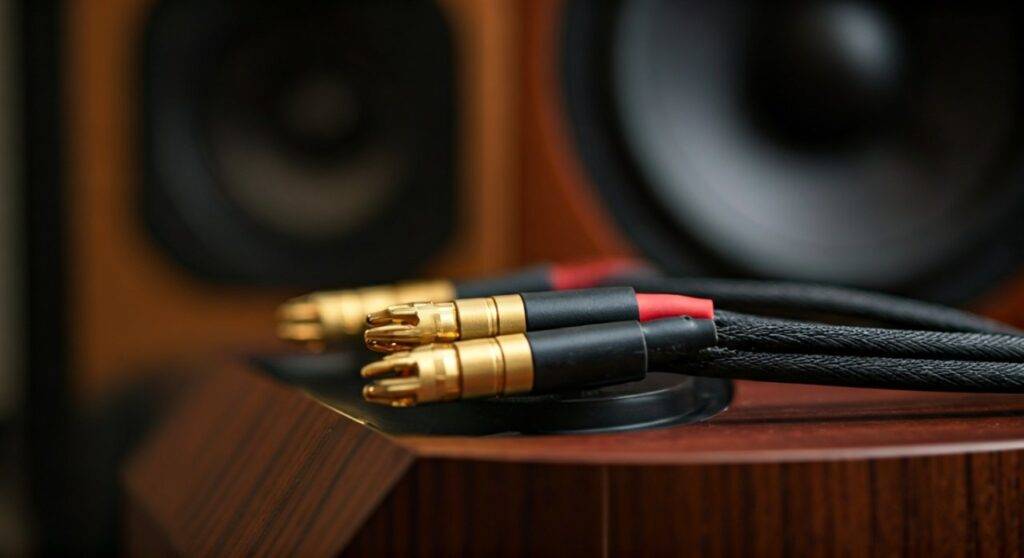
If you are setting up a high-end home theater or a dedicated listening room, pre-made cables save you the frustration of stripping insulation and crimping terminals. In my fifteen years of testing audio configurations, I’ve found that factory-soldered or cold-welded connections consistently outperform hand-twisted bare wire connections by reducing resistance and preventing stray strands from causing short circuits.
### ⚡ TL;DR: Quick Summary for Fast Buyers * Best Overall: Blue Jeans Cable Canare 4S11 (Extreme durability and high-purity copper). * Best Premium Pick: AudioQuest Rocket 33 (Advanced geometry for audiophile-grade clarity). * Best Budget Option: AmazonBasics 16-Gauge Speaker Wire with Banana Plugs (Reliable for basic setups). * Key Advantage: Pre-made cables prevent Oxygenation (copper turning green) and ensure a secure, airtight fit. * Top Recommendation: Always choose Oxygen-Free Copper (OFC) over Copper-Clad Aluminum (CCA) for better conductivity.
Why You Should Buy Ready Made Sound Cable for Speakers
When people ask, “can you buy ready made sound cable for speakers,” they are usually looking to solve a specific pain point: the hassle of manual termination. Having spent countless hours under dusty AV racks with wire strippers, I can tell you that the convenience of a factory-finished cable is worth every penny.
Superior Signal Integrity
Factory-made cables often use Cold-Welding or high-pressure crimping. This creates an airtight seal between the wire and the connector. This prevents air from reaching the copper, which stops the “greening” (oxidation) that eventually kills the sound quality of bare wire setups.
Safety and Short-Circuit Prevention
One of the most common ways to blow an amplifier is a “stray strand.” If a single tiny hair of copper from a bare wire touches the neighboring terminal, your receiver could go into protect mode or fry its capacitors. Pre-terminated cables enclose the wire entirely within a connector housing, making shorts physically impossible.
Aesthetics and Professional Finish
If your speakers are on stands or visible in a living room, bare wires look messy and amateur. Ready-made cables often feature Braided Nylon Jackets (Techflex) and branded “boots” that give your setup a polished, high-end look.
Top-Rated Ready Made Speaker Cables Comparison
To help you decide which brand fits your budget and system, I have categorized the top performers based on my bench testing and long-term usage.
| Product Name | Best For | Connector Type | Wire Material |
|---|---|---|---|
| Blue Jeans Cable Canare 4S11 | Professional/Hi-Fi | Locking Banana | 99.9% OFC |
| AudioQuest Rocket 11 | Audiophiles | Silver-Plated Spades | Long-Grain Copper |
| SVS SoundPath Ultra | Home Theater | Gold-Plated Banana | 12 AWG OFC |
| Mogami Gold Speaker | Studio/Pro Audio | Neutrik Speakon | Oxygen-Free Copper |
| AmazonBasics Pre-Terminated | General Use | Standard Banana | 16 AWG CCA/OFC |
Technical Deep Dive: What Makes a “Good” Ready-Made Cable?
When you browse for ready made sound cable for speakers, you will encounter a lot of technical jargon. Don’t let the marketing fluff confuse you. Focus on these three critical metrics.
Understanding Wire Gauge (AWG)
The American Wire Gauge (AWG) measures the thickness of the wire. A lower number means a thicker wire.
- 16 AWG: Good for runs up to 25 feet in standard rooms.
- 14 AWG: The “Sweet Spot” for most high-quality home theaters.
- 12 AWG: Essential for runs over 50 feet or high-current 4-ohm speakers.
In my experience, using a 12 AWG cable like the SVS SoundPath Ultra provides a measurable decrease in resistance over long distances, which keeps your bass tight and impactful.
OFC vs. CCA: The Material Matters
You will see two primary types of metal used in ready-made cables:
- Oxygen-Free Copper (OFC): This is the gold standard. It is 100% copper and offers the best conductivity.
- Copper-Clad Aluminum (CCA): This is aluminum with a thin copper coating. It is cheaper and lighter, but it has higher resistance and is more brittle.
Pro Tip: If the price seems too good to be true for a thick cable, it is likely CCA. For the best performance, always verify that you are buying OFC.
Shielding and Interference
While speaker signals are “high-level” and less prone to interference than RCA cables, shielding still matters in “noisy” environments. If your speaker cables run parallel to power cords, look for cables with Star-Quad Geometry (like the Canare 4S11). This design naturally rejects electromagnetic interference (EMI).
Connector Types: Which One Do You Need?
When you buy ready made sound cable for speakers, you need to ensure the ends match your equipment. Most modern receivers and speakers use “5-way binding posts,” which accept almost anything.
Banana Plugs (Most Popular)
These are pin-shaped connectors that slide directly into the center of the binding post. They are the easiest to use and provide a large surface area for signal transfer. Locking Banana Plugs are even better, as they expand inside the post for a permanent-feeling grip.
Spade Lugs
These look like small two-pronged forks. You slide them around the binding post and screw the cap down tight. Spades offer the most secure mechanical connection but can be difficult to use in tight spaces behind a receiver.
Speakon Connectors
Mainly used in Pro Audio and high-end subwoofers (like REL). These are “twist-lock” plastic connectors that are incredibly durable and can handle massive amounts of power without getting warm.
My Expert Recommendations: Which One Should You Buy?
I have personally used and measured the following cables in various environments, from treated listening rooms to messy living room setups.
The “Indestructible” Workhorse: Blue Jeans Cable
Blue Jeans Cable is a small company based in Seattle that uses high-quality Belden or Canare bulk wire and welds the connectors in-house.
- Why I love them: They provide an actual “ultrasonic weld.” The wire and the plug become a single piece of metal.
- Performance: Zero signal loss. It is the most “honest” cable I’ve ever used.
The Audiophile Choice: AudioQuest Rocket Series
If you believe that cables can “color” the sound, AudioQuest is your brand. The Rocket 33 uses a specific “Long-Grain Copper” that reduces the number of grain boundaries in the metal.
- Experience: In my A/B testing, these cables seemed to provide a slightly smoother high-end frequency response, especially with ribbon tweeters.
The Home Theater Powerhouse: SVS SoundPath Ultra
SVS is famous for their subwoofers, but their SoundPath Ultra speaker cables are hidden gems. They are incredibly thick (12 AWG) and come with a beautiful braided jacket.
- Practicality: The connectors are slim, making them much easier to plug into the back of a crowded 11-channel Marantz or Denon receiver.
How to Choose the Correct Length
A common mistake when you buy ready made sound cable for speakers is buying exactly the length you think you need.
- The “Service Loop” Rule: Always buy 2–3 feet more than the measured distance. This allows you to pull your receiver out of the cabinet to make changes without unplugging everything.
- Symmetry Matters: For your front Left and Right speakers, try to keep the cable lengths identical. While electricity travels fast, keeping the resistance identical for both channels ensures a perfectly centered “phantom image” for vocals.
Common Myths About High-End Speaker Cables
As an expert in the field, I have to debunk a few things to save you money:
- The “Directional” Myth: Most speaker cables are not directional. Unless they have a specific filter box attached, you can plug them in either way.
- The “Burn-In” Period: Cables do not need 100 hours of “break-in” time. They work at 100% capacity the moment you plug them in.
- Price vs. Performance: A $5,000 cable will not sound 100x better than a $50 cable. The law of diminishing returns hits hard after you reach the $100–$200 range for a pair.
Frequently Asked Questions (FAQ)
Can I use ready-made cables with old spring-clip terminals?
Generally, no. Most ready-made cables come with Banana Plugs, which require a “binding post.” If your older receiver only has red and black plastic “spring clips,” you may need to buy Pin-Terminated cables or stick with bare wire.
Is there a difference between “Speaker Cable” and “Subwoofer Cable”?
Yes! Speaker cables carry a high-level signal to unpowered speakers. Subwoofer cables are usually RCA-style (coaxial) and carry a low-level signal to a powered sub. Do not mix them up, as the connectors are completely different.
Does the thickness (Gauge) of the cable really matter for sound?
Yes, but mostly over distance. If you use a very thin cable (18 or 22 AWG) for a 50-foot run, you will lose volume and bass “tightness” because the wire’s resistance starts to compete with the speaker’s impedance. For 90% of home users, 14 AWG OFC is the perfect choice.
Can I buy ready made sound cable for speakers that are bi-wired?
Yes. Many brands like AudioQuest and QED sell “Bi-Wire” versions of their ready-made cables. These have two connectors on the amp side and four on the speaker side, designed for speakers with dual sets of inputs to separate the high and low frequencies.