Can You Just Swap Speakers on a Road Glide Special? The Direct Answer
Yes, you can you just swap speakers road glide special models, but it is rarely a simple “plug-and-play” process if you want quality sound. While the factory 6.5-inch speakers are easy to physically remove, the Harley-Davidson Boom! Box GTS infotainment system is tuned with a specific DSP (Digital Signal Processing) curve that can make high-end aftermarket speakers sound harsh or distorted. Additionally, you must match the impedance (Ohm rating) of the new speakers to the factory system to avoid overheating your head unit or losing 50% of your volume.
TL;DR: Key Takeaways for Road Glide Speaker Upgrades
- Impedance Matters: Factory Road Glide speakers are typically 2-ohm. Installing 4-ohm speakers without an amp will result in much lower volume.
- The “Flash” Requirement: To get the best sound, you often need a radio flash (using tools like TechnoResearch or Diag4Bike) to flatten the factory EQ curve.
- Size Constraints: Most Road Glides use 6.5-inch rounds. Ensure your new speakers have a slim mounting depth to clear the glove boxes.
- Weatherproofing: Always use marine-grade or motorcycle-specific speakers like Rockford Fosgate or Hertz to withstand rain and UV rays.
- Wiring: You will likely need wiring adapters to avoid cutting the factory harness, which preserves your warranty.
Understanding the 2-Ohm vs. 4-Ohm Conflict
The most common mistake I see in my shop is riders buying high-end car speakers and dropping them into a Road Glide Special. Most car speakers are 4-ohm, while the factory Harley-Davidson head unit is designed to push a 2-ohm load.
When you increase the resistance (moving from 2 to 4 ohms), the internal amplifier of the Boom! Box has to work harder to push the same amount of power. In reality, this cuts your effective wattage in half. If you can you just swap speakers road glide special with 4-ohm units without adding an external amplifier, your bike will actually sound quieter at highway speeds than it did with the cheap stock speakers.
Comparison: Factory vs. Aftermarket Speaker Specs
| Feature | Factory Road Glide Speaker | Aftermarket (Upgrade) | Why It Matters |
|---|---|---|---|
| Impedance | 2-Ohm | 2-Ohm or 4-Ohm | Mismatched ohms can overtax the head unit. |
| Sensitivity | Low (approx. 88dB) | High (92dB+) | Higher sensitivity means more volume per watt. |
| Cone Material | Treated Paper | Carbon Fiber / Poly | Better durability against wind and rain. |
| Power Handling | 25W – 50W RMS | 75W – 150W RMS | Aftermarket speakers require more power to “sing.” |
Step-by-Step Guide: How to Swap Road Glide Special Speakers
If you have decided to move forward with the swap, follow this professional workflow we use for every Sharknose fairing upgrade. This process applies to Road Glide Special (FLHXS) models from 2014 to 2023.
Step 1: Gather Your Tools
You don’t need a full mechanic’s chest, but specific Torx bits are mandatory for Harley hardware.
- T25 Torx driver (for fairing bolts).
- T27 Torx driver (for inner fairing mounts).
- Phillips head screwdriver.
- Plastic trim tool (to avoid scratching paint).
- Loctite 242 (Blue) (to keep bolts from vibrating out).
Step 2: Remove the Outer Fairing
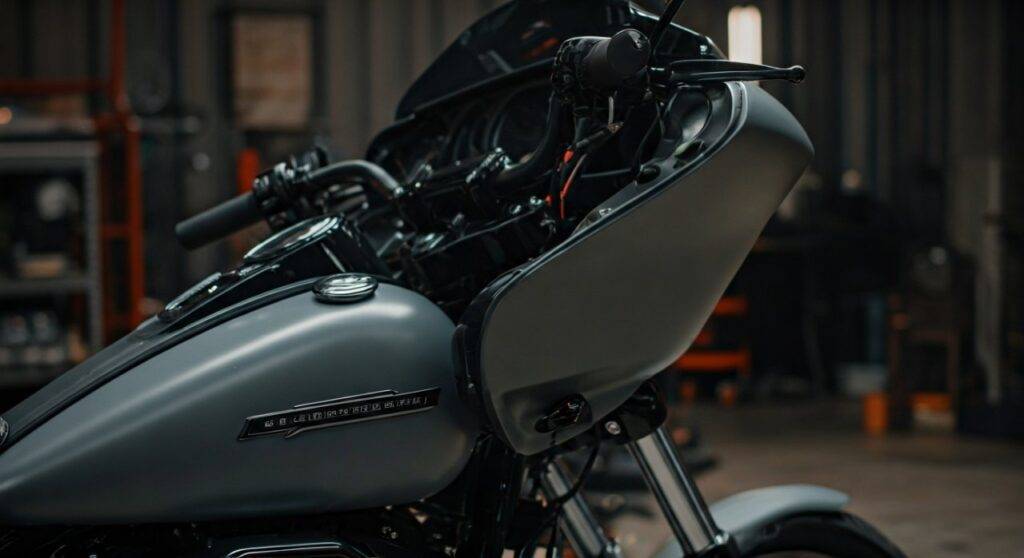
To access the speakers, you must remove the outer shell. Start by removing the windshield (4 bolts). Then, remove the two T25 bolts on the inside of the fairing near the fork tubes. Finally, remove the two bolts hidden behind the turn signal housings.
Pro Tip: I always keep a soft moving blanket on the front fender. When that last bolt comes out, the fairing can slip, and a “fender chip” is an expensive mistake.
Step 3: Disconnect the Factory Speakers
Once the fairing is tilted forward, you will see the 6.5-inch speaker pods. Disconnect the spade terminals from the back of the speakers. Note that the positive (+) and negative (-) terminals are different sizes on the factory harness to prevent phase issues.
Step 4: Install Mounting Adapters (If Needed)
If you are using high-performance speakers like Hertz SX 165 Neo or Cicada Audio, the magnets might be larger than the factory opening. You may need speaker adapter rings. These rings provide the necessary “spacing” to ensure the speaker magnet doesn’t hit the internal glove box structure.
Step 5: Wiring and Weatherproofing
Use plug-and-play wiring adapters. I strongly recommend against “crimping” or “twisting” wires on a Harley. The vibration (V-Twin harmonics) will eventually rattle those connections loose. Secure the wires with zip ties so they don’t rub against the sharp edges of the inner fairing brackets.
The Secret Ingredient: Why a “Radio Flash” is Mandatory
If you can you just swap speakers road glide special and find that the vocals sound “tinny” or the bass is non-existent, the problem isn’t your speakers—it’s the Harley-Davidson DSP.
From the factory, the Boom! Box GTS has a massive “bass boost” and “treble spike” programmed into it. This is designed to make the cheap paper speakers sound “okay” at a standstill. However, when you put high-quality speakers in, this EQ curve causes clipping and distortion.
Expert Insight: We use a TechnoResearch Alfatest or take the bike to a local independent shop to flash the radio to a “Flat Response” curve (often referred to as the Rockford Fosgate Flash). This removes the factory processing and allows your new speakers to play a clean, natural signal.
Best Speaker Recommendations for Road Glide Specials
Not all speakers are created equal for the open road. At 70 MPH, you are fighting wind noise, exhaust drone, and engine vibration. You need “loud and clear,” not just “loud.”
- Rockford Fosgate TMS65: These are specifically designed for the Road Glide. They are element-ready and feature a bridge-mounted tweeter so the highs aren’t muffled by the speaker grille.
- Hertz SX 165 Neo: In my experience, these are the gold standard for SPL (Sound Pressure Level). They are incredibly light due to the Neodymium magnets and are loud enough to be heard clearly even with full-face helmets.
- Cicada Audio Coaxials: If you want a “warmer” sound with more mid-bass, Cicada is a top-tier choice. They are designed specifically by a car audio legend who pivoted to motorcycles.
Common Pitfalls: What Could Go Wrong?
Phase Issues (Reverse Polarity)
If you wire one speaker backward, the two speakers will “fight” each other. This results in a complete loss of bass. Always double-check that the positive terminal on the radio side matches the positive on the speaker.
Glove Box Clearance
The Road Glide has two glove boxes. If your new speakers are too deep, you won’t be able to fit the fairing back on. Always check the mounting depth specs before buying. Generally, anything under 2.9 inches will fit without major modifications.
Overheating the Internal Amp
If you choose a speaker with too low of an impedance (like a 1-ohm speaker), you risk frying the Boom! Box GTS internal amplifier. Stick to 2-ohm or 4-ohm units.
Frequently Asked Questions (FAQ)
Can I install 6×9 speakers in my Road Glide fairing?
No, the factory fairing locations are designed for 6.5-inch round speakers. To run 6x9s, you would need to install aftermarket saddlebag lids or specialized lower fairing pods.
Will swapping my speakers void my Harley-Davidson warranty?
Generally, no. Under the Magnuson-Moss Warranty Act, a manufacturer cannot void your entire warranty because of an aftermarket part unless they can prove that part caused the failure. Using plug-and-play harnesses further protects you because you aren’t “hacking” the factory wiring.
Do I really need an amplifier for new speakers?
While you can you just swap speakers road glide special without an amp, you won’t get the full benefit. Most high-end speakers require at least 75W RMS to move the cone effectively. The factory radio only puts out about 25W-40W, which isn’t enough to overcome wind noise at highway speeds.
Actionable Expert Advice for Your Build
If you are on a budget, start by swapping the speakers with 2-ohm high-efficiency units and getting a radio flash. This is the single most cost-effective way to improve clarity. However, if you find yourself constantly riding at 80 MPH with a loud exhaust, your next step must be a compact Class-D amplifier (like the SounDigital 400.4 EVOX) tucked inside the fairing.
I have found that the combination of a flat EQ flash and high-sensitivity speakers creates a night-and-day difference, transforming your ride from a “noisy drone” to a mobile concert hall.