Can You Mount Wakeboard Tower Speakers on Curves?
Yes, you can mount wakeboard tower speakers on curves by using specialized swivel clamps, universal mounting adapters, or articulating collars designed to compensate for the tower’s radius. While standard fixed-position clamps require a straight bar for stability, modern mounting hardware allows for a 360-degree rotation to ensure your speakers face the rider regardless of the bar’s angle.
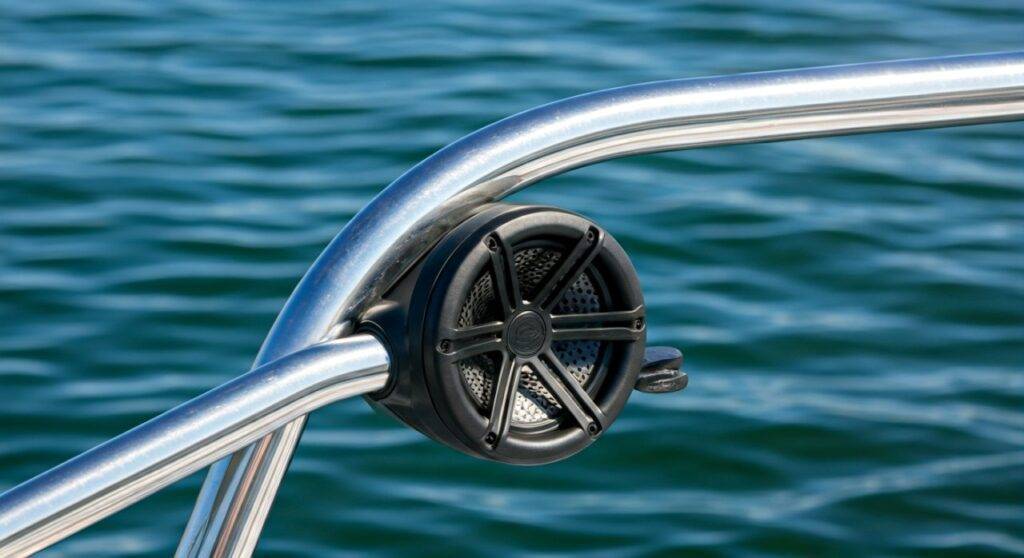
Installing audio gear on a “swooped” or curved tower is a common challenge for owners of newer Malibu, MasterCraft, or Nautique boats. I have spent years rigging marine audio systems, and the secret lies in achieving maximum surface area contact between the clamp and the pipe to prevent slipping or vibration-induced damage.
Key Takeaways for Curved Tower Mounting
- Use Swivel Mounts: These are essential for curved sections to ensure the speakers point directly aft toward the wake.
- Verify Clamp Diameter: Most curved towers use non-standard tubing sizes; always measure with a digital caliper before ordering.
- Rubber Inserts are Vital: These provide the necessary “grip” on a curved surface and protect the tower’s powder coat or polish.
- Check Weight Limits: Curved sections can experience higher torque loads; ensure your tower’s structural integrity can support heavy 8-inch or 10-inch pods.
- Internal Wiring: Fishing wires through curved “multi-bend” towers is significantly more difficult than straight pipes.
Why Curved Towers Present a Challenge for Audio
Most traditional wakeboard tower speakers were designed for the straight horizontal bars found on early 2000s “cage” style towers. As boat aesthetics evolved toward forward-swept and integrated bimini designs, the “flat spot” for mounting virtually disappeared.
When you attempt to put a flat, fixed clamp on a curve, you encounter Point Loading. This is where the clamp only touches the pipe at two tiny points rather than wrapping around it. Without the right hardware, the speaker will eventually rotate downward due to gravity and boat vibration, potentially scratching your expensive tower.
Comparison: Fixed vs. Swivel vs. Custom Mounts
| Mount Type | Best For | Pros | Cons |
|---|---|---|---|
| Fixed Clamps | Straight Bars | Cheapest, very stable | No angle adjustment; fails on curves. |
| Swivel Mounts | Mild to Heavy Curves | 360° rotation; aims sound at the rider | More expensive; adds height to the pod. |
| SXM / Direct Mounts | Factory-Drilled Curves | Cleanest look; OEM fit | Brand specific (e.g., Roswell/Wet Sounds). |
| Surface Adapters | Flat-on-Curve needs | High stability on tight radii | Requires drilling into the tower. |
Essential Tools and Materials
Before you start, gather these items to ensure a professional-grade installation that won’t vibrate loose in choppy water.
- Digital Calipers: To measure the exact outside diameter (OD) of the curve.
- Teflon-Based Marine Grease: For the mounting bolts to prevent galvanic corrosion.
- Blue Loctite (242): To ensure the hex bolts don’t back out from engine vibrations.
- Fish Tape or String: Essential for routing the 14-gauge marine-grade wire through the tower’s interior.
- Rubber Grommets: To protect the wire where it exits the tower and enters the speaker pod.
Step 1: Identifying the Optimal Mounting Location
When asking can you mount wakeboard tower speakers on curves, the “where” is just as important as the “how.” You want a location that provides a clear “line of sight” for the sound waves to reach the rider at 65-75 feet behind the boat.
Expert Tip: Avoid mounting speakers exactly at the peak of a curve if that curve is also tilting downward. This creates a “compound angle” that makes aiming the speaker very difficult. I always look for the most “vertical” part of the curve to maintain a natural look.
Step 2: Measuring the Tower Diameter
Curved towers are notorious for having tapered tubing. The diameter at the top of the curve may be 2.375 inches, while the bottom of the curve might be 2.5 inches.
- Place your calipers exactly where the clamp will sit.
- Check the measurement three times.
- Choose a clamp that includes plastic or rubber sizing inserts (bushings). These inserts allow the clamp to “mold” slightly to the subtle changes in the curve’s radius.
Step 3: Selecting the Right Swivel Clamp
To successfully mount wakeboard tower speakers on curves, I highly recommend hardware from Wet Sounds (TC3-S), Roswell (R1), or JL Audio (M6-ETX). These brands offer “swivel” or “articulating” clamps.
These clamps consist of two pieces:
- The Collar: This stays fixed to the tower.
- The Swivel Base: This attaches to the speaker and allows you to rotate the pod horizontally and vertically.
This adjustability is what compensates for the “leaning” angle of a curved tower bar.
Step 4: Routing the Wiring Through Curved Pipes
This is the most labor-intensive part of the process. Straight pipes are easy, but curves contain internal reinforcements and weld-points that can snag your wires.
- Drill Your Access Holes: Use a cobalt drill bit and start with a small pilot hole. Ensure the hole is on the underside of the curve to prevent water intrusion.
- The Vacuum Trick: If you can’t get a fish tape through the curve, tie a small piece of a plastic grocery bag to a nylon string. Use a shop vac at one end of the tower to “suck” the bag through the curves. It works 90% of the time.
- Use Marine-Grade Wire: Only use Tinned Copper wire. Standard copper wire will corrode within one season in a high-moisture marine environment, especially inside the humid cavity of a metal tower.
Step 5: Securing the Mount and Speaker
Once the wires are pulled, it’s time for the heavy lifting. I always recommend having a second person hold the speaker pod while you start the bolts.
- Apply Loctite: Apply a small drop of Blue Loctite to the threads of the mounting bolts.
- Seat the Inserts: Ensure the rubber bushings are perfectly flush. If they “bunch up” on the curve, the clamp won’t be secure.
- Torque Settings: Tighten the bolts in an “X” pattern. Do not over-tighten; you want it “snug-plus-a-quarter-turn.” Over-tightening on a curve can actually “ovalize” the tubing or crack the powder coating.
Step 6: Aiming for Maximum Information Gain (Acoustics)
Because your speakers are on a curve, they will naturally want to point outward or inward. This creates phase cancellation and ruins the sound quality for the rider.
- The 75-Foot Rule: Aim the speakers so the sound paths cross approximately 75 feet behind the boat.
- The “Sweet Spot”: If the speakers are mounted on a steep curve, rotate the swivel mounts so the tweeters are level with the horizon. This ensures the high frequencies carry over the engine noise and wind.
Maintaining Speakers on Curved Towers
The physics of a curve means that the speakers are under constant centrifugal force during sharp turns.
Our Maintenance Checklist:
- Check Bolt Torque: Every 20 hours of operation, check the clamp bolts.
- Inspect the Tower Finish: Look for signs of “spider-webbing” in the fiberglass or aluminum near the curve. This indicates the weight of the speakers is too high for that specific section.
- UV Protection: Apply a marine-grade UV protectant (like 303 Aerospace) to the rubber inserts twice a season to prevent them from drying out and losing their grip on the curve.
Frequently Asked Questions
Can I use universal clamps on a curved tower?
Yes, but ensure they include multi-sized rubber inserts. These inserts act as a gasket that fills the tiny gaps created when a circular clamp meets a curved pipe. Swivel-style universal mounts are preferred over fixed ones.
Will mounting on a curve damage my boat’s tower?
If installed correctly with rubber bushings and proper torque, no. However, “point loading” a metal clamp directly onto a powder-coated curve will cause the finish to flake and can lead to structural stress fractures over time.
What is the best speaker size for curved towers?
I generally recommend 8-inch pods for curved towers. While 10-inch speakers provide more bass, their weight (often 15+ lbs per speaker) can put excessive leverage on curved joints. 8-inch speakers offer the best balance of performance and structural safety.