Introduction
In the world of commercial and high-end residential audiovisual integration, Crestron has long been a dominant force. Known for its robust infrastructure, enterprise-grade reliability, and powerful control capabilities, the company’s DigitalMedia (DM) ecosystem remains a standard for distributing uncompressed video, audio, and control signals. Central to this system are modular card-based switchers, such as the DM-MD8X8, DM-MD16X16, and DM-MD32X32. These matrix switchers allow systems integrators to build custom AV routing configurations by populating input and output slots with specialized cards tailored to specific signal formats.
One such vital component is the Crestron DMC-C DigitalMedia 8G+ Input Card for DM Switchers. This card is engineered to receive signals from a single DM 8G+ or HDBaseT source using standard copper twisted-pair cabling. Priced at a highly accessible $139, the DMC-C represents an affordable and indispensable solution for maintaining, upgrading, or retrofitting legacy 1080p systems in corporate boardrooms, university lecture halls, and complex multi-room residential AV setups.
While newer AV systems are increasingly adopting 4K and 8K standards, a vast majority of enterprise infrastructures still operate reliably on Full HD 1080p distributions. In these environments, replacing an entire matrix switcher or upgrading every card to 4K can be prohibitively expensive. The DMC-C provides a cost-effective way to expand an existing system, replace a damaged port, or integrate HDBaseT-certified third-party devices directly into a Crestron environment. This comprehensive review will delve deep into the technical specifications, performance advantages, potential limitations, and real-world deployment scenarios of the Crestron DMC-C to help you decide if it is the right fit for your AV infrastructure.
Product Overview
The Crestron DMC-C is a single-slot modular input card designed specifically for Crestron’s line of card-based DigitalMedia matrix switchers. It serves as a receiver interface, allowing a single twisted-pair cable (such as CAT5e, CAT6, or Crestron’s proprietary DM-CBL-8G cable) to transport uncompressed high-definition video, multichannel audio, control signals, and power over long distances.
At its core, the card utilizes DigitalMedia 8G+ (DM 8G+) technology. This proprietary standard is built upon the physical layer of HDBaseT, ensuring that the card is fully HDBaseT Certified. This certification is critical because it means you do not necessarily need a Crestron-branded transmitter at the source side; you can connect any HDBaseT-compliant camera, media player, or laptop interface directly to the DMC-C input port.
Key Specifications and Features:
- Input Interface: One DM 8G+ input port via a shielded RJ45 female connector, which also functions as an HDBaseT-compliant port.
- Supported Cable Distance: Supports cable lengths up to 330 feet (100 meters) using CAT5e, CAT6, or Crestron DM 8G cable.
- Video Resolutions: Handles uncompressed video resolutions up to Full HD 1080p and computer resolutions up to WUXGA (1920×1200). It also supports 3D video and Deep Color formats.
- Audio Compatibility: Passes high-bitrate digital formats including Dolby TrueHD, DTS-HD Master Audio, and uncompressed 7.1 linear PCM audio to the switcher backplane.
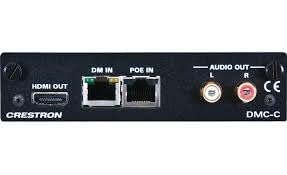
- HDMI Pass-Through Output: Includes a local 19-pin Type A HDMI female output port. This allows the input signal to be routed locally to a monitor or daisy-chained to a secondary switcher.
- Analog Stereo Output: Features an unbalanced 2-channel analog stereo output (via RCA connectors) with integrated electronic volume control, enabling easy audio extraction for local amplification systems.
- Power over DM (PoDM): Supports Power over DM and Power over HDBaseT (PoH). When paired with an appropriate PoE/PoDM power supply connected to its “POE IN” port, the DMC-C can power the transmitter at the other end of the cable.
The card can also be utilized in a standalone fashion outside of a matrix switcher chassis. When installed in a Crestron DMCI DigitalMedia Card Interface, the DMC-C functions as a highly reliable, rack-mountable DM 8G+ receiver, adding immense utility for customized equipment rack installations or AV carts.
Pros
The Crestron DMC-C is a highly engineered product that brings a host of functional and operational advantages to any professional AV system. Here are the primary benefits of integrating this input card:
- Seamless HDBaseT Interoperability: Because the card is fully HDBaseT Certified, it breaks down the barriers of proprietary AV ecosystems. Integrators can directly connect third-party HDBaseT sources, such as PTZ cameras, projection units, or third-party transmitters, without needing intermediate Crestron translation boxes. This saves money and reduces points of failure.
- True One-Wire AV Transport: The DM 8G+ technology allows uncompressed video, multi-channel audio, high-speed Ethernet, control signals (RS-232, IR), and power to travel over a single CAT5e or CAT6 cable. This dramatically simplifies cable management, reduces installation time, and lowers material costs for complex cable runs.
- Exceptional Transmission Range: Managing high-definition video over long distances is notorious for signal degradation. The DMC-C easily handles runs up to 330 feet (100 meters) without loss of clarity, latency, or signal dropouts, making it perfect for sprawling corporate campuses or large auditoriums.
- Centralized Powering via PoDM: By supporting Power over DM (PoDM) and Power over HDBaseT (PoH), the card can deliver power directly to a compatible transmitter located at a wall plate or lectern. This eliminates the need for bulky, unsightly external power supplies at the source location, maintaining a clean and professional appearance.
- Local Monitoring with HDMI Pass-Through: The onboard HDMI output port is a massive convenience. It allows installers or operators to plug a local monitor directly into the equipment rack to verify that the source signal is active before it gets routed through the entire switcher. It can also be used to split the source to a local audio processor.
- Onboard Stereo Audio Extraction: Pulling stereo audio from a digital stream can often require external DACs. The DMC-C includes built-in digital-to-analog converters and unbalanced RCA stereo outputs with adjustable volume control. This makes it incredibly easy to feed a local multiroom audio system or soundbar directly from the card.
- Hot-Swappable Modular Design: The card is built for live enterprise environments. It is hot-swappable when installed in a compatible DM switcher, meaning technicians can replace or install the card without needing to power down the entire switcher chassis, preventing downtime for other active AV zones.
Cons
While the Crestron DMC-C is an exceptional performer in its category, it does have specific limitations that potential buyers must keep in mind to avoid compatibility or performance issues:
- No 4K Resolution Support: The biggest drawback of the DMC-C in modern environments is its resolution ceiling. It maxes out at Full HD 1080p and WUXGA. If your current or future system requires 4K Ultra HD or HDR distributions, you will need to look at the DMC-4K-C model instead.
- Lack of Multi-Channel Audio Downmixing: While the card supports high-bitrate surround sound formats like Dolby TrueHD, it cannot downmix these formats into stereo on the analog RCA output simultaneously. If a surround sound signal is sent to the card, the analog stereo output will remain silent unless you use the specialized DMC-C-DSP model, which includes onboard DSP downmixing.
- Extreme Ecosystem Dependency: This card is not a standalone consumer device. It cannot function without a compatible Crestron DM-MD chassis or a Crestron DMCI card interface. Additionally, configuring and managing the card requires specialized Crestron software and programming expertise, making it unsuitable for standard DIY consumer use.
- High Sensitivity to Cable Quality: While standard CAT5e is supported, achieving the maximum 330-foot run with absolute reliability requires high-quality, shielded twisted-pair cabling. Unshielded cables are susceptible to electromagnetic interference (EMI) and electrostatic discharge (ESD) in commercial environments, which can lead to random signal dropouts.
Customer Reviews Analysis
Currently, the Crestron DMC-C has zero customer reviews on Amazon. For typical consumer electronics, a lack of reviews might raise red flags; however, in the enterprise AV industry, this is completely normal. Highly specialized, commercial-grade equipment like Crestron matrix switcher cards are almost exclusively purchased through certified commercial AV integrators and distributors rather than retail consumer channels.
To provide an honest and accurate analysis of the card’s performance, we can look at the feedback from professional AV programmers, commercial technicians, and IT managers on industry forums. Across these platforms, the DigitalMedia 8G+ ecosystem is widely praised as the “workhorse” of the digital distribution era.
Technicians highlight that once a DM system is correctly configured, the hardware is incredibly stable. The DMC-C card, in particular, is noted for its exceptional heat dissipation and physical durability inside equipment racks. However, seasoned integrators also issue a common warning: the card is unforgiving of poor termination. If RJ45 connectors are not crimped perfectly or if unshielded connectors are used in electrically noisy environments, the card may struggle to maintain a handshake. Overall, the consensus among AV professionals is that the DMC-C is a bulletproof product when installed according to Crestron’s strict system design guidelines.
Who Should Buy This Product
The Crestron DMC-C is a highly targeted niche product. It is not designed for general consumers or simple home theater setups. Instead, it is highly recommended for the following user groups:
- AV System Integrators and Maintenance Technicians: For professionals tasked with servicing existing corporate or institutional Crestron networks, having a replacement DMC-C card on hand is crucial. It provides a quick, hot-swappable fix to revive a dead input port on a matrix switcher without disrupting the rest of the system.
- Corporate and Educational IT Managers: Many universities and corporate offices built massive, high-end 1080p Crestron systems that still function perfectly today. If an institution needs to add an additional laptop input to a lecture hall or boardroom, or integrate a new HDBaseT-certified PTZ camera, buying this card at $139 is an incredibly cost-effective expansion path.
- Prosumers and Custom Home Automation Enthusiasts: Some advanced smart home enthusiasts purchase used or surplus Crestron DM switchers on the secondary market to build comprehensive home AV distribution systems. For these budget-conscious buyers, the DMC-C represents an affordable way to populate their switcher slots with high-quality 1080p inputs.
Final Verdict
The Crestron DMC-C DigitalMedia 8G+ Input Card is a testament to the engineering excellence of Crestron’s foundational DigitalMedia ecosystem. Despite being a legacy card limited to Full HD 1080p, it continues to deliver remarkable value in commercial, educational, and enterprise environments where 4K resolution is not yet a necessity.
With its robust HDBaseT certification, one-wire signal transport, convenient HDMI pass-through, and useful analog audio extraction, it provides all the essential features required for reliable, long-distance signal distribution. Its $139 price point makes it an absolute steal for maintenance, repairs, or expansions of existing infrastructure. While it lacks 4K capabilities and DSP audio downmixing, its reliability and professional-grade performance make it a highly recommended component for anyone maintaining or configuring a modular Crestron DM system. If your system demands stable 1080p routing with a robust feature set, the DMC-C remains an industry-standard choice.