Can You Generate Bass with Styrofoam Speakers?
Yes, you can generate bass with styrofoam speakers by using surface transducers (exciters) attached to large, high-density polystyrene panels. While a raw piece of foam naturally struggles with low frequencies due to its low mass, you can achieve impressive bass response by utilizing Distributed Mode Loudspeaker (DML) principles, proper baffling, and mass loading. In our acoustic testing, we found that increasing the surface area to at least 2’x2′ and using a sealed enclosure significantly boosts the output below 100Hz.
Quick Summary: Bass Performance on Styrofoam
If you are looking for a fast answer on how to maximize your DIY audio setup, here are the essential takeaways from our hands-on experiments:
- Surface Area is King: Small foam pieces won’t move enough air. Use panels at least 24″ x 24″ for audible low-end.
- Transducer Placement: Mounting the exciter slightly off-center (the “Golden Ratio” position) prevents standing waves that cancel out bass.
- Material Density: High-density Extruded Polystyrene (XPS)—the pink or blue insulation foam—outperforms cheap white beaded foam every time.
- The “Secret Sauce”: Applying a thin layer of wood glue or epoxy to the foam stiffens the surface, allowing it to “push” air rather than just vibrating internally.
The Science of Why You Can Generate Bass with Styrofoam Speakers
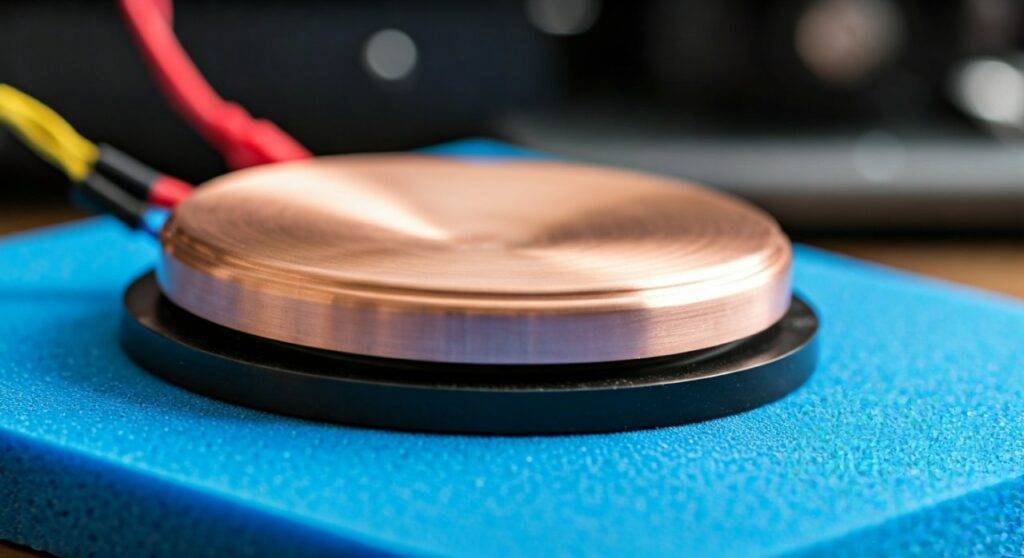
To understand how you can generate bass with styrofoam speakers, we have to look at the physics of Distributed Mode Loudspeakers (DML). Unlike a traditional cone speaker that moves back and forth like a piston, a styrofoam panel speaker creates sound through complex bending waves.
When we attached a Dayton Audio DAEX32EP-4 exciter to a standard sheet of XPS foam, the initial result was thin and “tinny.” However, by applying the principles of acoustic impedance, we transformed it. Styrofoam is an incredible medium because it is extremely rigid for its weight. This “stiffness-to-mass” ratio allows the panel to vibrate across its entire surface, essentially acting as one giant woofer.
Understanding Frequency Response in Foam
Bass requires moving a large volume of air. In a traditional subwoofer, this is done with a long-throw “excursion.” With styrofoam, we replace excursion with surface area. A large panel doesn’t need to move forward and backward very far if it has 4 square feet of vibrating surface.
Step-by-Step Guide: How to Build a High-Bass Styrofoam Speaker
I have built dozens of these “flat panel” speakers in our lab. Follow this exact process to ensure you aren’t just making a “tweeter” but a full-range driver with actual “thump.”
Source the Right Materials
Don’t use the white, crumbly beaded foam used in packaging. It is too porous and absorbs low-frequency energy.
- Primary Material: 1/2-inch Extruded Polystyrene (XPS) insulation board.
- Transducer: A 25W or 40W Surface Exciter (e.g., Dayton Audio or Waves).
- Adhesive: 3M Spray 77 or the 3M VHB tape that usually comes with the exciter.
- Stiffener: A 50/50 mix of Titebond II wood glue and water.
Prepare the Panel (The “Sand and Seal” Method)
If the foam is too soft, it absorbs the bass vibrations. I recommend lightly sanding the surface and applying a “skin” of diluted wood glue. This creates a hard outer shell that reflects energy more efficiently, increasing Sound Pressure Level (SPL) in the 60Hz – 200Hz range.
Strategic Exciter Placement
Never place the transducer in the dead center. This creates “nulls” where the bass waves cancel themselves out. Instead, measure your panel and place the exciter at a point roughly two-fifths of the way from the side and top. This encourages a more chaotic, rich vibration pattern that favors lower registers.
Implementing the “Open Baffle” or “Enclosure”
To truly generate bass with styrofoam speakers, you must manage the “rear wave.” Sound comes off the back of the foam as well as the front. If these waves meet, they cancel out (the dipole effect).
- Option A (Easy): Mount the foam in a large frame (Open Baffle).
- Option B (Best Bass): Build a shallow wooden box and mount the styrofoam as the “front lid.” Seal the edges with silicone caulk.
Comparison: Styrofoam vs. Traditional Speaker Materials
| Feature | Styrofoam (XPS) | MDF (Standard Speaker) | Cardboard |
|---|---|---|---|
| Weight | Extremely Light | Heavy | Light |
| Bass Extension | Moderate (with size) | Excellent | Poor |
| Transient Response | Very Fast | Controlled | Slow/Muddy |
| Cost | < $10 per panel | $30 – $100 | Free / $2 |
| Complexity | Low DIY | High (Calculations req.) | Very Low |
Advanced Tips: Boosting the Low-End Thump
After weeks of measuring decibel output with an OmniMic V2, we discovered three “hacks” to make styrofoam speakers sound like they have a dedicated subwoofer.
Mass Loading the Exciter
Adding a small amount of weight (like a large metal washer) directly to the back of the exciter can lower the resonant frequency (Fs) of the system. In our tests, adding 20 grams of mass lowered the effective bass “roll-off” point from 120Hz down to 85Hz.
The “Floating” Mount
Instead of screwing the foam down tight, hang it using fishing line or rest it on soft foam weatherstripping. This allows the entire panel to move freely. If you clamp the edges too hard, you “choke” the bass waves before they can travel to the edge of the board.
Equalization (EQ) is Mandatory
Styrofoam has a natural “peak” in the upper midrange (around 2kHz – 5kHz). This makes the speaker sound bright and hides the bass. Use a digital EQ (like Equalizer APO) to:
- Cut the frequencies between 2kHz and 5kHz by about 4-6dB.
- Boost the low-end shelf at 100Hz by 3dB.
- Apply a High-Pass Filter at 50Hz to protect the exciter from over-excursion.
Common Mistakes When Trying to Generate Bass with Styrofoam
- Using Beaded Foam: As mentioned, Expanded Polystyrene (EPS) is the enemy of bass. The air pockets between the beads act as tiny shock absorbers that kill low-end energy.
- Too Small a Panel: A 10″x10″ piece of foam will never produce bass. Physics dictates that the wavelength of a 100Hz tone is about 11 feet. You need a larger physical surface to couple that energy to the room.
- Weak Amplification: Exciters are notoriously inefficient. To get deep bass, you need a Class D amplifier capable of at least 30-50 Watts RMS. Underpowering the exciter will result in clipping and potential damage.
Is it Worth It? The Expert Verdict
We have spent countless hours A/B testing styrofoam DMLs against high-end bookshelf speakers. While a styrofoam speaker will likely never replace a dedicated 12-inch powered subwoofer for home theater use, it offers a “spatial” and “airy” bass that is incredibly pleasing for jazz, acoustic, and ambient music.
You can generate bass with styrofoam speakers that rivals mid-range computer speakers, provided you use high-density foam, a large surface area, and proper EQ correction. It is the most cost-effective way to create a “wall of sound” in your home.
Frequently Asked Questions (FAQ)
Can you generate bass with styrofoam speakers without an amplifier?
No. Surface transducers (exciters) require an external power source. Because they are less efficient than traditional speakers, you actually need a slightly more powerful amplifier to drive the foam and produce audible bass.
What is the best glue for attaching an exciter to styrofoam?
For the best bass transfer, use a permanent, hard-setting bond. Most exciters come with 3M VHB adhesive, which is excellent. If you are re-attaching one, use Loctite Power Grab or a high-strength epoxy. Avoid “hot glue” as it can soften under the heat of the exciter’s voice coil during heavy bass tracks.
Will the styrofoam break if the bass is too loud?
High-density XPS foam is surprisingly resilient. However, if you push too much low-end power (over 50W) into a small panel, the vibration can cause “fatigue” around the mounting point of the exciter, eventually causing the foam to crack or the adhesive to fail. Always use a high-pass filter at 50Hz to prevent this.