Can I Use a Low Voltage Transformer for Stereo Speakers?
Technically, you cannot use a standard low voltage power transformer (like those used for landscape lighting or doorbells) for stereo speakers because they are designed for a fixed 60Hz frequency, whereas audio signals fluctuate between 20Hz and 20,000Hz. Using a power transformer will result in extreme audio distortion, potential overheating, and can permanently damage your amplifier or speakers due to impedance mismatching. However, you can use specialized audio matching transformers (often used in 70V or 100V systems) to connect multiple speakers over long distances.
TL;DR: Key Takeaways
- Power vs. Audio: Standard 12V/24V power transformers are incompatible with audio signals.
- The Risk: Using the wrong transformer leads to clipping, core saturation, and blown fuses.
- The Exception: Only use 70V/100V line transformers for high-impedance commercial audio setups.
- Impedance is King: Speakers usually need 4-ohm or 8-ohm loads; power transformers do not provide this.
- Expert Advice: If you need to run speakers over 100 feet, switch to a 70V distributed audio system rather than hacking a lighting transformer.
Why Power Transformers and Audio Speakers Don’t Mix
In my years of troubleshooting commercial AV installs, I’ve seen many DIY enthusiasts attempt to repurpose low voltage transformers from old halogen lighting kits to “boost” speaker signals. The result is almost always a “muddy” sound or a dead amplifier.
The fundamental issue lies in the magnetic core construction. A low voltage transformer for lighting is optimized for a single frequency: 60Hz (the standard US power grid frequency).
Audio signals, conversely, are incredibly complex. They represent a wide spectrum of frequencies. A transformer designed for 60Hz will “saturate” when hit with low-frequency bass notes and act as a massive filter that blocks high-frequency treble, effectively killing your sound quality.
Comparing Power Transformers vs. Audio Transformers
| Feature | Low Voltage Power Transformer | Audio Matching Transformer |
|---|---|---|
| Primary Purpose | Converting 120V AC to 12V/24V AC | Matching Impedance/Voltage for Sound |
| Frequency Response | Fixed (50Hz – 60Hz) | Wide (20Hz – 20,000Hz) |
| Core Material | Heavy Laminated Steel | High-Permeability Silicon Steel/Nickel |
| Input Signal | Constant Voltage | Variable AC (Audio Signal) |
| Result on Speakers | Distortion, Overheating, Damage | Clear Sound, Long-Distance Efficiency |
The Physics of Impedance Mismatching
When you ask, “can i use a low voltage transformer for stereo speakers,” you are really dealing with a question of Impedance (Ohms).
Most home stereo speakers are 8-ohm loads. Amplifiers are designed to “see” that specific resistance. If you insert a 12V lighting transformer into the circuit, the amplifier sees an extremely low DC resistance.
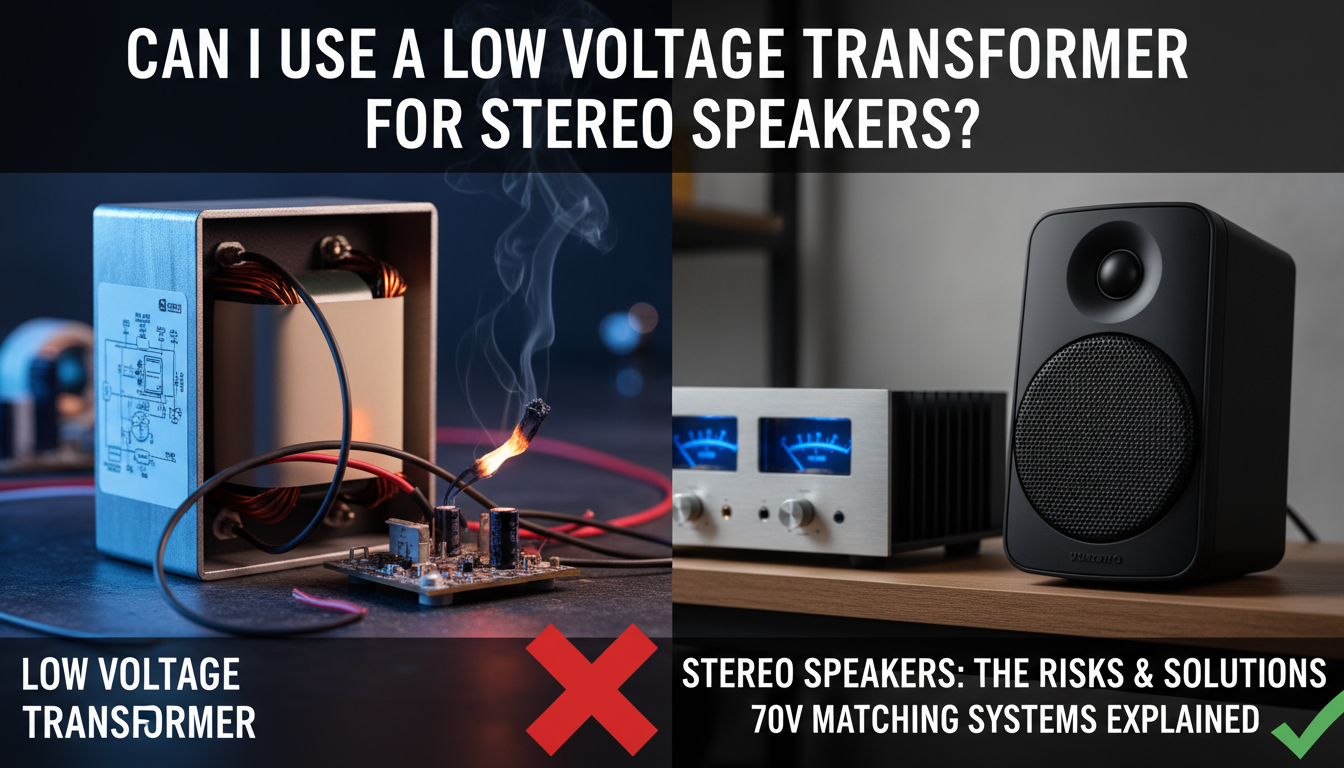
This causes the amplifier to pull too much current, leading to:
- Thermal Shutdown: The amp gets too hot and turns off.
- Blown Output Transistors: Permanent hardware failure.
- Signal Clipping: The “square waving” of audio, which can melt your speaker’s voice coils.
Understanding 70V Audio Systems: The “Good” Low Voltage
While you can’t use a lighting transformer, there is a specific type of low voltage transformer system used in professional audio. This is known as a 70-volt (or 100-volt) distributed line system.
In these setups, a transformer is placed at the amplifier to “step up” the voltage, and a smaller transformer is placed at each speaker to “step down” the voltage. This allows you to:
- Run thousands of feet of wire without signal loss.
- Connect dozens of speakers to a single amplifier channel.
- Adjust the volume of each speaker individually using transformer taps.
We frequently use these in warehouses, restaurants, and outdoor malls. If your goal is to power many speakers across a large property, this is the only “low voltage transformer” method that actually works.
Step-by-Step: How to Properly Use Transformers in Audio
If you have decided to use a professional 70V audio matching transformer for your speaker project, follow these steps to ensure safety and fidelity.
Step 1: Check Equipment Compatibility
Ensure your amplifier is 70V capable. If it is a standard 8-ohm home receiver, you will need an external Step-Up Transformer connected to the speaker outputs.
Step 2: Select the Correct Tap Setting
Audio transformers have multiple “taps” (wires) labeled in Watts (e.g., 5W, 10W, 15W, 30W).
- Higher Wattage Tap: Louder volume, lower impedance.
- Lower Wattage Tap: Lower volume, higher impedance.
- Pro Tip: Total the wattage of all speakers. The sum must not exceed 80% of your amplifier’s total power rating.
Step 3: Wiring for Phase (Polarity)
Match the Positive (+) and Negative (-) terminals correctly.
- Common (C) on the transformer usually goes to the Negative (-).
- The selected Wattage Tap wire goes to the Positive (+).
- Note: If speakers are “out of phase,” the bass will disappear, and the sound will feel “hollow.”
Step 4: Wire Gauge Selection
Because 70V systems operate at a higher voltage and lower current, you can use thinner wire. For runs under 500 feet, 18AWG CL3-rated wire is usually sufficient. For longer runs, we recommend 16AWG or 14AWG.
Step 5: Testing and Measurement
Before turning the volume up, use an Impedance Meter (not a standard Multimeter) to check the total load of the speaker line. This ensures you haven’t accidentally created a short circuit that will fry your equipment.
Common Myths About Audio and Power Transformers
Myth 1: “A 12V Transformer is just a 70V Transformer with fewer windings.”
False. The core materials are entirely different. Power transformers use thicker laminations that cannot switch polarities fast enough for high-frequency audio. You will lose everything above 1kHz, making voices sound like they are underwater.
Myth 2: “I can use a transformer to make my speakers louder.”
False. Transformers are passive devices. They actually introduce a small amount of insertion loss (usually 0.5dB to 2dB). They are used for distribution and matching, not for increasing raw power.
Myth 3: “It’s safe to experiment.”
Dangerous. Unlike a speaker, which has some resistance, a transformer’s primary coil can look like a dead short to an amplifier if not matched correctly. You can destroy a $500 amplifier in less than a second of “testing.”
Practical Actionable Advice for DIYers
If you are trying to solve a specific problem, here is what I recommend based on my field experience:
- If you need more volume: Don’t look for a transformer. Look for high-sensitivity speakers (rated 90dB or higher) or a more powerful amplifier.
- If you are running wire over 50 feet: Use high-quality oxygen-free copper (OFC) wire in 14-gauge. This eliminates the need for any “step-up” transformers.
- If you want to connect 4 speakers to 1 amp: Use an Impedance-Matching Speaker Selector Switch. These contain specialized resistors and circuitry designed for audio signals, unlike lighting transformers.
- If you are building an outdoor system: Buy active (powered) outdoor speakers or use a dedicated 70V commercial amp with matching 70V outdoor rock speakers.
When You Should Use a Transformer in Audio
There are legitimate “low voltage” signal transformers used in high-end audio, but they are not the “low voltage transformers” found in the electrical aisle of Home Depot. These include:
- DI Boxes (Direct Injection): Use tiny transformers to convert high-impedance guitar signals to low-impedance mic signals.
- Isolation Transformers: Used to break ground loops and stop that annoying 60Hz hum in your speakers.
- Moving Coil (MC) Step-Up Transformers: Used by audiophiles to boost the tiny voltage of a high-end turntable cartridge.
FAQ: Low Voltage Transformers and Speakers
Q: Can I use a 12V DC power supply to power my speakers?
A: No. Speakers require AC (Alternating Current) audio signals. A DC (Direct Current) power supply will simply push the speaker cone all the way out and hold it there until the voice coil burns out.
Q: Why do some speakers have transformers built-in?
A: These are 70V/100V commercial speakers. They are designed for “constant voltage” systems in offices or malls. To use them with a home stereo, you must bypass the internal transformer and wire directly to the speaker driver.
Q: Is there any risk of electric shock when using audio transformers?
A: In standard 8-ohm systems, the voltage is very low. However, in 70V or 100V systems, the voltage is high enough to give you a painful “tingle.” Always turn off the amplifier before touching speaker connections in these systems.
Q: What happens if I use a lighting transformer for a subwoofer?
A: It might actually “work” better than for a tweeter because subwoofers operate at low frequencies (20Hz-100Hz), which is closer to the transformer’s 60Hz design. However, it will still sound terrible, offer zero “punch,” and likely trip the protection circuit on your amp.
Q: Can I use an old doorbell transformer for audio?
A: Absolutely not. Doorbell transformers are usually “current-limiting” and have very poor magnetic coupling for anything other than a simple chime. Using one for stereo speakers is a fire hazard.