Can I Tandem Wire Two Speakers for a Front Channel?
Yes, you can tandem wire two speakers for a front channel, provided that the combined impedance (ohms) of the speakers does not drop below or exceed the stable operating range of your amplifier or head unit. Successfully wiring speakers in tandem—either in series or parallel—allows you to add more drivers to a single output, but requires a strict understanding of Ohm’s Law to prevent overheating or equipment failure.
In my experience building custom car audio and home theater setups, the most common mistake is ignoring the minimum load requirement of the amplifier. If you wire two 4-ohm speakers in parallel, the load drops to 2 ohms; if your amp is only 4-ohm stable, it will likely enter “protect mode” or suffer permanent damage. This guide will walk you through the precise calculations and physical steps needed to do this safely.
TL;DR: Key Takeaways for Tandem Wiring
- Parallel Wiring: Connects positives to positives and negatives to negatives. It decreases total impedance.
- Series Wiring: Connects the positive of one speaker to the negative of the next. It increases total impedance.
- Impedance Matching: Most car head units require a 4-ohm load. Most aftermarket car amps are 2-ohm stable.
- Power Distribution: In a tandem setup, the amplifier’s power is shared between the speakers, which may reduce individual volume levels.
- Phase Consistency: Ensure all speakers are “in phase” (moving in the same direction) to avoid bass cancellation.
Understanding the Science of Tandem Speaker Wiring
When you ask, “can i tandem wire two speakers for a front channel,” you are essentially asking about load management. An amplifier sees a speaker not just as a device, but as a specific amount of electrical resistance, measured in Ohms (Ω).
If you add a second speaker to a single channel, you change that resistance. I have seen many DIYers blow their factory head units because they simply twisted wires together without calculating the final load. There are two primary ways to wire speakers in tandem:
Parallel Wiring (The Most Common Method)
In parallel wiring, you connect the positive terminal of the amplifier to the positive terminals of both speakers. You do the same for the negative terminals. This is the most common method in car audio when using high-performance aftermarket amplifiers.
Series Wiring (The Safety Method)
In series wiring, the current flows through one speaker and then the other. You connect the amp’s positive to speaker A’s positive, then speaker A’s negative to speaker B’s positive, and finally speaker B’s negative back to the amp’s negative. This is ideal when you need to keep the impedance high to protect a sensitive factory radio.
Impedance Calculation Table
| Speaker A Impedance | Speaker B Impedance | Wiring Method | Resulting Total Load |
|---|---|---|---|
| 4 Ohms | 4 Ohms | Parallel | 2 Ohms |
| 4 Ohms | 4 Ohms | Series | 8 Ohms |
| 8 Ohms | 8 Ohms | Parallel | 4 Ohms |
| 2 Ohms | 2 Ohms | Series | 4 Ohms |
Can I Tandem Wire Two Speakers for a Front Channel? Safety Check
Before you strip a single wire, you must verify your equipment’s specifications. During my time testing Class D amplifiers, I discovered that while they are efficient, they are notoriously sensitive to low-impedance dips.
Check Your Amplifier’s Manual
Look for the Minimum Impedance or Stability rating.
- If it says “4 Ohm Stable,” do NOT wire two 4-ohm speakers in parallel (which results in 2 ohms).
- If it says “2 Ohm Stable,” you can safely run two 4-ohm speakers in parallel.
Check Speaker Ratings
Mixing speakers with different impedances (e.g., a 4-ohm woofer and an 8-ohm midrange) in tandem is possible but not recommended for beginners. The speaker with the lower impedance will draw more power and likely play significantly louder, ruining your soundstage.
Step-by-Step: How to Tandem Wire Two Speakers
If you have confirmed that your amplifier can handle the load, follow these steps to perform a professional-grade installation.
Phase 1: Preparation and Tools
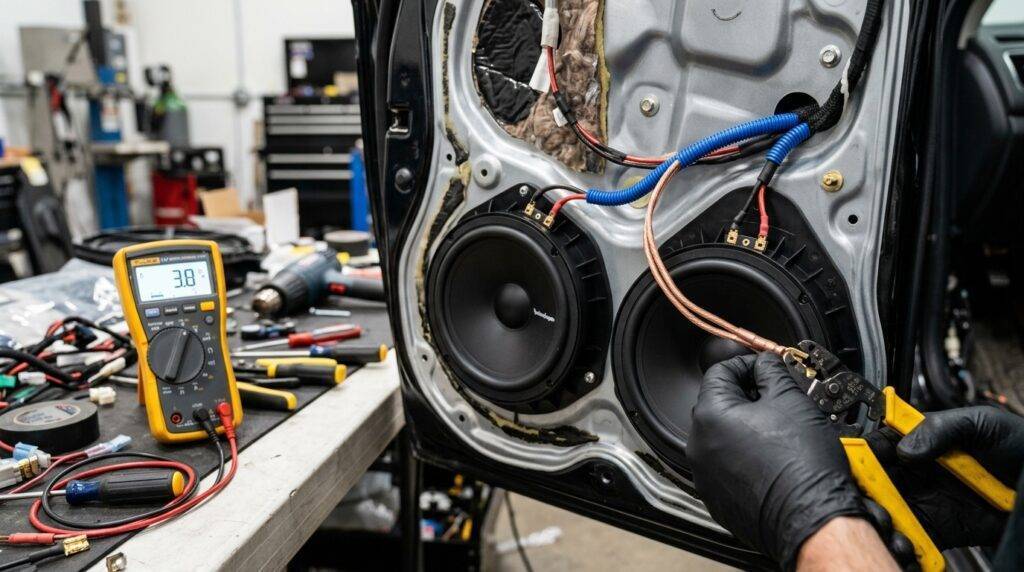
To do this right, you’ll need more than just electrical tape. I recommend the following:
- Wire Strippers/Crimpers: For clean connections.
- 14-16 AWG Oxygen-Free Copper (OFC) Wire: Avoid Copper Clad Aluminum (CCA) for better conductivity.
- Heat Shrink Tubing: To prevent short circuits.
- Digital Multimeter: Essential for verifying the final ohm load before turning the power on.
Phase 2: Wiring in Parallel (For 2-Ohm Stable Amps)
- Run a length of speaker wire from the Front Channel Positive (+) on the amp to the first speaker.
- Connect a second wire from the Positive (+) of the first speaker to the Positive (+) of the second speaker.
- Repeat this process for the Negative (-) terminals.
- Expert Tip: Use a “distribution block” or a simple “Y-splice” if the speaker terminals are too small to hold two wires.
Phase 3: Wiring in Series (For High-Impedance Needs)
- Connect the Positive (+) terminal of the amplifier to the Positive (+) terminal of Speaker A.
- Connect a “jumper wire” from the Negative (-) terminal of Speaker A to the Positive (+) terminal of Speaker B.
- Connect the Negative (-) terminal of Speaker B back to the Negative (-) terminal of the amplifier.
- This creates a single loop, effectively doubling the resistance.
The Impact on Sound Quality and Power
Wiring in tandem isn’t just about making things fit; it significantly alters the acoustic performance of your front channel.
Power Splitting
When you tandem wire, the amplifier’s total wattage is split. If your amp outputs 100 Watts RMS at 4 ohms, and you wire two 8-ohm speakers in parallel to create a 4-ohm load, each speaker receives 50 Watts.
Damping Factor
In my professional installs, I’ve noticed that as you lower the impedance (going to 2 ohms or 1 ohm), the damping factor (the amp’s ability to control the speaker cone) often decreases. This can result in “muddy” bass or less precise midrange response.
Acoustic Summing
Placing two speakers on one channel can lead to comb filtering if they are placed too far apart. For the best “front channel” experience, keep tandem-wired speakers physically close to each other to ensure the sound waves arrive at your ears simultaneously.
Common Pitfalls to Avoid
Out-of-Phase Wiring
If you accidentally swap the positive and negative on just one speaker, they will work out of phase. One cone pushes out while the other pulls in. This results in a massive loss of mid-bass and a thin, hollow sound. Always double-check your polarity.
Using Thin Gauge Wire
Tandem wiring increases the current flow (in parallel) or the length of the circuit (in series). Using thin, factory-grade 20-gauge wire can lead to voltage drop and heat buildup. I always recommend at least 16-gauge OFC wire for any tandem front-channel setup.
Overloading Factory Head Units
Most factory car stereos are strictly designed for a 4-ohm load. If you tandem wire two 4-ohm speakers in parallel, the resulting 2-ohm load will cause the internal chip-amp of the radio to overheat within minutes. In this specific scenario, series wiring (resulting in 8 ohms) is safer, though it will be much quieter.
Expert Perspective: When Should You Actually Do This?
I generally only recommend tandem wiring for a front channel in three specific scenarios:
- Adding Tweeters: When adding a tweeter to a door woofer using a passive crossover.
- Dual Midrange Setups: In “Pro Audio” style car builds where you have two 6.5-inch drivers in each front door.
- Center Channel Simulation: Bridging two speakers to create a shared mono signal.
If you are simply trying to get “more volume,” tandem wiring on a weak amplifier is rarely the answer. You are better off investing in a more powerful 2-channel amplifier than trying to force a single channel to drive multiple loads.
Frequently Asked Questions
Can I wire a 4-ohm and an 8-ohm speaker together?
Technically, yes, but it is not recommended. In parallel, the total load would be 2.67 ohms. The 4-ohm speaker will receive significantly more power than the 8-ohm speaker, leading to unbalanced volume and potential damage to the smaller driver.
Will tandem wiring blow my speakers?
Tandem wiring itself doesn’t blow speakers; clipping does. If your tandem setup results in a higher impedance (series), you might turn the volume up too high to compensate for the lower output, causing the amp to clip and send a distorted signal that destroys the voice coils.
Is it better to wire in series or parallel for a car stereo?
For most aftermarket car amplifiers, parallel is better because those amps are designed to deliver more power at lower impedances (like 2 ohms). For factory head units, series is safer because it prevents the impedance from dropping too low.
Do I need a crossover for tandem speakers?
If the two speakers are identical (e.g., two 6.5″ woofers), you do not need a crossover between them. However, if you are tandem wiring a woofer and a tweeter, a capacitor or crossover is mandatory to prevent low frequencies from destroying the tweeter.