Understanding the Core: What is the Difference Between Coaxial and Component Speakers?
Upgrading your car audio system often leads to one pivotal question: what is the difference between coaxial and component speakers? Simply put, coaxial speakers (full-range) combine the woofer and tweeter into a single physical unit, while component speakers separate these drivers into individual pieces with an external crossover to provide superior sound imaging. Choosing between them depends on whether you value installation simplicity or audiophile-grade clarity.
🚀 Key Takeaways: Expert Summary
Coaxial Speakers: Best for budget-friendly, “plug-and-play” upgrades in factory locations.
Component Speakers: Best for high-end systems where soundstage and vocal clarity are priorities.
Crossovers: Coaxials use simple built-in filters; Components use complex external networks to direct frequencies precisely.
Installation: Coaxials take minutes; Components require custom mounting for tweeters and crossovers.
Verdict: If you are an average listener, go Coaxial. If you are an enthusiast, go Component.
Step 1: Analyze the Architecture of Your Audio System
To truly understand what is the difference between component and coaxial speakers, you must first look at how they are built. Every speaker system aims to reproduce a wide range of frequencies (20Hz to 20,000Hz).
The “All-in-One” Coaxial Design
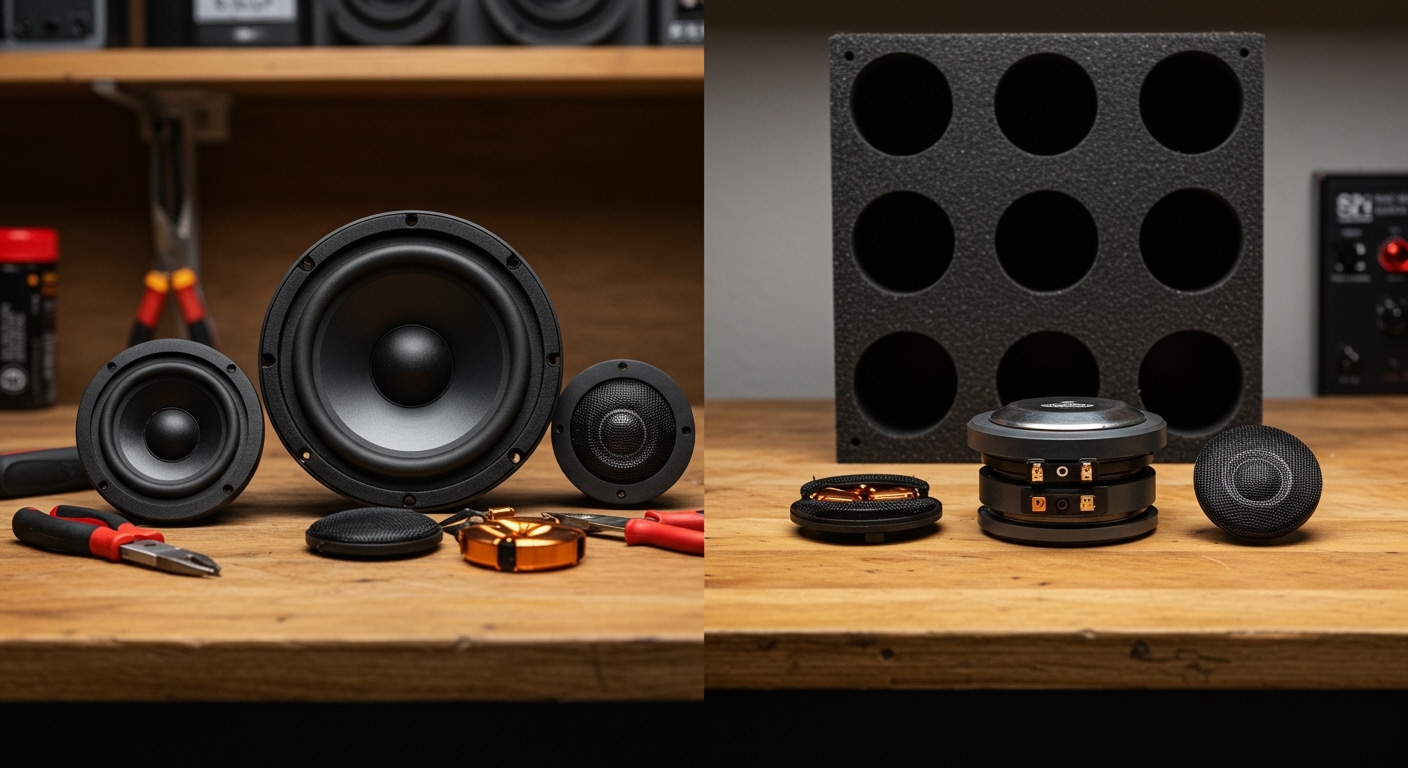
Coaxial speakers are often called “full-range” speakers. They contain a large woofer for mid-bass and a small tweeter mounted directly over the center of the woofer on a pole.
Some designs, known as 3-way or 4-way coaxials, add extra “super-tweeters” to handle even higher frequencies. These are designed to fit exactly where your factory speakers were, making them the ultimate convenience choice.
The “Split” Component Design
Component speakers treat each frequency range as a specialist’s job. A standard set includes:
- Two separate woofers (for mids and lows).
- Two separate tweeters (for highs).
- Two external crossovers (the “brain” that sends the right signal to the right driver).
By separating the tweeter from the woofer, you can mount the tweeter higher up on the dashboard or A-pillar. This raises the soundstage, making it feel like the band is performing on your hood rather than at your feet.
Understanding the Core: What is the Difference Between Coaxial and Component Speakers?
Upgrading your car audio system often leads to one pivotal question: what is the difference between coaxial and component speakers? Simply put, coaxial speakers (full-range) combine the woofer and tweeter into a single physical unit, while component speakers separate these drivers into individual pieces with an external crossover to provide superior sound imaging. Choosing between them depends on whether you value installation simplicity or audiophile-grade clarity.
🚀 Key Takeaways: Expert Summary
Coaxial Speakers: Best for budget-friendly, “plug-and-play” upgrades in factory locations.
Component Speakers: Best for high-end systems where soundstage and vocal clarity are priorities.
Crossovers: Coaxials use simple built-in filters; Components use complex external networks to direct frequencies precisely.
Installation: Coaxials take minutes; Components require custom mounting for tweeters and crossovers.
Verdict: If you are an average listener, go Coaxial. If you are an enthusiast, go Component.
Step 1: Analyze the Architecture of Your Audio System
To truly understand what is the difference between component and coaxial speakers, you must first look at how they are built. Every speaker system aims to reproduce a wide range of frequencies (20Hz to 20,000Hz).
The “All-in-One” Coaxial Design
Coaxial speakers are often called “full-range” speakers. They contain a large woofer for mid-bass and a small tweeter mounted directly over the center of the woofer on a pole.
Some designs, known as 3-way or 4-way coaxials, add extra “super-tweeters” to handle even higher frequencies. These are designed to fit exactly where your factory speakers were, making them the ultimate convenience choice.
The “Split” Component Design
Component speakers treat each frequency range as a specialist’s job. A standard set includes:
- Two separate woofers (for mids and lows).
- Two separate tweeters (for highs).
- Two external crossovers (the “brain” that sends the right signal to the right driver).
By separating the tweeter from the woofer, you can mount the tweeter higher up on the dashboard or A-pillar. This raises the soundstage, making it feel like the band is performing on your hood rather than at your feet.
Step 2: Compare Performance and Sound Quality
When asking which is better coaxial or component speakers, the answer usually lies in “imaging.” In my 15 years of tuning car audio, I have found that physical placement dictates 70% of the final sound quality.
Soundstage and Imaging
Coaxial: Because the tweeter is at your feet (in the door), the high frequencies—which are very directional—get muffled by your legs and the car’s carpet.
Component: You can “aim” the separate tweeters directly at your ears. This creates a realistic stereo image where you can pinpoint exactly where the guitarist is standing.
Frequency Separation
What’s the difference between coaxial and component speakers regarding technical precision? It comes down to the crossover.
Coaxials usually use a cheap capacitor to block bass from the tweeter.
Components use high-quality coils and capacitors in an external box. This results in a much smoother transition between the woofer and tweeter, eliminating “harsh” peaks in the music.
| Feature | Coaxial Speakers | Component Speakers |
|---|---|---|
| Driver Configuration | Integrated (Woofer + Tweeter) | Separate (Woofer, Tweeter, Crossover) |
| Sound Quality | Good (Standard Upgrade) | Excellent (High Fidelity) |
| Ease of Install | High (Drop-in replacement) | Moderate to Difficult (Custom mounting) |
| Cost | $50 – $200 (Average) | $150 – $1,000+ (Premium) |
| Power Needs | Works well with Head Unit | Usually requires an External Amp |
| Best For | Casual listeners, Commuters | Audiophiles, Competition builds |
Step 3: Assess Your Installation Skill Level
Understanding what is the difference between coaxial and component car speakers is only half the battle; you must also know if you can install them.
Installing Coaxial Speakers (The DIY Route)
- Remove the door panel.
- Unplug the old factory speaker.
- Screw in the new coaxial speaker using the same holes.
- Connect the wires. This is a 30-minute job for most beginners.
Installing Component Speakers (The Pro Route)
- Mount the woofer in the door.
- Find a location for the tweeter. You may need to drill a hole in the door sail or use a custom bracket on the dashboard.
- Mount the crossover box inside the door or under the dash.
- Run multiple wires: One from the amp to the crossover, then separate wires from the crossover to the woofer and tweeter.
Step 4: Determine Your Budget and Power Requirements
If you are wondering which is better component or coaxial speakers for your wallet, coaxials win every time. However, there is a hidden cost to components: Amplification.
Sensitivity: Coaxials are often more “sensitive,” meaning they can play loudly using just the small amount of power from your factory radio.
Power Handling: Most high-quality component sets have heavy magnets and stiff cones. They require an external amplifier (at least 50W-100W RMS) to move properly. If you run high-end components off a stock radio, they may actually sound worse than cheap coaxials because they are “underpowered.”
Step 5: Match the Speakers to Your Vehicle Type
What’s better coaxial or component speakers for your specific car?
Luxury Cars/Modern SUVs: These often come with “component” style setups from the factory (tweeters in the dash, woofers in the door). Replacing these with a component set is easier because the mounting locations already exist.
Older Trucks/Economy Cars: These usually have one single speaker in the door. If you don’t want to cut holes in your interior, coaxial speakers are the smartest choice.
🛠 Tools and Materials Needed for Installation
Before you start, ensure you have these essentials:
| Tool | Purpose |
|---|---|
| Panel Removal Tool | To pop off plastic door clips without breaking them. |
| Wire Strippers | For connecting the crossover and speakers. |
| Soldering Iron/Heat Shrink | The “Expert” way to ensure connections never vibrate loose. |
| Multimeter | To check for correct Polarity (+/-) and impedance. |
| Sound Deadening (Butyl) | Highly recommended to stop door vibrations and improve bass. |
💡 Expert Tips and Common Mistakes to Avoid
Don’t Mix Brands: If you are doing a full system, try to keep the same brand for front and rear to maintain a consistent tonal balance.
Phase Matters: If your bass sounds weak after an install, you likely have the wires swapped on one speaker (Out of Phase). One speaker is pushing while the other is pulling, canceling out the sound.
Tweeter Positioning: When installing components, try “on-axis” (pointed at you) vs “off-axis” (pointed at each other) before final mounting. This drastically changes the brightness of the sound.
The “Rear Fill” Secret: Many experts use component speakers in the front for the best stage and cheaper coaxial speakers in the rear doors just for “fill” sound.
❓ Frequently Asked Questions (FAQs)
Are component speakers worth the extra money?
Yes, if you plan on adding an amplifier and care about “vocal clarity.” The separation of frequencies allows for a much cleaner sound at high volumes. If you are just looking for a quick fix for a blown factory speaker, coaxials are a better value.
Can I run component speakers without an amplifier?
You can, but it is not recommended for high-end sets. Most component speakers have a lower sensitivity and higher RMS power requirement. Without an amp, you may experience distortion (clipping) at higher volumes, which can actually damage the tweeters.
What is the difference between 2-way and 3-way coaxial speakers?
A 2-way coaxial has one woofer and one tweeter. A 3-way coaxial adds a third driver (usually a “midrange” or “super-tweeter”). While 3-way sounds more impressive, a high-quality 2-way usually outperforms a cheap 3-way in terms of overall accuracy.
Are coaxil or component speakers better for car bass?
Generally, the woofer in a component set is built to higher standards and can handle more mid-bass. However, neither will replace a dedicated subwoofer. For true low-end bass, you need a speaker specifically designed for frequencies below 80Hz.
Conclusion: Final Verdict on Coaxial vs Component
Deciding what is the difference between coaxial and component speakers comes down to your goals as a listener.
Choose Coaxial Speakers if:
You want a fast, easy DIY project.
You are on a budget under $150.
You are using the factory radio without an external amp.
Choose Component Speakers if:
You want the best possible “concert-like” soundstage.
You are willing to spend time on a custom installation.
- You have (or plan to buy) an external power amplifier.
Regardless of which path you take, upgrading from factory paper-cone speakers to any aftermarket set will provide a massive jump in audio fidelity and enjoyment on your daily commute.
Ready to upgrade? Start by measuring your door speaker size and deciding where you want your tweeters to live!