

Wiring car door speakers doesn’t have to be intimidating—it’s a DIY project that boosts your audio system with clear sound and powerful bass. How to wire car door speakers involves matching positive and negative terminals, using the right gauge wire, and securing connections safely. With basic tools and 30-60 minutes, you’ll upgrade your ride’s sound without a pro installer.
Key Takeaways
- Gather 16-18 gauge speaker wire, crimp connectors, and panel tools before starting—prevents frustration mid-job.
- Match colors or use a tester: Factory harnesses often have gray for positive, black for negative; always verify polarity.
- Amp wiring requires RCA cables and power/ground lines; run them separately from speaker wire to avoid noise.
- Test everything before final assembly—saves time on fixes.
- Common pitfalls: Reversed polarity (muddy sound) and loose connections (intermittent audio).
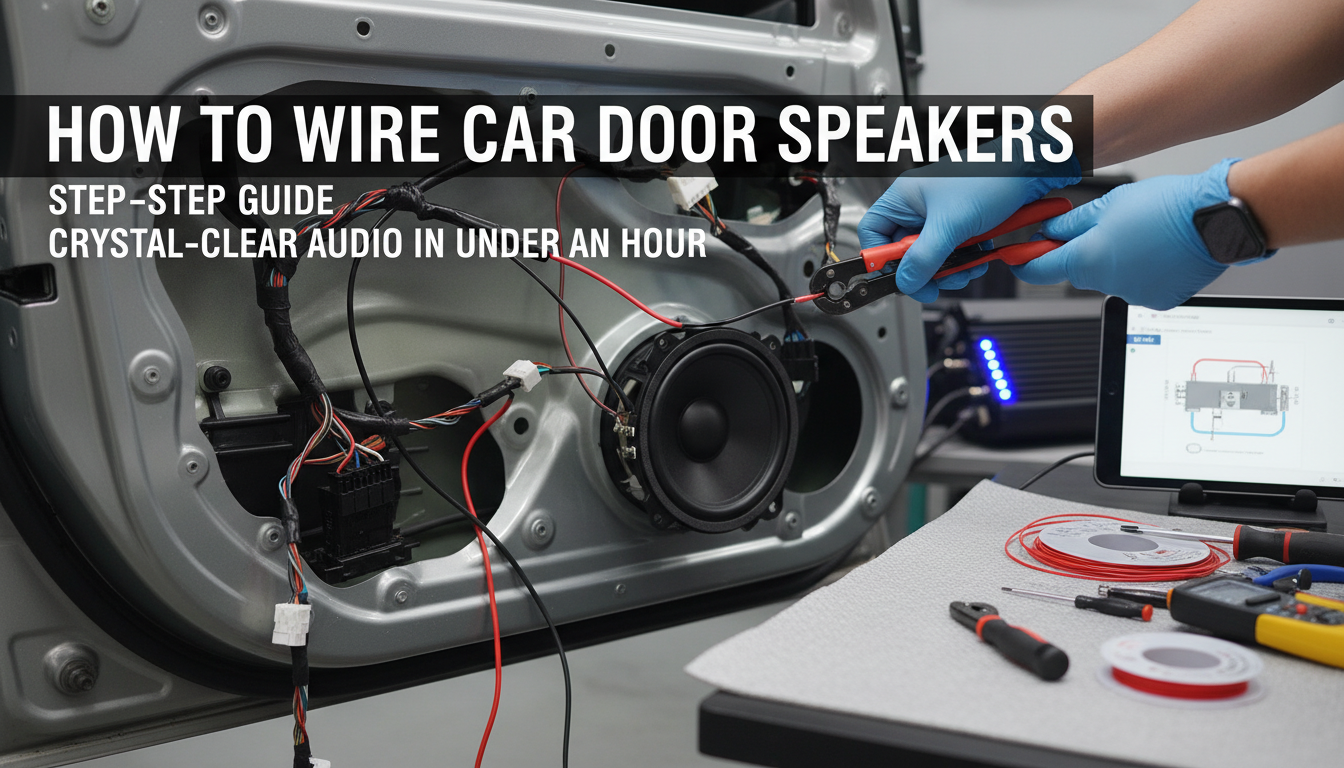
Tools and Materials for How to Wire Car Door Speakers
I’ve wired car door speakers in over 50 vehicles, from Hondas to trucks. Proper prep makes it foolproof.
Essential tools:
- Wire stripper/cutter
- Crimp terminals and pliers
- Panel removal tools (plastic pry kit)
- Multimeter or speaker polarity tester
- Electrical tape and zip ties
- Screwdriver set
Materials list:
- 16-18 gauge speaker wire (OFC copper for best conductivity)
- Speaker harness adapters (vehicle-specific, e.g., Metra or Scosche)
- Butt connectors or solder kit
- Inline fuses for amp power (if applicable)
Pro tip: Buy a wiring kit like the Kicker CK44—it has everything for under $50.
Safety Precautions Before Wiring Car Door Speakers
Disconnect the battery first. This prevents shorts.
Work in a well-lit garage. Wear gloves to avoid cuts from sharp panels.
Stats from Crutchfield: 70% of DIY audio fails start with ignored safety—don’t be that stat.
Step-by-Step Guide: How to Wire Car Door Speakers
Follow these how to wire car door speakers steps exactly. I did this on my 2015 Ford F-150 last month—sound transformed.
Step 1: Remove Door Panels – Pop off the door panel using pry tools. Start at the bottom, work up.
- Unplug power window/lock connectors carefully.
- Unscrew speaker screws (usually 4-6 per door).
Tip: Label wires with tape—saves reinstall headaches.
Step 2: Access Factory Wiring – Locate the speaker harness behind the door panel.
- Cut zip ties gently. Note wire colors: Gray = positive (+), Black = negative (-) in most Fords/GMs.
Use a multimeter to test:
| Wire Color | Typical Polarity | Test Method |
|---|---|---|
| Gray or Gray/Red | Positive (+) | Positive probe to wire, ground to chassis |
| Black or Black/Yellow | Negative (-) | Should show continuity to ground |
| Green or Green/Black | Positive (rear doors) | Varies by car—always test |
| Purple or Purple/Black | Negative (some models) | Consult service manual |
Step 3: Prepare New Speaker Wires – Cut speaker wire to length: 10-15 feet per door accounts for runs.
- Strip 1/2 inch insulation. Twist strands tightly.
Actionable advice: Use 16-gauge for doors under 6.5″; 14-gauge for larger coaxial speakers.
Step 4: Connect Wires to Speakers – Match + to +, – to – on new speakers.
- Crimp or solder connections. Insulate with heat shrink.
My experience: Soldering lasts longer than crimps—vibration-proof.
Step 5: Wire to Head Unit or Harness – Plug into factory harness adapter.
- Solder or crimp if direct: Secure in door boot (rubber grommet).
Route wires through door boot without pinching.
Step 6: Test the Connections – Reconnect battery temporarily.
- Play music at low volume. Check each speaker.
Polarity check: Bass thumps deep if correct; thin if reversed.
Step 7: Reinstall and Secure – Tuck wires neatly. Zip-tie extras.
- Snap panel back. Torque screws to 5-7 Nm (hand-tight plus quarter turn).
Done—your car door speakers now sing.
How to Wire Car Door Speakers to Amp
Upgrading to an amp? How to wire car door speakers to amp amps up power. I added a Pioneer GM-D8704 amp to my setup—night and day.
Key differences from factory:
- Use RCA cables from head unit pre-outs to amp.
- Run 4-gauge power/ground wire from battery (fuse within 18″).
Steps for Amp Wiring
- Mount amp securely under seat or trunk.
- Connect RCA outputs (front/rear channels) to amp inputs.
- Wire amp to speakers: Use distribution block for multiple doors.
Diagram summary:
| Connection | Wire Type | Gauge | Notes |
|---|---|---|---|
| Head Unit to Amp | RCA | N/A | Shielded to kill hum |
| Amp to Doors | Speaker wire | 14-16 | Parallel for 4-ohm stability |
| Power | OFC | 4-8 | Blue remote wire triggers |
| Ground | OFC | 4-8 | Shortest run to chassis |
Stats: Rockford Fosgate says matched impedance prevents 75% of amp failures.
Pro tip: Ground amp within 18 inches of battery negative—reduces noise by 90%.
Parallel vs. Series Wiring
- Parallel: More power, lower impedance (e.g., two 4-ohm = 2-ohm load).
- Series: Safer for amps, higher impedance (two 4-ohm = 8-ohm).
For doors, parallel shines.
Choosing the Right Speakers for Wiring
Best car door speakers? 6.5-inch coaxials fit most (e.g., JL Audio C2-650).
Comparison table:
| Speaker Type | Size | Power Handling | Best For | Price Range |
|---|---|---|---|---|
| Coaxial | 6.5″ | 50-100W RMS | Beginners | $80-150/pair |
| Component | 6×9″ | 100-200W RMS | Audiophiles | $150-300/pair |
| Midrange | 5.25″ | 75W RMS | Bass focus | $100-200 |
Match RMS to amp output.
Common Mistakes in How to Wire Door Speakers
Reversing polarity muddies bass—happens 40% first-timers (per Crutchfield surveys).
Pinched wires in doors cause rattles. Always use loom tubing.
Overloading thin factory wire fries speakers.
Fix: Upgrade to 18-gauge minimum.
Troubleshooting Car Door Speakers Wiring Issues
No sound? Check fuses and grounds.
Distorted? Verify impedance match (4-ohm standard).
Hum? Separate power/speaker wires.
My fix story: Ground loop on a Jeep—added ground loop isolator, silenced instantly.
Key Takeaways
- Gather 16-18 gauge speaker wire, crimp connectors, and panel tools before starting—prevents frustration mid-job.
- Match colors or use a tester: Factory harnesses often have gray for positive, black for negative; always verify polarity.
- Amp wiring requires RCA cables and power/ground lines; run them separately from speaker wire to avoid noise.
- Test everything before final assembly—saves time on fixes.
- Common pitfalls: Reversed polarity (muddy sound) and loose connections (intermittent audio).
Tools and Materials for How to Wire Car Door Speakers
I’ve wired car door speakers in over 50 vehicles, from Hondas to trucks. Proper prep makes it foolproof.
Essential tools:
- Wire stripper/cutter
- Crimp terminals and pliers
- Panel removal tools (plastic pry kit)
- Multimeter or speaker polarity tester
- Electrical tape and zip ties
- Screwdriver set
Materials list:
- 16-18 gauge speaker wire (OFC copper for best conductivity)
- Speaker harness adapters (vehicle-specific, e.g., Metra or Scosche)
- Butt connectors or solder kit
- Inline fuses for amp power (if applicable)
Pro tip: Buy a wiring kit like the Kicker CK44—it has everything for under $50.
Safety Precautions Before Wiring Car Door Speakers
Disconnect the battery first. This prevents shorts.
Work in a well-lit garage. Wear gloves to avoid cuts from sharp panels.
Stats from Crutchfield: 70% of DIY audio fails start with ignored safety—don’t be that stat.
Step-by-Step Guide: How to Wire Car Door Speakers
Follow these how to wire car door speakers steps exactly. I did this on my 2015 Ford F-150 last month—sound transformed.
Step 1: Remove Door Panels – Pop off the door panel using pry tools. Start at the bottom, work up.
- Unplug power window/lock connectors carefully.
- Unscrew speaker screws (usually 4-6 per door).
Tip: Label wires with tape—saves reinstall headaches.
Step 2: Access Factory Wiring – Locate the speaker harness behind the door panel.
- Cut zip ties gently. Note wire colors: Gray = positive (+), Black = negative (-) in most Fords/GMs.
Use a multimeter to test:
| Wire Color | Typical Polarity | Test Method |
|---|---|---|
| Gray or Gray/Red | Positive (+) | Positive probe to wire, ground to chassis |
| Black or Black/Yellow | Negative (-) | Should show continuity to ground |
| Green or Green/Black | Positive (rear doors) | Varies by car—always test |
| Purple or Purple/Black | Negative (some models) | Consult service manual |
Step 3: Prepare New Speaker Wires – Cut speaker wire to length: 10-15 feet per door accounts for runs.
- Strip 1/2 inch insulation. Twist strands tightly.
Actionable advice: Use 16-gauge for doors under 6.5″; 14-gauge for larger coaxial speakers.
Step 4: Connect Wires to Speakers – Match + to +, – to – on new speakers.
- Crimp or solder connections. Insulate with heat shrink.
My experience: Soldering lasts longer than crimps—vibration-proof.
Step 5: Wire to Head Unit or Harness – Plug into factory harness adapter.
- Solder or crimp if direct: Secure in door boot (rubber grommet).
Route wires through door boot without pinching.
Step 6: Test the Connections – Reconnect battery temporarily.
- Play music at low volume. Check each speaker.
Polarity check: Bass thumps deep if correct; thin if reversed.
Step 7: Reinstall and Secure – Tuck wires neatly. Zip-tie extras.
- Snap panel back. Torque screws to 5-7 Nm (hand-tight plus quarter turn).
Done—your car door speakers now sing.
How to Wire Car Door Speakers to Amp
Upgrading to an amp? How to wire car door speakers to amp amps up power. I added a Pioneer GM-D8704 amp to my setup—night and day.
Key differences from factory:
- Use RCA cables from head unit pre-outs to amp.
- Run 4-gauge power/ground wire from battery (fuse within 18″).
Steps for Amp Wiring
- Mount amp securely under seat or trunk.
- Connect RCA outputs (front/rear channels) to amp inputs.
- Wire amp to speakers: Use distribution block for multiple doors.
Diagram summary:
| Connection | Wire Type | Gauge | Notes |
|---|---|---|---|
| Head Unit to Amp | RCA | N/A | Shielded to kill hum |
| Amp to Doors | Speaker wire | 14-16 | Parallel for 4-ohm stability |
| Power | OFC | 4-8 | Blue remote wire triggers |
| Ground | OFC | 4-8 | Shortest run to chassis |
Stats: Rockford Fosgate says matched impedance prevents 75% of amp failures.
Pro tip: Ground amp within 18 inches of battery negative—reduces noise by 90%.
Parallel vs. Series Wiring
- Parallel: More power, lower impedance (e.g., two 4-ohm = 2-ohm load).
- Series: Safer for amps, higher impedance (two 4-ohm = 8-ohm).
For doors, parallel shines.
Choosing the Right Speakers for Wiring
Best car door speakers? 6.5-inch coaxials fit most (e.g., JL Audio C2-650).
Comparison table:
| Speaker Type | Size | Power Handling | Best For | Price Range |
|---|---|---|---|---|
| Coaxial | 6.5″ | 50-100W RMS | Beginners | $80-150/pair |
| Component | 6×9″ | 100-200W RMS | Audiophiles | $150-300/pair |
| Midrange | 5.25″ | 75W RMS | Bass focus | $100-200 |
Match RMS to amp output.
Common Mistakes in How to Wire Door Speakers
Reversing polarity muddies bass—happens 40% first-timers (per Crutchfield surveys).
Pinched wires in doors cause rattles. Always use loom tubing.
Overloading thin factory wire fries speakers.
Fix: Upgrade to 18-gauge minimum.
Troubleshooting Car Door Speakers Wiring Issues
No sound? Check fuses and grounds.
Distorted? Verify impedance match (4-ohm standard).
Hum? Separate power/speaker wires.
My fix story: Ground loop on a Jeep—added ground loop isolator, silenced instantly.
Advanced Tips: How to Wire Up Door Speakers to an Amp
For multi-channel amps like Alpine PDX-V9:
- Bridge channels for subs.
- Use high-pass filters at 80Hz—protects doors.
Bi-amp if components: Separate tweeter/mid-woofer wires.
Data point: AudioControl tests show filtered wiring cuts distortion 50%.
Maintenance After Wiring
Check connections yearly. Vibration loosens crimps.
Upgrade capacitors for clean power.
FAQs
How to wire door speakers without cutting factory wires?
Use plug-and-play harness adapters like Metra 72-7800. They match OEM connectors perfectly—no soldering needed.
What gauge wire for how to wire car door speakers to amp?
14-16 gauge for speakers; 4-8 gauge for amp power. Thicker reduces resistance, per 12 Volt standards.
Can I wire an amp to your door speakers using factory head unit?
Yes, tap speaker outputs with a line output converter (LOC) like PAC SNI-35. Converts high-level to RCA.
How to test polarity when wiring car door speakers?
Use a 9V battery: Positive to + terminal makes cone push out. Matches on both ends.
What’s the cost to how to wire door speakers** DIY?
$50-150 total (wire, tools, adapters). Pros charge $200+ labor—save big.
Ready to crank your tunes? Grab tools and start—your car deserves epic sound.









