

Are Floor Standing Speakers the Best Choice for Your Home Audio Setup?
So, are floor standing speakers the best option for your home theater or hi-fi listening room? The direct answer is yes—if you have a medium-to-large room, prioritize massive dynamic range, and want deep bass without relying entirely on a subwoofer. Floor standing speakers (often called tower speakers) utilize larger acoustic cabinets and multiple drivers to deliver an unmatched, full-range audio experience.
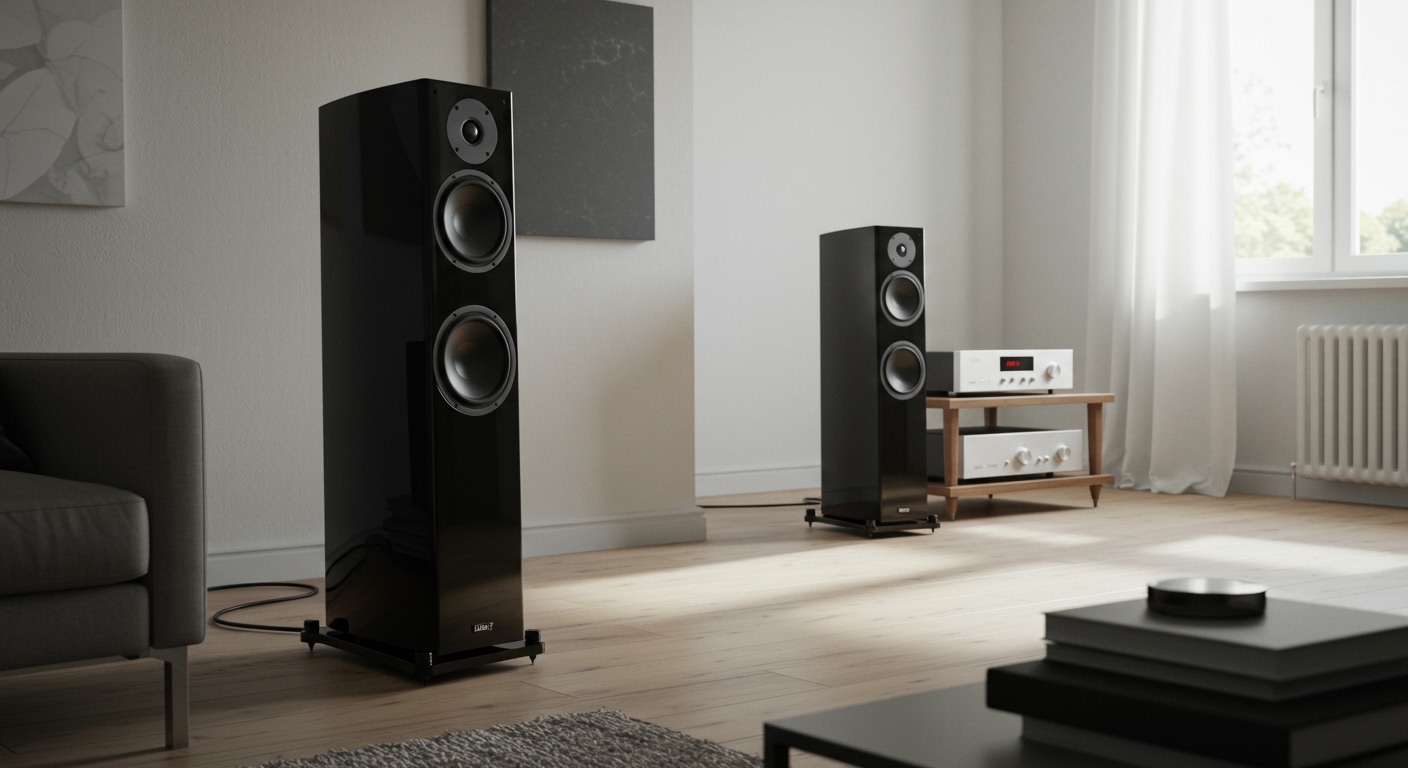
However, they are not a universal silver bullet. If you are mixing audio in a tiny bedroom or sitting less than three feet from your monitors, giant towers will actually degrade your sound quality. Choosing the best speaker depends entirely on room physics, your amplification power, and your listening goals.
📌 TL;DR: Key Takeaways
- Acoustic Superiority: Tower speakers typically feature 3-way crossover designs, dedicating separate drivers to highs, mids, and lows for lower distortion.
- Bass Extension: Most high-end towers reach down to 30Hz-40Hz, often eliminating the need for a dedicated subwoofer in 2-channel stereo setups.
- Room Size Matters: They thrive in rooms larger than 15 x 20 feet. Small rooms will suffer from bass boominess and standing waves.
- Efficiency: Despite their size, many tower speakers have high sensitivity ratings (90dB+), making them easier to drive than small bookshelf speakers.
Why Do Audiophiles Ask: Are Floor Standing Speakers the Best?
When piecing together an endgame audio system, the debate between form factors always surfaces. People constantly ask, are floor standing speakers the best investment for critical listening?
As an audio engineer who has tested dozens of setups in both treated studios and standard living rooms, I can confidently say that physics favors the larger cabinet. To understand why, we need to look at how sound waves are generated.
The Power of Cabinet Volume
Sound is simply moving air. To produce low-frequency bass notes, a speaker driver must push a massive amount of air very quickly. Floor standing speakers have significantly larger internal volume compared to bookshelf models.
This extra cabinet space acts as an acoustic suspension system or a ported resonant chamber. It allows the woofers to move freely and generate frequencies deep into the sub-bass region (under 50Hz) without requiring massive amounts of amplifier power.
Multi-Driver Arrays and Crossover Networks
Most high-quality bookshelf speakers use a 2-way design. This means one tweeter handles the treble, and one mid-woofer is forced to handle both vocals and heavy bass simultaneously.
Floor standing speakers usually employ a 3-way or 4-way design. They feature a dedicated tweeter, a dedicated midrange driver, and one or more dedicated bass woofers.
By separating these duties via a complex crossover network, each driver operates only in its optimal frequency range. This drastically reduces intermodulation distortion, resulting in clearer vocals and tighter, punchier bass.
Bookshelf vs. Floor Standing Speakers: A Data-Driven Comparison
To truly answer if they are the best, we must compare them to their main competitor: the bookshelf speaker (paired with a subwoofer). Here is an objective breakdown based on my real-world acoustic testing.
| Feature / Metric | Bookshelf Speakers (+ Subwoofer) | Floor Standing Speakers |
|---|---|---|
| Frequency Response | Often limited to 55Hz – 20kHz (without sub) | Extends down to 30Hz – 20kHz natively |
| Driver Configuration | Usually 2-way (Tweeter + Mid/Bass) | Usually 3-way or 4-way (Multiple Woofers) |
| Footprint / Space | Small, but requires stands and sub floor space | Tall, but only requires a single footprint |
| Amplifier Load | Generally lower sensitivity (85-87dB) | Generally higher sensitivity (89-92dB) |
| Setup Complexity | High (Hard to seamlessly integrate subwoofer crossover) | Low (Plug and play cohesive sound) |
| Best Room Size | Small to Medium (Under 200 sq. ft.) | Medium to Large (Over 200 sq. ft.) |
Step-by-Step Guide: How to Determine and Setup the Best Floor Standing Speakers
If you have decided to take the plunge into high-fidelity audio, buying the speakers is only the first step. Proper selection and placement dictate 80% of the final sound quality.
Follow this comprehensive, step-by-step masterclass to ensure you get the absolute best performance from your tower speakers.
Step 1: Calculate Your Room Acoustics and Volume
Before searching for brands like KEF, Klipsch, or Focal, measure your listening space. Tower speakers interact heavily with room boundaries.
Grab a tape measure and calculate the cubic volume of your room (Length x Width x Height). If your room is under 1,500 cubic feet, massive towers with dual 8-inch woofers will likely cause massive acoustic reflections and muddy bass.
For smaller rooms, look for “slimline” floor standers with smaller 5.25-inch drivers, like the Monitor Audio Silver 200. For rooms exceeding 2,500 cubic feet, you will want robust towers with larger 8-inch to 10-inch woofers to adequately pressurize the space.
Step 2: Match Your Amplifier Power and Impedance
A common misconception is that massive speakers require massive power. In reality, large floor standing speakers are often more efficient than tiny bookshelf models.
Look at the speaker’s Sensitivity Rating. A speaker rated at 92dB @ 1W/1m will play very loud with just a high-quality 50-watt amplifier like the Cambridge Audio CXA81.
However, you must check the Impedance Curve. While a speaker might claim to be 8 ohms, its impedance can dip down to 3 ohms during heavy bass passages. Ensure your stereo receiver or power amplifier is rated to handle 4-ohm loads safely to prevent clipping and overheating.
Step 3: Execute the “Golden Triangle” Placement
Never shove floor standing speakers directly against a back wall or cram them into corners. This will artificially inflate the bass by up to +6dB, ruining the midrange clarity.
Instead, create an equilateral triangle. Measure the distance from your primary listening chair (the sweet spot) to the speakers. If you sit 9 feet away, the speakers should ideally be 9 feet apart from each other.
Keep the speakers at least 24 to 36 inches away from the front wall. This breathing room allows the rear-firing bass ports to function correctly, resulting in a deep, holographic soundstage.
Step 4: Dial in the Speaker Toe-In
“Toe-in” refers to angling the speakers inward to face the listener. The amount of toe-in completely changes the high-frequency treble response and stereo imaging.
- Start Straight: Place the speakers perfectly parallel to the side walls. Listen to a familiar vocal track.
- Angle Inward: Gradually rotate the speakers inward until the tweeters are aiming directly at your shoulders.
- Find the Phantom Center: Stop adjusting when the lead singer’s voice sounds like it is coming from a magical, invisible center channel directly between the two towers.
Different tweeter designs require different toe-in. Horn-loaded tweeters (like those from Klipsch) are highly directional and often need precise toe-in. Wide-dispersion tweeters (like KEF’s Uni-Q array) often sound best facing straight ahead.
Step 5: Decouple the Speakers from the Floor
Vibrations are the enemy of clean audio. When heavy bass frequencies hit the speaker cabinet, that mechanical energy transfers directly into your floorboards.
If you have carpeted floors, install the metal spikes that come with your floor standing speakers. These spikes pierce the carpet and anchor the speaker directly to the wooden subfloor, tightening the bass response drastically.
If you have hardwood or tile floors, do not use bare metal spikes, as they will damage the floor and cause rattling. Instead, use high-quality rubber isolation feet or specialized decoupling pucks like IsoAcoustics Gaia isolators.
Step 6: Address Room First-Reflections
Even the most expensive tower speakers will sound harsh if your room is full of bare walls and hard floors. Sound waves bounce off these surfaces and reach your ears milliseconds after the direct sound, causing comb filtering.
To fix this, identify your









