

If you are wondering, are Ghanaians native English speakers, the direct answer is nuanced: while English is the official language of Ghana, the vast majority of the population learns it as a second language alongside a local indigenous mother tongue. However, because all formal education, government affairs, and national media are conducted in English, Ghanaians possess exceptionally high proficiency. To navigate this linguistic landscape effectively, you need to understand the difference between an official language and a native mother tongue.
In my years of working with West African businesses and traveling through Accra and Kumasi, I have seen firsthand how language barriers can confuse expats and tourists. Many visitors arrive expecting British or American English, only to encounter a unique, vibrant dialect known as Ghanaian English.
This comprehensive, step-by-step guide will answer your questions about Ghanaian English fluency. We will explore the country’s linguistic diversity, break down the local dialects, and provide actionable steps to help you communicate seamlessly in Ghana.
TL;DR: Key Takeaways on English in Ghana
- Official vs. Native: English is the sole official language of Ghana, but indigenous languages like Akan (Twi), Ewe, and Ga are usually spoken as first languages (L1).
- High Proficiency: Most educated Ghanaians are highly fluent, bilingual, or multilingual, using English daily for business and education.
- Generational Shifts: A growing number of urban children in major cities like Accra are now being raised speaking English as their absolute first language.
- Unique Dialects: Ghanaians speak Standard Ghanaian English in formal settings and Ghanaian Pidgin English in casual, social environments.
- British Roots: Ghanaian English relies on British spelling and grammar rules, a remnant of the colonial era.
Step 1: Understand Why We Ask, “Are Ghanaians Native English Speakers?”
To properly address whether are Ghanaians native English speakers, we must first define what “native” means in modern sociolinguistics. Traditionally, a native speaker learns a language from birth as their primary means of communication.
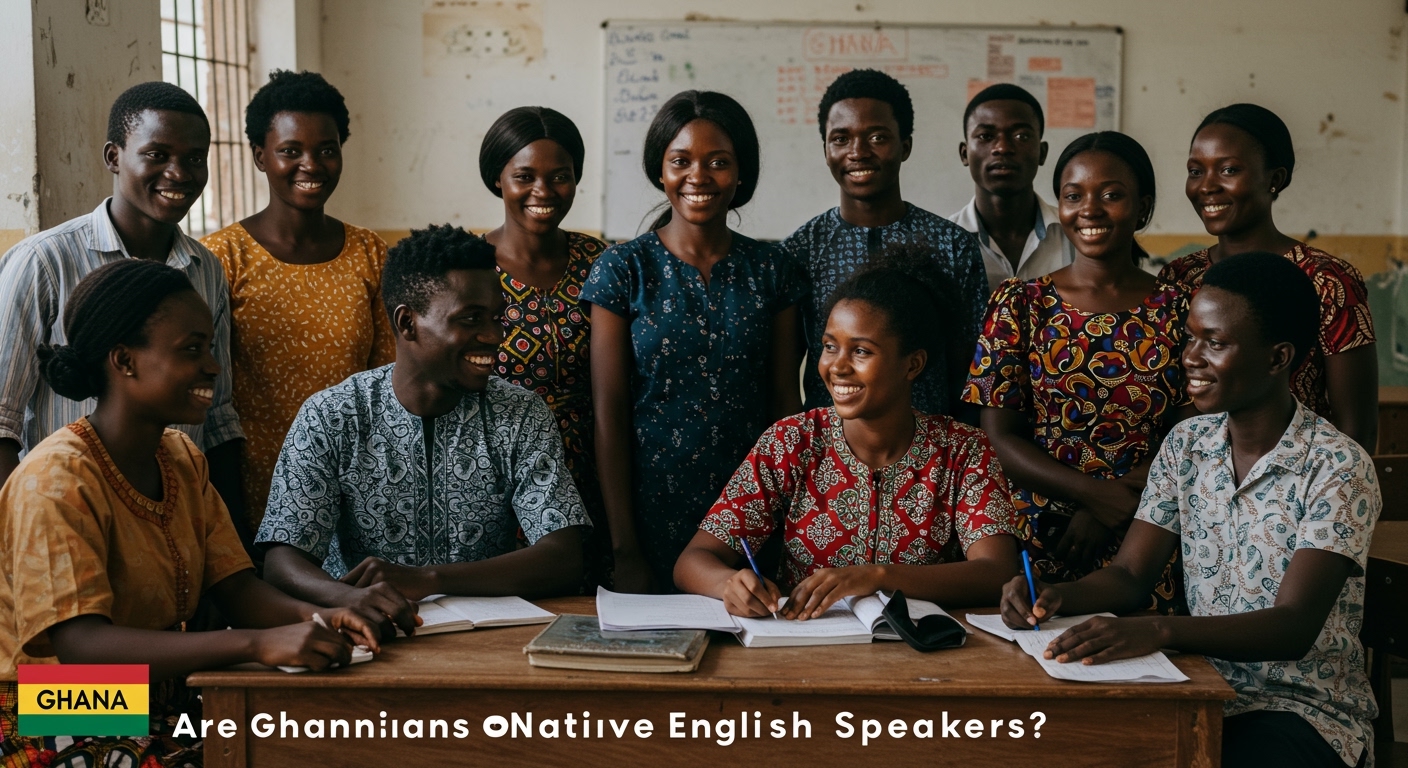
In Ghana, the reality is much more complex. Before European colonization, the region was home to dozens of distinct ethnic groups, each with its own language. Today, there are over 80 indigenous languages spoken across the country.
Because of this incredible diversity, the country needed a lingua franca—a common bridge language—to unite the nation after independence in 1957. English was chosen to serve this exact purpose. Therefore, while English may not be the “native” bloodline language of the ancestors, it functions as the native language of the state.
Step 2: Recognize the Role of the Ghanaian Education System
If you want to understand how fluent Ghanaians are, look no further than their schools. The Ghana Education Service (GES) mandates that English is the medium of instruction from the upper primary level all the way through university.
This means that every textbook, exam, and lecture is delivered in English. As a result, anyone who has completed formal education in Ghana reads, writes, and speaks English at a highly proficient level. In our experience collaborating with Ghanaian professionals, their written English is often impeccable and strictly adheres to British Standard English rules.
However, in rural areas where access to formal education is limited, English proficiency drops significantly. In these regions, local languages like Twi, Dagbani, or Fante dominate daily life.
Step 3: Learn the Differences Between the Three Tiers of Ghanaian English
To effectively communicate in Ghana, you must realize that there isn’t just one type of English spoken. Ghanaians expertly code-switch between three distinct tiers of English depending on the social context.
Understanding these tiers is a crucial step for expats, tourists, and business travelers.
Standard Ghanaian English (SGE)
This is the formal register used in news broadcasts, courts, corporate offices, and academic institutions. It heavily mimics British English but features a distinct West African cadence and intonation. You will hear precise enunciation, though certain vowel sounds may be flattened compared to a London accent.
Colloquial Ghanaian English
This is the everyday English spoken among friends and colleagues. It mixes standard English with local Ghanaian idioms, direct translations from indigenous languages, and unique vocabulary. For example, a Ghanaian might say “I am coming” when they actually mean “I will be right back.”
Ghanaian Pidgin English (Kru English)
Primarily spoken by the youth, university students, and the working class, Pidgin is a vibrant creole language. It blends English vocabulary with West African grammatical structures. It is highly informal and is often used as a unifying language across different ethnic groups in informal settings.
Step 4: Master Common Ghanaian English Vocabulary and Idioms
If you are researching are Ghanaians native English speakers, you likely want to know how easily you will be understood. While you will be understood perfectly, you might struggle to understand certain local phrasing.
Ghanaians have developed unique colloquialisms that are technically English but carry localized meanings. Here is a breakdown of common phrases you will encounter:
Essential Ghanaian English Phrases
- “Flash me”: This means to give someone a missed call on their mobile phone so they have your number.
- “Alighting”: Used when getting off public transportation (the Trotro). You will hear, “Mate, I am alighting here.”
- “Small small”: This translates to “step by step” or “gradually.” If you ask how someone’s new business is going, they might reply, “We are growing small small.”
- “Take the lead”: This means “go ahead of me, and I will follow.”
- “Machine”: Often used to refer to a motorcycle or a sewing machine, rather than industrial equipment.
Step 5: Study the Standard vs. Pidgin English Comparison Table
To truly grasp the linguistic environment, it helps to see the language in action. Below is a comparative table showing how a single concept changes depending on the tier of English being used in Ghana.
| Situation / Intent | Standard UK/US English | Standard Ghanaian English | Ghanaian Pidgin English |
|---|---|---|---|
| Greeting | How are you doing today? | How are you? / Hope you are well? | Charlie, how far? / How body? |
| Agreement | I completely agree with you. | That is very true. / I side with you. | Bam! / You do all. |
| Expressing Hunger | I am really hungry right now. | I am feeling hungry. | Hunger dey wire me. |
| Saying Goodbye | I am going to leave now. | I am making a move. / I am going. | I dey bounce. / I dey go. |
| Asking for a Favor | Could you please help me? | Please, I am begging you, help me. | Abeg, do me a solid. |
Table: A practical comparison of English variations used daily in Ghana.
Step 6: Adjust Your Communication Style for Business in Ghana
If you are traveling to Ghana for business, understanding that Ghanaians are native English speakers in a corporate sense is vital. You do not need a translator to conduct business in Accra. However, you do need to adjust your communication style to build rapport and respect cultural norms.
Be Polite and Formal Initially
Ghanaian culture places a high value on respect and hierarchy. Always start emails and meetings with formal greetings. Use titles like Mr., Mrs., or Doctor until you are explicitly invited to use first names. Plunging straight into business without asking about someone’s well-being is considered rude.
Speak Clearly, Not Loudly
Because Ghanaian English pronunciation differs slightly from American or Australian English, you may occasionally ask for repetition. Do not raise your voice; simply speak clearly and avoid overly complex Western slang. They understand standard English perfectly, but hyper-regional idioms from your home country might not translate well.
Embrace “African Time” but Expect Professionalism
While social events may run on a relaxed schedule, modern Ghanaian corporate environments are highly professional. Written English in contracts and proposals will be of a very high standard. Always ensure your own documentation is meticulously proofread.









