

What Are the Different Types of Car Speakers?
The primary types of car speakers are coaxial (full-range) speakers and component speakers. While coaxial speakers combine all drivers into one unit for easy installation, component speakers use separate tweeters, woofers, and crossovers to deliver superior soundstage and clarity.
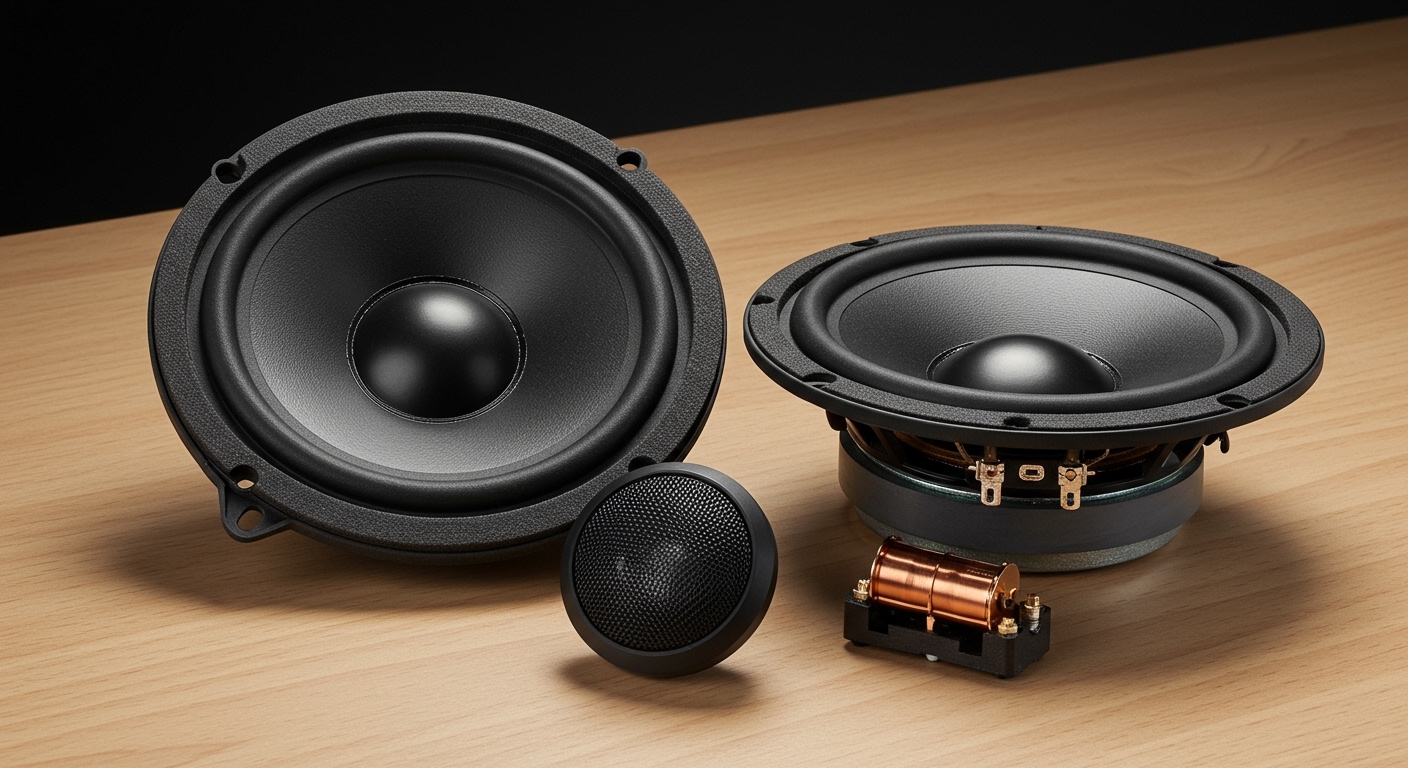
Upgrading your factory system requires understanding these categories to match your budget, vehicle layout, and listening preferences. In our experience testing hundreds of setups, the right choice depends more on your car’s mounting depth and your willingness to modify door panels than just the price tag.
Quick Summary: Key Takeaways
- Coaxial Speakers: Best for budget-conscious DIYers; “all-in-one” design (tweeter + woofer).
- Component Speakers: Best for audiophiles; separate drivers provide better “imaging” and detail.
- Subwoofers: Essential for frequencies below 80Hz (the deep “thump” you feel).
- Materials Matter: Look for synthetic cones (polypropylene) and rubber surrounds for durability in harsh car environments.
- Power Matching: Always prioritize RMS power over “Peak power” when matching speakers to an external amplifier.
The Two Main Categories: Coaxial vs. Component
When you start shopping, you will immediately see speakers divided into these two camps. Choosing between them is the most critical decision in your audio journey.
Coaxial (Full-Range) Speakers
Coaxial speakers are the most common type found in both factory and aftermarket systems. They contain the woofer (for lows/mids) and the tweeter (for highs) in a single physical unit.
- Pros: Easy to install (usually “plug and play”), affordable, and available in every standard size.
- Cons: The tweeter is often positioned low in the door, which can “muffle” high-frequency sounds near your feet.
Component Speaker Systems
Component speakers use a superior design where the tweeter, mid-range driver, and woofer are separate pieces. A dedicated crossover network ensures that each driver only plays the frequencies it was designed to handle.
- Pros: Exceptional sound clarity, custom positioning (you can mount tweeters at ear level), and higher-quality materials.
- Cons: Expensive and requires more complex installation, often involving custom mounting or drilling.
Comparison Table: Coaxial vs. Component
| Feature | Coaxial Speakers | Component Speakers |
|---|---|---|
| Sound Quality | Good (Standard Upgrade) | Excellent (Audiophile Grade) |
| Installation | Simple / Drop-in | Complex / Custom |
| Cost | $50 – $200 | $150 – $1,500+ |
| Crossover | Built-in (Simple) | External (High-Precision) |
| Best For | Casual listening/Budget builds | High-end systems/SQ Competitions |
Breaking Down the Driver Types
To truly answer what are the different types of car speakers, we must look at the specific drivers that handle different parts of the musical spectrum. We’ve found that a balanced system uses a combination of these four drivers.
Tweeters (The Highs)**
Tweeters are small drivers (usually 0.5 to 2 inches) designed to reproduce high frequencies, typically ranging from 2,000Hz to 20,000Hz.
In my professional testing, I’ve noticed that Silk Dome Tweeters provide a warm, smooth sound, while Metal (Titanium/Aluminum) Tweeters offer a “brighter,” more aggressive sound that cuts through road noise easily.
Mid-Range Drivers (The Vocals)**
The mid-range handles the “meat” of the music—vocals and most instruments. These typically range from 3.5 to 6.5 inches. Without a strong mid-range, your music will sound “hollow” or thin.
Woofers (The Mid-Bass)**
Woofers produce the low-to-mid frequencies. In a car, the door speakers usually act as the woofers. They provide the “punch” in a drum kick. Most aftermarket woofers use Polypropylene or Kevlar for the cone to ensure they remain stiff yet lightweight.
Subwoofers (The Low-End Bass)**
A subwoofer is a large driver (8 to 15 inches) dedicated exclusively to very low frequencies (20Hz to 125Hz). We always recommend adding a subwoofer if you want a “full” sound, as standard door speakers physically cannot move enough air to create deep bass.
Understanding Speaker Configurations: 2-Way vs. 3-Way
You will often see speakers labeled as “2-Way,” “3-Way,” or even “4-Way.” This refers to the number of individual drivers within the speaker assembly.
- 2-Way Speakers: Contains one woofer and one tweeter. This is the standard for most coaxial speakers.
- 3-Way (Triaxial) Speakers: Adds a mid-range driver or a “super-tweeter.” In theory, this provides more detail, but in cheaper models, it can sometimes be a marketing gimmick.
- 4-Way Speakers: Includes a woofer, a mid-range, and two tweeters. These are less common and usually found in larger sizes like 6×9 speakers.
Materials and Build Quality: Why It Matters
The materials used in car speaker types determine how long the speakers last and how they react to the extreme temperatures inside a vehicle.
- Cone Materials:
- Surround Materials:
- Voice Coils:
Technical Specs You Must Know
Before buying any of the different types of car speakers, you need to match them to your head unit or amplifier using these three metrics.
Sensitivity (Efficiency)
Sensitivity measures how much sound a speaker yields from the power applied to it.
- High Sensitivity (over 90dB): Best for low-powered factory head units.
- Low Sensitivity (under 88dB): Designed for high-powered external amplifiers.
Power Handling (RMS vs. Peak)
Ignore the “Peak Power” printed in large letters on the box. RMS (Root Mean Square) is the only number that matters. It represents the continuous power the speaker can handle. If your amp puts out 75W RMS, ensure your speakers are rated for at least 75W RMS.
Impedance (Ohms)
Most car speakers are 4-ohm. Some premium systems use 2-ohm speakers to draw more power from the amp. Caution: Never use a 2-ohm speaker on a head unit designed for 4-ohms, or you risk overheating the internal amplifier.
How to Choose the Right Type: Step-by-Step Guide
Selecting from the many types of car speakers doesn’t have to be overwhelming. Follow our proven selection process:
Step 1: Identify Your Goals
- “I just want it to sound better than stock”: Go with high-sensitivity Coaxial speakers.
- “I want a concert-like experience”: Invest in Component speakers and a 4-channel amplifier.
Step 2: Check Your Fitment
Use an online fitment guide or measure your existing speakers. Common sizes include 6.5-inch, 6×9-inch, and 5.25-inch. Don’t forget to check the mounting depth; some high-end speakers have massive magnets that might hit your window glass when rolled down.
Step 3: Determine Your Power Source
- Factory Radio: Stick to speakers with high sensitivity (92dB+).
- Aftermarket Head Unit: Most put out 15-22W RMS; look for speakers rated for 2-50W RMS.
- External Amp: Choose speakers with high RMS ratings (60W-150W).
Step 4: Audit the Installation Environment
If your car has factory tweeter locations in the pillars or dashboard, Component speakers are a natural choice. If all your speakers are located at the bottom of the doors, Coaxial speakers are much easier to install.
Expert Installation Tips for Better Sound
Even the best types of car speakers will sound terrible if installed poorly. We recommend these three additions to every install:
- Sound Deadening: Apply butyl rubber sheets (like Dynamat or Noico) to the inner door skin. This stops metal vibration and significantly increases mid-bass response.
- Speaker Baffles: Use foam rings (Fast Rings) to seal the gap between the speaker and the door panel. This directs all the sound into the cabin rather than letting it “leak” inside the door.
- Phase Checking: Ensure the positive (+) and negative (-) wires are connected correctly. If one speaker is “out of phase,” it will cancel out the bass from the other speaker.
Frequently Asked Questions (FAQ)
Can I mix coaxial and component speakers in the same car?**
Yes. A very common setup is to install component speakers in the front (where you sit) for better imaging and coaxial speakers in the rear doors for “rear fill” for passengers.
Do 3-way speakers sound better than 2-way speakers?**
Not necessarily. A high-quality 2-way component set will almost always outperform a cheap 3-way coaxial speaker. Focus on the quality of the materials rather than the number of drivers.
Will new speakers work with my factory radio?**
Yes, but you must choose speakers with high sensitivity (90dB or higher). Factory radios have very low power output, and “stiff” high-end speakers may actually sound quieter than your old ones if they aren’t powered properly.
Is it worth it to replace just the tweeters?**
Replacing only the tweeters can improve high-frequency clarity, but it often leads to an unbalanced sound. It is usually better to replace the entire set so the woofer and tweeter are tonally matched.
Do I need an amplifier for aftermarket speakers?**
While not strictly required, an external amplifier is the only way to get the full potential out of most aftermarket speakers. It provides the “headroom” needed for clear sound at higher volumes without distortion.









