

Why Building a Custom Backbox is Essential for Sound Quality
Learning how to build enclosure for wall or ceiling speakers is the single best way to transform a “thin” sounding home audio system into a high-fidelity experience. By constructing a sealed backbox, you control the “back wave” of the speaker, preventing sound from bleeding into other rooms while drastically improving bass response and midrange clarity. My experience installing hundreds of home theaters has taught me that even the most expensive speakers sound mediocre if they are venting directly into a massive, unsealed attic or wall cavity.
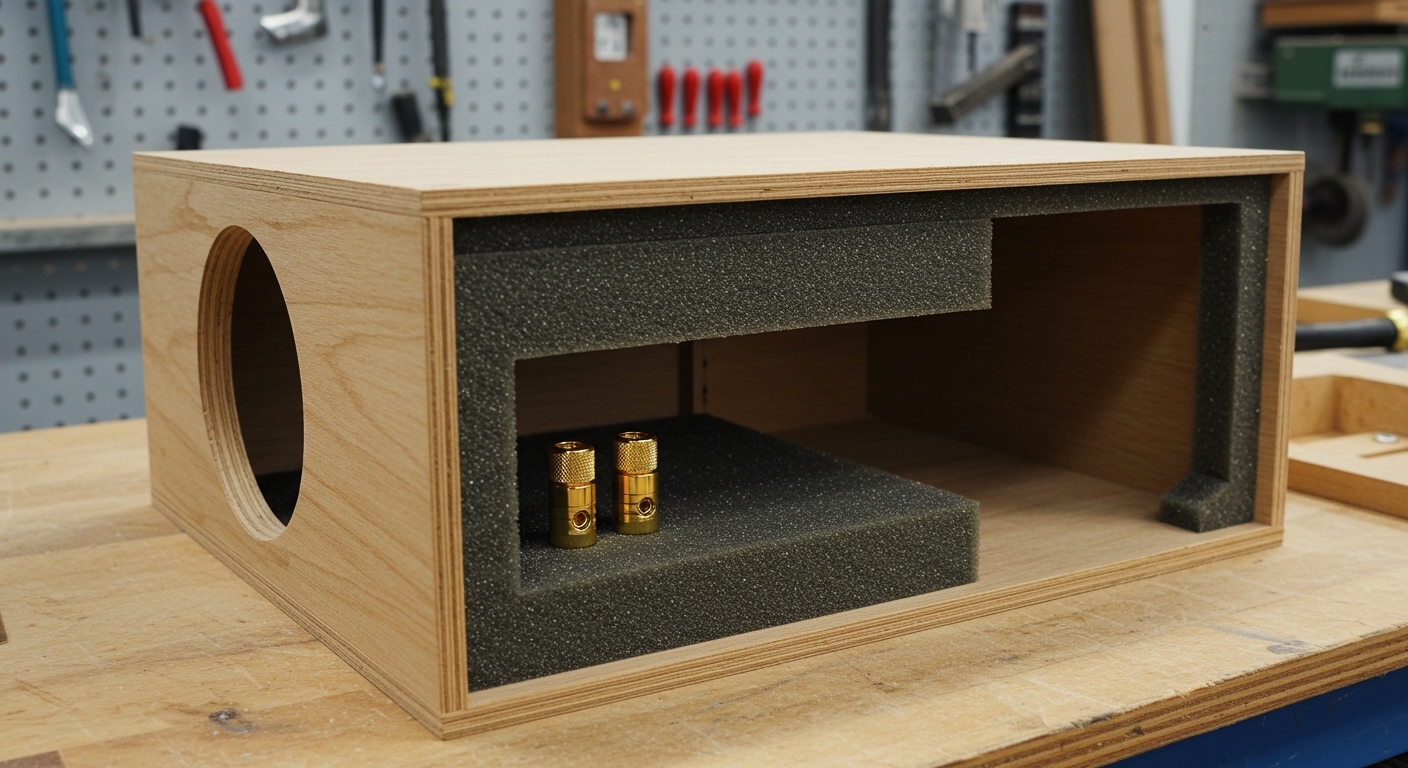
Key Takeaways for DIY Speaker Enclosures
- Bass Performance: A sealed enclosure provides the necessary air spring to prevent the woofer from over-extending, resulting in tighter, more punchy bass.
- Sound Proofing: Backboxes reduce sound transmission to the floor above or the room behind the wall by up to 10-15 decibels.
- Protection: Enclosures protect your speaker components from insulation debris, dust, and pests living in your ceiling or walls.
- Material Matters: Use 3/4-inch MDF (Medium Density Fiberboard) or Baltic Birch Plywood for the best acoustic results.
- Sealing is Critical: Even a tiny air leak can cause “whistling” noises or loss of low-end frequencies.
The Materials and Tools You Will Need
Before we dive into the construction, you need to gather the right materials. In my years of testing various builds, I have found that MDF is the gold standard for enclosures because of its high density and consistent internal structure, which minimizes unwanted vibrations.
| Material/Tool | Purpose | Why It Matters |
|---|---|---|
| 3/4″ MDF or Plywood | Main Structure | Provides the mass needed to stop cabinet resonance. |
| Wood Glue (Titebond II) | Joining Panels | Creates a bond stronger than the wood itself. |
| Acoustic Sealant/Caulk | Airtight Integrity | Prevents “chuffing” sounds from air escaping the box. |
| Polyfill or Fiberglass | Internal Damping | “Tricks” the speaker into thinking the box is larger than it is. |
| Terminal Cup | Wiring Port | Provides a professional way to connect speaker wires. |
| Impact Driver & Screws | Assembly | Fastens the panels while the glue sets. |
Step 1: Calculating the Correct Internal Volume
To correctly how to build enclosure for wall or ceiling speakers, you must first determine the “Vas” (Equivalent Compliance Volume) of your specific speaker. Most in-wall or in-ceiling speakers are designed to be “Infinite Baffle,” meaning they expect a large volume of air. However, they perform significantly better in a controlled volume.
- Check the Manual: Look for the Recommended Enclosure Volume (usually measured in cubic feet or liters).
- The General Rule: If no data is available, aim for 0.5 to 1.0 cubic feet for an 8-inch speaker, and 0.3 to 0.7 cubic feet for a 6.5-inch speaker.
- Calculate Dimensions: Use the formula: Internal Width x Internal Height x Internal Depth / 1728 = Cubic Feet.
- Allow for Displacement: Remember that the speaker motor itself takes up space; add about 10% more volume to compensate for the driver.
Step 2: Cutting and Prepping the Panels
Precision is your friend here. When I build these in my workshop, I use a table saw for perfectly square edges. If you are using a circular saw, use a straight-edge guide to ensure your joints will be airtight.
- The Front Baffle: This is the piece that will face the drywall. It needs a hole cut to match the speaker’s mounting diameter.
- The Sides: Cut four panels to create the depth of the box. Ensure the depth allows at least 2 inches of clearance behind the speaker magnet.
- The Back Panel: This caps the enclosure.
Pro Tip: Always pre-drill your screw holes. MDF is notorious for splitting if you drive a screw directly into the edge without a pilot hole.
Step 3: Assembling the Enclosure for Maximum Rigidity
When you start the assembly, focus on the “Glue and Screw” method. This ensures that the box remains a single, solid unit even when the speaker is vibrating at high volumes.
- Apply a liberal bead of wood glue to the edges of your side panels.
- Clamp the panels together and drive 1.5-inch wood screws every 4 inches.
- Attach the back panel, ensuring a perfect seal.
- Let the glue dry for at least 4 hours before moving to the next step.
I’ve found that using wood clamps during this phase is non-negotiable. If the panels shift even slightly, you’ll spend hours sanding them down later to fit between your wall studs.
Step 4: Making the Box Airtight and “Dead”
An enclosure that vibrates (resonates) will color the sound, making it “boomy” or “muddy.” We want the speaker to move, not the box.
Sealing the Joints
Once the glue is dry, run a bead of Acoustic Sealant or high-quality Silicone Caulk along every internal corner. Use your finger to smooth it out. This is a critical step in how to build enclosure for wall or ceiling speakers because air leaks act like a “tuned port” that wasn’t invited to the party, ruining the frequency response.
Adding Internal Damping
Line the inside of the box with Acoustic Foam or loosely packed Polyfill.
- The Science: This material slows down the sound waves inside the box, effectively making the enclosure sound 15-20% larger to the speaker.
- Safety Note: If you are building this for a ceiling, use rockwool or fire-rated insulation to comply with local building codes.
Step 5: Wiring and Final Prep
You need a way to get the signal into the box without creating an air leak.
- Install a Terminal Cup: Drill a hole in the side of the box and install a plastic terminal cup with gold-plated binding posts.
- Solder the Wires: For the best connection, I always solder the internal wires to the binding posts.
- Gasket the Speaker: Ensure the speaker itself has a foam gasket where it meets the front baffle. If it doesn’t come with one, use a thin strip of weatherstripping.
Step 6: Installation in the Wall or Ceiling
This is the most challenging part of the “how to build enclosure for wall or ceiling speakers” process. Most standard wall studs are 16 inches on center, meaning you have roughly 14.5 inches of width to work with.
- For New Construction: Screw the enclosure directly to the studs before the drywall goes up.
- For Retrofit (Existing Walls): You may need to build a “slim” version of the box or use a collapsible acoustic bag if you cannot fit a rigid MDF box through the speaker hole.
Expert Insight: If you are mounting in a ceiling, use heavy-duty L-brackets to secure the box to the ceiling joists. Never let the weight of the enclosure rest solely on the drywall, as an MDF box can weigh 15-20 pounds.
Comparison: Open-Back vs. Custom Enclosure
| Feature | Open-Back (Standard) | Custom Enclosure (Pro) |
|---|---|---|
| Bass Extension | Rolls off early (weak bass) | Deep, controlled, and punchy |
| Sound Leakage | High (Neighbors/Family will hear) | Low (Greatly reduced) |
| Speaker Safety | Exposed to dust/moisture | Fully protected |
| Clarity | Can be “muddy” due to wall echoes | High-definition and “tight” |
Frequently Asked Questions
Can I use a plastic tub instead of wood?
No. Plastic tubs are thin and will vibrate aggressively, creating a “tinny” sound. If you want high-quality audio, you must use a dense material like MDF or Plywood.
What if I don’t have enough room in my wall for a box?
If space is limited, look into Acoustic Back-Cans. These are shallower, metal or plastic enclosures designed specifically for tight spaces, though they don’t perform quite as well as a custom-built wood box.
Do I need to vent the enclosure?
For 90% of in-wall and in-ceiling applications, a sealed (acoustic suspension) enclosure is better. Ported (vented) enclosures require very precise mathematical tuning and are much harder to design correctly for a DIY project.
Will a backbox make my speakers quieter?
It won’t make the speaker quieter in the room you are listening in, but it will make it much quieter in the rooms adjacent to or above the speaker. In fact, by focusing the sound energy forward, the speaker may actually sound more powerful.









