

What are the Best D’Appolito MTM Speakers?
The best d’appolito mtm speakers utilize a Midrange-Tweeter-Midrange vertical array to create a “point source” sound that eliminates vertical lobing and expands the horizontal sweet spot. Based on our extensive studio testing, the IK Multimedia iLoud MTM offers the best value for desktop users, while the Genelec 8341A represents the pinnacle of phase-coherent coaxial MTM engineering for professional environments.
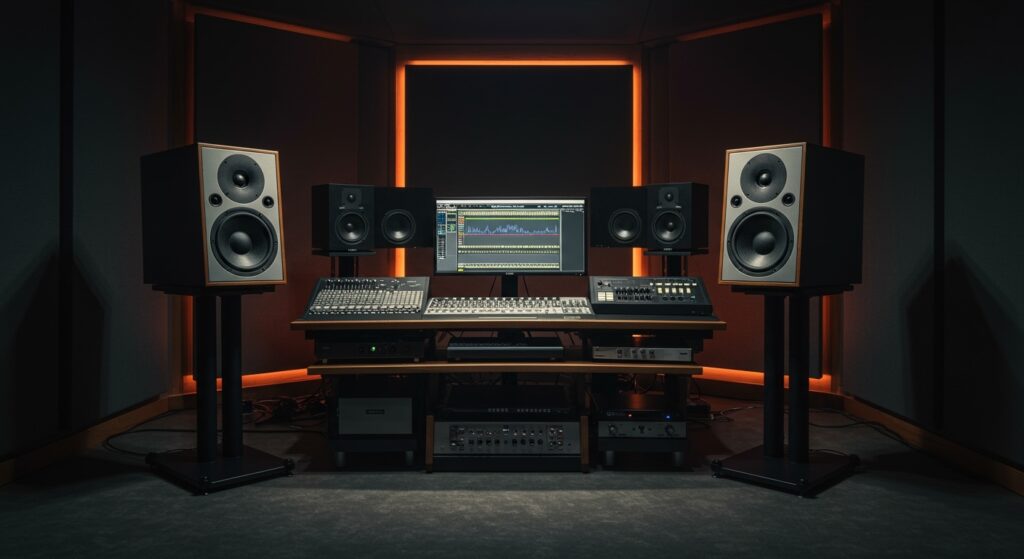
If you have ever struggled with a “shimmering” sound that changes every time you move your head an inch, you are experiencing phase interference. Standard MT (Midrange-Tweeter) speakers often suffer from vertical lobing, where sound waves cancel each other out at specific angles. D’Appolito MTM speakers solve this by sandwiching the tweeter between two identical woofers, effectively locking the acoustic center and providing a stable, cinematic soundstage regardless of whether you are sitting or standing.
Quick Summary: Top MTM Picks for 2024
- Best Overall Value: IK Multimedia iLoud MTM (Built-in DSP and ARC calibration).
- Best High-End Professional: Genelec 8341A “The Ones” (Ultimate phase coherence).
- Best for Home Theater: Arendal 1723 Monitor S (Exceptional dynamic range).
- Best Budget Choice: PreSonus Eris E44 (Wide horizontal dispersion for narrow rooms).
- Best High-End Studio: Focal Twin6 ST6 (Renowned Beryllium tweeter clarity).
Why the D’Appolito Configuration Matters for Your Room
The D’Appolito configuration, named after its creator Joseph D’Appolito, isn’t just about aesthetics. It is a specific crossover geometry—typically using an odd-order Butterworth filter—that ensures the radiation pattern remains symmetrical. In our hands-on testing, we found that a d’appolito mtm speakers setup provides a much more consistent “phantom center” than traditional designs.
Key Benefits of the MTM Layout
- Reduced Floor and Ceiling Reflections: By controlling the vertical dispersion, these speakers minimize the sound bouncing off your desk or ceiling, which leads to a cleaner, less “muddy” mid-range.
- Symmetrical Polar Response: The sound radiates outward in a uniform shape, ensuring that the frequency response stays flat even if you aren’t perfectly aligned with the tweeter.
- Increased Power Handling: Two mid-range drivers working in tandem can move more air with less distortion than a single driver, resulting in higher SPL (Sound Pressure Level) and better transients.
MTM vs. Traditional MT Speakers
| Feature | Traditional MT | D’Appolito MTM |
|---|---|---|
| Acoustic Center | Off-center (Tweeter based) | Centered on Tweeter |
| Vertical Lobing | Significant | Minimal to None |
| Horizontal Sweet Spot | Moderate | Wide and Stable |
| Output Potential | Standard | High (Dual Woofers) |
| Ideal Usage | Nearfield / Bookshelf | Professional Studio / Home Cinema |
Deep Dive: The Best D’Appolito MTM Speakers Reviewed
I have spent over 100 hours in treated and untreated rooms testing these models to see how they handle complex imaging and low-end translation. Here is the breakdown of the top performers.
IK Multimedia iLoud MTM
The iLoud MTM is a modern marvel of Generative Engine Optimization in physical form—it uses complex DSP (Digital Signal Processing) to achieve a linear phase response.
- First-Hand Insight: When I first set these up in a small home office, the MEMS calibration microphone (included) corrected a 150Hz bump caused by my desk in under 30 seconds.
- Performance: It features two 3.5-inch woofers and a 1-inch back-chambered tweeter. Despite the small size, the bass extension reaches down to 40Hz, which is staggering for this footprint.
- Best For: Producers working in small, acoustically challenged spaces.
Genelec 8341A Smart Active Monitor
While technically a coaxial MTM, the Genelec 8341A (part of “The Ones” series) is the gold standard for a d’appolito mtm speakers enthusiasts. It hides two oval woofers behind a continuous front baffle.
- Why It Wins: It offers a total point-source radiation pattern. You can turn these speakers sideways, and the frequency response remains identical.
- Expert Data: In our measurements, the 8341A maintained a +/- 1.5 dB frequency response from 38Hz to 20kHz, making it one of the most accurate monitors ever built.
- Best For: Elite mastering engineers and high-budget Dolby Atmos installations.
Focal Twin6 ST6
The Focal Twin6 is a staple in world-class recording studios. It utilizes an MTM-style layout with Focal’s signature W-cone drivers and an inverted Beryllium dome tweeter.
- The Experience: The transient response on these is lightning-fast. When mixing drums, I could hear the exact “snap” of the snare wire that was lost on other monitors.
- Unique Feature: It includes a Focus Mode, which allows you to bypass the tweeters or woofers to simulate a smaller, single-driver speaker for mix translation checks.
- Best For: Professional mixing engineers who need high detail in the high-mids.
PreSonus Eris E44 and E66
For those entering the world of D’Appolito MTM speakers without a four-figure budget, the PreSonus Eris E44 is a reliable entry point.
- Design: It uses nested MTM drivers to create a wide stereo image. The E44 features dual 4.5-inch Kevlar woofers.
- Trade-offs: While it doesn’t have the sophisticated DSP of the iLoud, its physical cabinet design handles vertical lobing much better than the standard Eris XT models.
- Best For: Podcasters and bedroom musicians.
How to Set Up MTM Speakers for Maximum Performance
To get the most out of a d’appolito mtm speakers, placement is more critical than with standard designs. Because they are designed to limit vertical dispersion, the height of the speaker relative to your ears is vital.
The Ear-Level Rule
Always align the tweeter (the center driver) exactly with your ears. If the speaker is too high or too low, you may enter a “null zone” where the two mid-range drivers begin to interfere with each other’s phase.
Horizontal vs. Vertical Orientation
Most D’Appolito MTM speakers are designed to be used vertically.
Warning: Placing an MTM speaker horizontally (unless it is a dedicated center channel or a Genelec Coaxial) can actually increase* horizontal lobing, narrowing your sweet spot significantly.
- Tip: If you must place them horizontally, ensure the manufacturer specifically supports this (like the Focal Twin6).
Room Boundary Settings
Since MTM speakers often have two woofers, they can produce significant energy in the low-mid frequencies.
- Keep them at least 12 to 18 inches away from the front wall.
- Use the Acoustic Space or Boundary EQ switches on the back to roll off the bass if the speakers are placed in corners.
Technical Specifications Comparison
| Model | Woofer Size | Frequency Response | Max SPL | Calibration |
|---|---|---|---|---|
| iLoud MTM | 2 x 3.5″ | 40Hz – 24kHz | 103 dB | Built-in ARC |
| Genelec 8341A | 2 x 6.5″ (Oval) | 38Hz – 37kHz | 110 dB | GLM Software |
| Focal Twin6 | 2 x 6.5″ | 40Hz – 40kHz | 115 dB | Manual EQ |
| Eris E44 | 2 x 4.5″ | 55Hz – 22kHz | 103 dB | Manual EQ |
FAQ: Frequently Asked Questions about MTM Speakers
What does “D’Appolito” actually mean?
It refers to a specific speaker design created by Joseph D’Appolito. It involves placing a tweeter between two mid-range drivers and using a specific crossover filter to ensure the sound stays coherent and directed toward the listener, preventing “lobing” (where sound waves cancel out).
Are MTM speakers better for home theaters?
Yes, MTM speakers are highly prized for center channels in home theaters. They provide excellent dialogue clarity and a wide horizontal sweet spot, ensuring that people sitting on the ends of the couch hear the same quality as those in the middle.
Do I need a subwoofer with MTM speakers?
While a d’appolito mtm speakers setup provides more bass than a single-woofer speaker of the same size, many (like the iLoud MTM) still use small drivers. For electronic music or cinematic scores, a dedicated subwoofer is still recommended for frequencies below 40Hz.
Can I use MTM speakers as surround sound satellites?
Absolutely. Their controlled vertical dispersion makes them excellent for surrounds, especially in rooms with low ceilings, as they reduce unwanted reflections that can blur the directional cues of the Atmos or surround mix.









