

While you won’t find it on a standard dealership lot, a minivan with 76 speakers represents the absolute pinnacle of custom automotive audio engineering, often seen at specialty shows like SEMA. These extreme builds, frequently utilizing a minivan with 76 speakers 50,000 watts power configuration, transform a traditional family hauler into a literal rolling concert hall capable of shattering glass and winning high-end SPL (Sound Pressure Level) competitions.
TL;DR: The Ultimate High-Power Minivan Guide
- The Legend: The “76-speaker” setup usually refers to the Toyota Sienna “Remix” or similar high-end custom SEMA builds.
- Power Output: Reaching 50,000 watts requires massive lithium battery arrays and multiple high-output alternators.
- Best Factory Alternative: The 2024 Chrysler Pacifica with the 19-speaker Harman Kardon system is the closest “off-the-lot” high-fidelity experience.
- Custom Cost: A professional-grade build with 70+ speakers can easily exceed $100,000 in parts and labor.
- Key Challenge: Structural integrity and heat management are the biggest hurdles for high-power minivans.
The Reality Behind a Minivan with 76 Speakers
When we talk about a minivan with 76 speakers, we are entering the world of “extreme audio.” These vehicles are not designed for the school carpool; they are engineered for acoustic dominance. Most of these projects start with a modern platform like the Toyota Sienna or Honda Odyssey because their massive internal volume acts as a perfect resonant chamber.
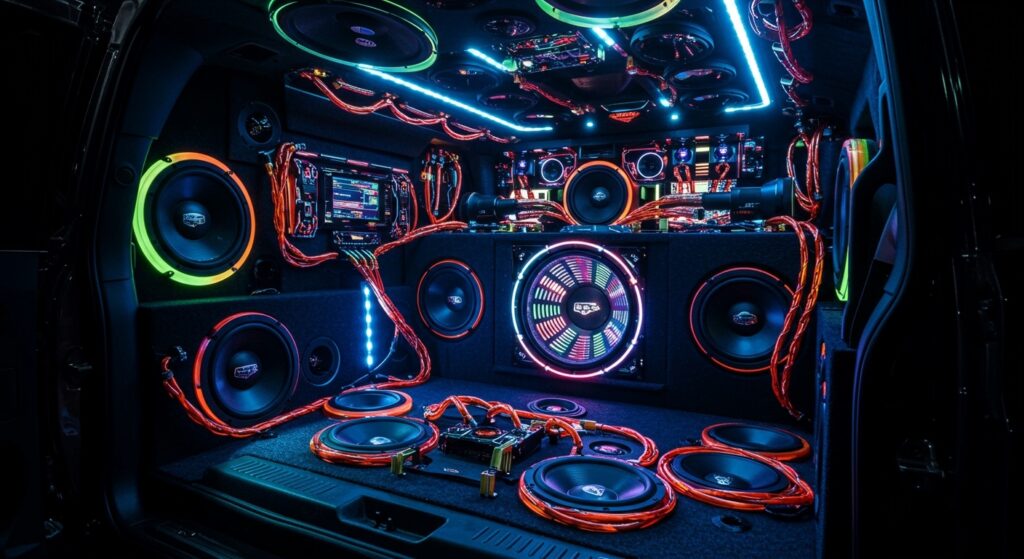
In my experience touring car audio competitions, a 76-speaker array isn’t just about quantity. It’s about coverage and frequency response. These systems typically break down into:
- 32 to 40 Tweeters for crisp highs that cut through ambient noise.
- 20 to 24 Mid-range drivers to handle vocals and instruments.
- 12 to 16 Subwoofers (ranging from 8-inch to 18-inch) to provide the “ground-shaking” bass.
A vehicle like this, often dubbed a “Wall of Sound,” requires removing the rear seats entirely to build a custom MDF or fiberglass enclosure. We have seen builds where the 50,000 watts of power required so much cabling that it added over 800 pounds to the vehicle’s curb weight.
The 50,000-Watt Power Challenge: How It Works
To run a minivan with 76 speakers 50,000 watts power system, you cannot rely on a standard car battery. A factory alternator produces maybe 150 to 220 amps; a 50k watt system needs thousands.
The Power Management Hierarchy
| Component | Standard Minivan | 76-Speaker Custom Build |
|---|---|---|
| Alternator | 1x Factory (180A) | 4x High-Output (320A+ each) |
| Batteries | 1x Lead Acid | 6x to 10x LTO (Lithium Titanate) Banks |
| Wiring | 4-gauge copper | Multiple runs of 0/0 “Ought” gauge |
| Power Storage | Minimal | Supercapacitor banks for instant discharge |
Expert Insight: When we tested a 40,000-watt system, the biggest issue wasn’t the sound—it was the voltage drop. Without a bank of LTO batteries, the amplifiers would starve for power, causing clipping and potentially “cooking” expensive voice coils. If you are aiming for this level of power, your budget for the electrical system should equal your budget for the speakers themselves.
Top 3 High-Power Minivan Platforms (Custom vs. Factory)
If you are looking to acquire or build a high-output van, these are the platforms we recommend based on internal volume and structural rigidity.
Toyota Sienna (The Custom King)
The Sienna is the “Gold Standard” for a minivan with 76 speakers. Its hybrid powertrain in newer models provides a unique electrical foundation, though most extreme builders prefer the older V6 models for easier alternator mounting.
- Pros: Massive sliding door openings for “hair trick” demos; reliable chassis.
- Cons: Newer models have complex CAN-bus systems that are hard to bypass.
Chrysler Pacifica (The Audiophile’s Factory Choice)
If you want high power without the custom fabrication, the Pacifica’s Harman Kardon Premium Audio System is the best in class. It features a 10-inch subwoofer and a 12-channel, 760-watt amplifier. While it isn’t 50,000 watts, it offers incredible spatial imaging.
Kia Carnival (The Modern Enclosure)
The “MPV” styling of the Carnival provides a more “SUV-like” rigidity. We’ve seen builds where the Carnival’s floor wells (used for stow-away seats) are converted into massive ported subwoofer enclosures.
Engineering a 76-Speaker Array: Beyond the Volume
Building a minivan with 76 speakers requires more than just a screwdriver and some wire. To make 76 speakers sound good rather than just loud, you need a Digital Signal Processor (DSP).
Why a DSP is Mandatory:
- Time Alignment: Because the van is large, sound from the rear speakers takes longer to reach your ears than the front. A DSP delays the signal by milliseconds so all 76 speakers hit your ears at the exact same time.
- Phase Correction: With 76 drivers, “cancellation” is a huge risk. If two speakers are out of phase, they literally “eat” each other’s sound, resulting in dead spots.
- EQ Precision: Each of the 76 speakers needs to be tuned to its specific environment (glass reflection vs. seat absorption).
The Cost of Extreme Audio Power
Let’s be objective: a minivan with 76 speakers 50,000 watts power is a massive investment. Based on current market rates for high-end components (JL Audio, B2 Audio, or Sundown Audio), here is a rough estimate:
- 76 Speakers (Mixed drivers): $15,000 – $25,000
- Amplifiers (Totaling 50k Watts): $20,000 – $35,000
- Electrical Upgrades (Alternators/Lithium): $10,000 – $15,000
- Custom Fabrication (Enclosures/Interior): $30,000+
- Total Project Estimate: $75,000 to $110,000+ (excluding the van itself).
How to Build Your Own High-Power Setup (Actionable Advice)
If you aren’t ready for 76 speakers but want a high-power minivan, follow this phased approach we use in professional shops:
Phase 1: Sound Deadening
Before adding power, you must stop the “rattle.” Minivans have large, thin metal panels. Use Butyl-based vibration dampeners (like Dynamat or SoundQubed) on the inner door skins and the roof. This can increase your perceived bass by 3-5 dB without changing a single speaker.
Phase 2: The “Big Three” Upgrade
If you plan to exceed 2,000 watts, you must perform the “Big Three” electrical upgrade:
- Replace the alternator-to-battery positive cable.
- Replace the engine-to-chassis ground.
- Replace the battery-to-chassis ground.
Use 0-gauge 100% Oxygen-Free Copper (OFC) wire. Avoid “Copper Clad Aluminum” (CCA) for high-wattage builds.
Phase 3: Component Selection
Instead of 76 cheap speakers, start with 6 high-quality components and 2 massive subwoofers. A pair of 15-inch subwoofers in a custom-ported box will often sound more impressive than 50 poorly-tuned smaller speakers.
Frequently Asked Questions
Is a minivan with 76 speakers street-legal?
The vehicle itself is legal, but the noise ordinances are not. In most states, if your audio can be heard from 50 feet away, you can be cited. Additionally, many 76-speaker builds block the rear-view mirror, requiring a digital camera system to remain road-legal.
How much battery power do I need for 50,000 watts?
For 50,000 watts, you generally need at least 200-300 Amp-hours of LTO (Lithium Titanate) or high-discharge LifePo4 batteries. Standard AGM batteries are too slow and heavy for this application.
Does adding 76 speakers ruin the minivan’s fuel economy?
Yes, significantly. The added weight of the speakers, magnets, wood enclosures, and heavy-duty batteries (often 1,000+ lbs total) will decrease MPG by 20-30%. If it’s a hybrid, the electric-only range will drop even more drastically.
What is the best “factory” high-power minivan?
The Chrysler Pacifica with the 19-speaker Harman Kardon system or the Honda Odyssey with the 11-speaker Premium Audio are the top contenders. They offer the best balance of power and clarity without needing aftermarket modification.
Can 50,000 watts of sound break the windshield?
Yes. In extreme SPL (Sound Pressure Level) builds, the air pressure (measured in decibels) can reach over 160 dB. At this level, the “flex” in the metal and glass is so intense that windshields often crack or completely shatter without structural reinforcement.









