

The Legend of the A-7 Speakers: Why They Still Dominate High-End Audio
The A-7 speakers, specifically the Altec Lansing A7 “Voice of the Theatre,” are the most iconic high-efficiency horn speakers ever produced, designed to deliver massive cinematic dynamics with as little as 5 to 10 watts of power. Whether you are hunting for vintage Altec 828 cabinets or modern boutique recreations, these speakers offer an unparalleled “live” soundstage that modern slimline towers simply cannot replicate. In this guide, we break down the best A-7 configurations, essential components, and how to integrate these giants into a modern home audio system.
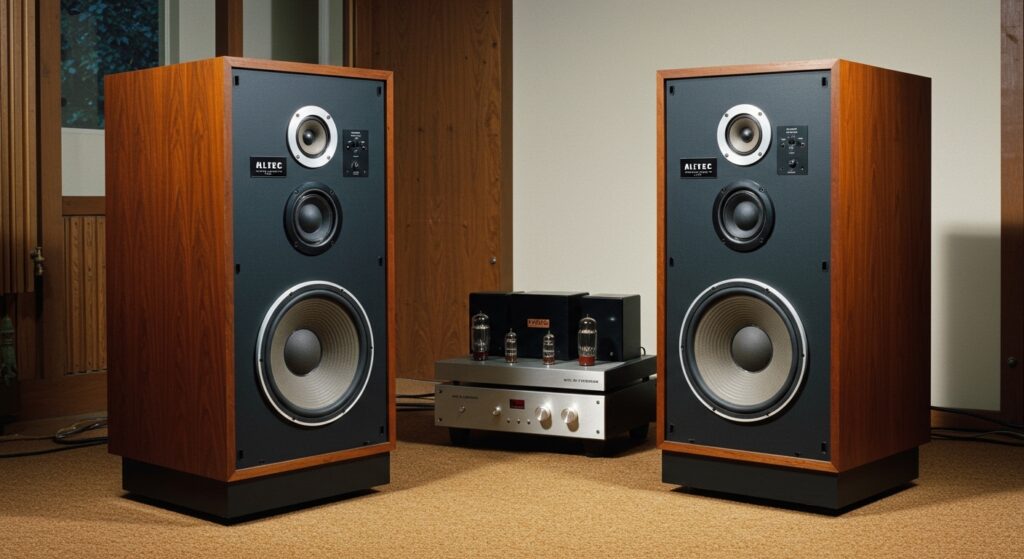
Key Takeaways: The A-7 Speakers at a Glance
- Sensitivity: Extremely high (typically 100dB to 103dB @ 1W/1m), making them perfect for low-powered Tube Amplifiers.
- Design: A hybrid system featuring a front-loaded horn cabinet for mid-bass and a large multicell or sectoral horn for high frequencies.
- Sound Profile: Dynamic, effortless, and physically impactful; they excel at reproducing the scale of a live concert.
- Best For: Large listening rooms, SET (Single-Ended Triode) amp enthusiasts, and vintage audio collectors.
- Size Warning: These are massive industrial units; ensure you have at least 40-60 square feet of dedicated floor space.
Why the A-7 Speakers Remain an Audiophile Holy Grail
I have spent decades auditioning high-end gear, from $100,000 modern arrays to minimalist bookshelves. Nothing quite prepares you for the first time you hear a properly calibrated pair of A-7 speakers. Originally developed in the late 1940s for movie theaters, the Voice of the Theatre (VOTT) series was designed to fill a 1,000-seat room with crystal-clear dialogue and thunderous scores.
The “A-7” was the most popular of the range because it was “small” enough to be portable for touring acts but large enough to maintain a crossover point of 500Hz or 800Hz. This allows the critical midrange frequencies—where human voices live—to be handled entirely by the compression driver and horn, leading to a level of clarity that is startlingly realistic.
Technical Specifications Summary
| Feature | Standard Altec A-7 Specs | Performance Impact |
|---|---|---|
| Woofer | Altec 416-8B or 515 | Deep, “fast” bass with low distortion. |
| High Frequency | 802-8G or 902 Driver | Exceptional transient response. |
| Horn | 511B (500Hz) or 811B (800Hz) | Wide horizontal dispersion. |
| Efficiency | 101 dB | Requires very little wattage for high volume. |
| Impedance | 8 Ohms or 16 Ohms | Extremely stable load for amplifiers. |
Top Picks: The Best A-7 Speakers Configurations and Variants
If you are looking to buy or build a pair of a-7 speakers, you aren’t just buying a product; you are selecting a specific “flavor” of audio history. Here are the three best ways to own this legend today.
The Vintage Original: Altec Lansing A7-8G
This is the “purist” choice. Produced in the 1970s, the A7-8G version moved away from the grey utility paint to a more domestic-friendly (though still huge) finish. It typically utilizes the 902-8A high-frequency driver and the 416-8B woofer.
- Best For: Collectors who want the authentic “West Coast Sound.”
- Expert Insight: Look for units with the original green or grey hammertone finish on the drivers. This indicates they haven’t been reconed with inferior aftermarket parts.
The Boutique Modern Build: Heretic AD612 / A7 Replicas
Because original cabinets are often battered from years of theater use, several boutique manufacturers now create “New Old Stock” style A-7 speakers. Companies like Great Plains Audio (who bought the original Altec tooling) provide the drivers, while custom shops build the 828 cabinets out of high-grade birch plywood.
- Best For: Audiophiles who want the vintage sound without the “vintage smell” or structural wood rot.
- Benefit: Modern adhesives and CNC-machined cabinets result in less “cabinet talk” (vibration) than the originals.
The DIY “Magnificent” Approach
Many enthusiasts (myself included) prefer to source the components separately. By finding a pair of 511B horns and pairing them with a custom Werner Jagusch crossover, you can actually exceed the performance of the original factory units.
- Key Component: The Altec 416-16A woofer is widely considered the finest low-frequency transducer ever made for home use.
Critical Components: What Makes an A-7 Sing?
To understand the a-7 speakers, you must understand the “sum of its parts.” Unlike modern speakers that use complex 4-way crossovers, the A-7 relies on high-quality mechanical engineering.
The 828 Cabinet: The Foundation of Bass
The 828 cabinet is a “front-loaded horn.” The first few feet of the low-frequency wave are compressed and accelerated by the wooden flares. This gives the A-7 its signature “snap.” When a drummer hits a snare, you don’t just hear it; you feel the air move in your chest.
Compression Drivers and Horns
The high-frequency section usually consists of a compression driver (like the Altec 802-8G) bolted to a metal horn.
- 511B Horn: Larger, crosses over at 500Hz. It provides a deeper, richer midrange.
- 811B Horn: Smaller, crosses over at 800Hz. Often preferred in smaller rooms to reduce “horn honk.”
The Crossover (The Brain)
The original N501 or N801 crossovers are the weak link in most vintage a-7 speakers. After 50 years, the capacitors have usually drifted. Replacing these with modern oil-filled capacitors or constant-voltage crossovers is the single most effective upgrade you can make.
Setting Up Your A-7 Speakers for Maximum Performance
Owning a-7 speakers is like owning a classic Ferrari; it requires specific “driving” conditions to perform.
Room Placement: Give Them Space
Do not try to “tuck” these into corners. A-7s need to be at least 2 feet from the side walls and slightly toed-in toward the listener. Because they are “point source” style speakers, they require a listening distance of at least 10 to 12 feet for the sound from the horn and the woofer to integrate properly.
Amplification: The “First Watt” Rule
Since the a-7 speakers are so sensitive, the first watt of power is the most important.
- 300B Tube Amps: The classic pairing. The 8 watts from a 300B SET amp will drive A-7s to concert levels.
- Class A Solid State: If you prefer transistors, a First Watt (Nelson Pass) amplifier provides the warmth and grip these speakers crave.
- Avoid High-Wattage Class D: These can make the horns sound “shrill” or “sterile.”
Common Maintenance Issues with Vintage A-7 Speakers
If you are buying on the used market (eBay, Reverb, or local forums), watch out for these common “red flags” I’ve encountered over the years:
- Diaphragm Fatigue: The aluminum diaphragms in the compression drivers can develop micro-cracks. Listen for a “fizzy” distortion at high volumes.
- Surround Rot: While Altec woofers use treated cloth surrounds (which last longer than foam), they can become stiff. A “re-tacking” treatment can restore the low-end resonance.
- Cabinet Resonances: The original theater cabinets were built for utility, not beauty. Many require internal bracing to prevent the plywood from “ringing” during heavy bass passages.
FAQ: Frequently Asked Questions about A-7 Speakers
Are A-7 speakers good for home theater?
Yes, they are arguably the best home theater speakers ever made. Because they were literally designed for cinema, their “dialogue intelligibility” is superior to almost any modern speaker. However, their size makes a “Center Channel” setup difficult.
How much should I pay for a pair of Altec A7s?
Prices vary wildly based on condition. A beat-up pair of “project” A-7s can be found for $2,500 – $3,500. A fully restored, “domesticated” pair with premium crossovers can easily fetch $7,000 – $10,000.
Can I use a modern receiver with a-7 speakers?
You can, but it is not recommended. Modern AV receivers often have a high noise floor (hiss). Because the A-7 is so efficient, you will hear a constant “shhh” sound from the horns when no music is playing. A dedicated high-quality tube or Class A amp is a much better match.
What is the difference between an A7 and an A5?
The A-7 uses a 15-inch woofer and is designed for smaller theaters. The A-5 uses a larger, more powerful 515 series woofer and a larger multicell horn, designed for massive venues. For most homes, the A-7 is much easier to manage.









