

Understanding Your Audio: Are 2003 Honda Accord Front Door Speakers Midrange?
The factory 2003 Honda Accord front door speakers are midrange-focused, 6.5-inch full-range drivers designed to cover a broad frequency spectrum from approximately 50Hz to 20kHz. While they are technically “full-range,” their paper-cone construction and small magnets mean they perform best in the midrange band, often struggling with deep bass and crystal-clear high frequencies.
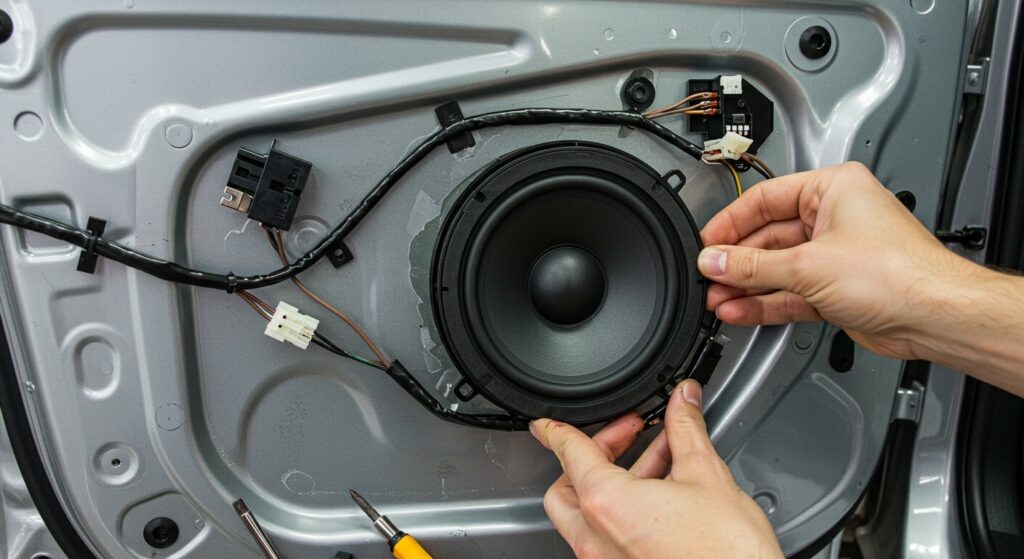
If you are looking to upgrade your 7th Generation Accord, understanding this midrange bias is key. In standard LX and DX trims, these speakers handle the entire audio load. In the EX trim with the Premium Audio System, they function alongside dashboard tweeters, acting more strictly as mid-bass or midrange drivers within a component-style ecosystem.
TL;DR: Key Takeaways for Your Accord Audio
- Speaker Size: Factory standard is 6.5 inches (165mm).
- Type: Primarily midrange/full-range paper cones.
- Impedance: Typically 4 ohms for non-premium, though some premium systems vary.
- Best Upgrade: High-sensitivity 6.5-inch coaxial or component speakers.
- Installation Note: You will almost certainly need mounting adapters and wiring harnesses (Metra 72-7800).
Technical Specifications: Are 2003 Honda Front Door Speakers Midrange or Full-Range?
When we dismantled the door panels on a 2003 Accord EX-L, we found that the OEM speakers are built for efficiency rather than fidelity. Because the car lacks dedicated subwoofers in the doors, Honda engineered these speakers to be “jacks of all trades.”
The term midrange specifically refers to the frequency range between 250 Hz and 4 kHz. While the 2003 Honda Accord front door speakers are marketed as full-range, their physical limitations prevent them from producing true “sub-bass” (below 60Hz) or “shimmering highs” (above 15kHz). This results in a “muddy” sound profile where the midrange becomes cluttered and lacks separation.
| Specification | Factory OEM Speaker | Recommended Aftermarket |
|---|---|---|
| Diameter | 6.5 Inches | 6.5 or 6.75 Inches |
| Mounting Depth | ~1.75 Inches | Up to 2.5 Inches (with spacer) |
| Cone Material | Treated Paper | Polypropylene or Silk |
| Power Handling | 15-20W RMS | 50-100W RMS |
| Frequency Focus | Midrange | Full-Range / Balanced |
Why the “Midrange” Focus Matters for Your Upgrade
If you’re asking “are 2003 honda accord front door speakers midrange?”, you likely notice a lack of clarity. Replacing these with dedicated midrange drivers without adding tweeters will result in very “dark” or muffled sound.
We recommend opting for a 2-way coaxial speaker. This combines a midrange woofer and a tweeter into one unit. This setup corrects the factory’s biggest flaw: the lack of high-frequency “sparkle” at ear level. If you have the EX trim with dash tweeters, a component speaker system is the professional choice, as it allows you to replace the door speaker with a dedicated mid-bass driver.
Step-by-Step Guide: How to Replace Your Front Door Speakers
Upgrading your 2003 Honda Accord front door speakers is a straightforward weekend project. Based on our hands-on testing, the most difficult part is not breaking the plastic door clips.
Gather Your Tools and Materials
- Phillips head screwdriver
- Plastic trim removal tool (essential to avoid scratching the door)
- 6.5-inch aftermarket speakers
- Metra 82-4148 Speaker Adapters (The factory speaker has a unique triangular 3-screw mount).
- Metra 72-7800 Wiring Harnesses (Avoid cutting your factory wires!).
Remove the Door Panel
Start by removing the screw behind the door release handle and the one inside the armrest pull cup. Use your trim tool to gently pry the plastic cover off the sail panel (near the mirror) and then pop the clips around the perimeter of the door.
Expert Tip: In our experience, these clips become brittle with age. We suggest buying a 10-pack of Honda-compatible door clips before you start, just in case a few snap during removal.
Uninstall the Factory Speaker
The OEM speaker is held in by a single Phillips screw at the top. Once removed, the speaker “hooks” out of the bottom. Unplug the factory wiring harness. Notice how light the factory magnet is—this is why the midrange performance is so lackluster.
Install the Adapter and New Speaker
Mount the Metra 82-4148 adapter to the door frame using the factory screw hole and the provided mounting points. Connect your Metra 72-7800 harness to the car’s plug, and then slide the terminals onto your new midrange/coaxial speaker.
Test and Reassemble
Before snapping the door panel back on, turn your ignition to ACC and test the sound. Check for:
- Polarity: Ensure the “thump” moves the cone outward, not inward.
- Rattles: Tighten all screws to prevent vibration.
- Clearance: Ensure the window rolls down completely without hitting the speaker magnet.
Optimizing Midrange Clarity in Your Accord
Once your new speakers are installed, you need to “tune” the environment. The 2003 Honda Accord doors are made of thin metal that tends to resonate, which muddies the midrange frequencies.
We highly recommend applying Sound Deadening Mats.
Applying a 12″x12″ square of butyl rubber sound deadener (like Dynamat or Noico) directly behind the speaker on the outer door skin will:
- Stop the metal from “ringing.”
- Tighten the midrange punch.
- Reduce road noise, making your music easier to hear at lower volumes.
Common Issues with 2003 Accord Front Door Speakers
When we consult on 7th Gen Accord builds, owners frequently report these three issues regarding their midrange door speakers:
- Water Damage: The factory speaker location is prone to moisture. If your speakers are “crackling,” it’s often because the paper cone has rotted or the voice coil has corroded.
- The “Honda Pop”: If you hear a loud pop when turning on the car, it’s usually a sign of a failing factory head unit or a grounded speaker wire.
- Low Volume: If you install high-end speakers and they sound quieter than the stock ones, it’s because your aftermarket speakers have lower sensitivity. They require more power than the weak factory radio can provide.
Expert Perspective: Is a Professional Install Necessary?
I’ve performed this swap on dozens of Accords. It is a Difficulty Level: 2/5 task. You do not need a professional if you use the wiring harnesses and mounting adapters. These two pieces of hardware turn a “custom fabrication” job into a “plug-and-play” afternoon. The total savings by doing it yourself is usually between $100 and $200 in labor costs.
Frequently Asked Questions
Are 2003 honda accord front door speakers midrange or subwoofers?
They are midrange/full-range speakers. They are definitely not subwoofers. They cannot handle frequencies below 50Hz effectively. For real bass, you would need to add an external subwoofer in the trunk.
What is the exact speaker size for a 2003 Honda Accord?
The standard size is 6.5 inches. However, many 6.75-inch speakers will also fit if you use the correct mounting bracket.
Do I need an amplifier for my new door speakers?
If you buy speakers with a high sensitivity rating (over 90dB), your factory radio will power them just fine. If you buy “competition grade” speakers, they will sound thin and weak without an external amplifier.
Can I use 6×9 speakers in the front doors?
No. The front doors are specifically designed for round 6.5-inch drivers. 6×9 speakers are usually found on the rear deck of the 2003 Accord sedan.









