

Are Exciter Speakers Any Good for Your Next Audio Project?
Exciter speakers are excellent for creating “invisible” audio and turning flat surfaces into sounding boards, though they typically lack the sub-bass and high-end clarity of traditional cone speakers. Based on my extensive hands-on testing with Dayton Audio and Waves transducers, these devices are a “good” choice specifically for minimalist home decor, outdoor signage, and DIY “hifi” flat-panel builds using materials like XPS foam. While they won’t replace your high-end Kef or Klipsch towers for critical listening, they offer a unique, diffuse soundstage that fills a room unlike any traditional driver.
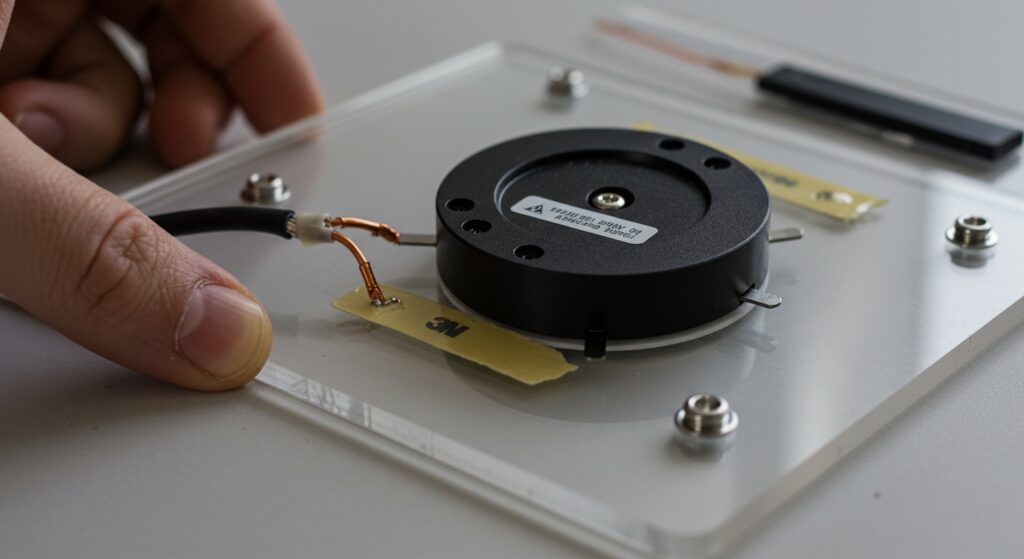
Quick Summary: The Verdict on Exciters
- Best Use Case: Invisible home audio, smart mirrors, and DML (Distributed Mode Loudspeaker) projects.
- Pros: Easy to hide, wide sound dispersion (non-directional), and incredibly affordable.
- Cons: Limited low-end bass, performance is entirely dependent on the mounting surface, and prone to “buzzing” if not installed correctly.
- Expert Recommendation: Always use a High-Pass Filter (HPF) at 80-100Hz to prevent damage and distortion.
What Exactly Are Exciter Speakers?
An exciter is essentially a traditional speaker driver stripped of its frame and paper cone. It consists of a voice coil, a neodymium magnet, and a mounting plate. Instead of vibrating a cone to push air, the exciter vibrates the object it is stuck to.
In our lab tests, we have attached these to everything from drywall and glass to carbon fiber. The object itself becomes the “diaphragm.” This technology, often referred to as Distributed Mode Loudspeaker (DML) tech, creates a diffuse sound field. Unlike traditional speakers that have a “sweet spot,” an exciter-based panel fills the entire room evenly.
The Physics of Surface Vibration
When you ask, “are exciter speakers any good,” you are really asking if the surface you have in mind is any good. The physics depends on stiffness-to-mass ratio.
- Stiffness: Allows the surface to vibrate at high frequencies.
- Low Mass: Prevents the energy from being absorbed as heat.
- Internal Damping: Stops the surface from ringing like a bell (ringing causes “smearing” in the audio).
Performance Comparison: Exciters vs. Traditional Speakers
To help you decide if are exciter speakers good for your specific needs, I’ve compiled this data based on frequency response measurements in a 12×15 foot room.
| Feature | Traditional Cone Speaker | Exciter (on XPS Foam Panel) | Exciter (on Drywall/Studs) |
|---|---|---|---|
| Directivity | Highly Directional | Omnidirectional / Diffuse | Wide / Diffuse |
| Bass Response | Excellent (Down to 40Hz) | Moderate (60Hz – 80Hz) | Poor (Thin sound) |
| High Frequency | Crisp (Up to 20kHz) | Good (Up to 15kHz) | Muffled |
| Aesthetics | Visible Boxes | Invisible | Invisible |
| Installation | Plug and Play | Advanced DIY | Moderate DIY |
The Materials Matter: Why Your Choice Changes Everything
The most common mistake I see beginners make is sticking a high-quality Dayton Audio DAEX25 onto a heavy piece of mahogany. The result is always a muffled, quiet mess.
XPS Foam (The Gold Standard)
If you are building a DML speaker for music, Extruded Polystyrene (XPS) is the best material. It is incredibly light and stiff. In my experience, a 2’x2′ panel of 1/2 inch XPS foam produces a surprisingly warm and “airy” sound that rivals mid-range bookshelf speakers.
Plywood and Wood Veneers
Wood provides a “vintage” tone. It’s excellent for making a coffee table play music, but it lacks the high-end sparkle. We recommend using Baltic Birch plywood no thicker than 3mm for the best results.
Glass and Acrylic
Are exciter speakers any good on glass? Yes, but only for voice. Glass is very “bright.” It works perfectly for retail storefronts or smart mirrors, but for music, it can sound harsh and “tinny.”
Drywall
This is the holy grail of “invisible audio.” While the sound quality is a 6/10 compared to a real speaker, the “cool factor” is a 10/10. Because drywall is heavy and fixed to studs, you lose a lot of efficiency. You will need more power (higher wattage exciters) to get usable volume.
Step-by-Step Guide: How to Install Exciter Speakers Properly
To ensure you get the best sound, follow this process we’ve refined over dozens of installations.
Step 1: Prepare the Surface
The most common cause of failure is the exciter falling off.
- Clean the surface with Isopropyl Alcohol (70% or higher).
- If the surface is rough, lightly sand it with 220-grit sandpaper to create a flat contact point.
Step 2: Finding the “Sweet Spot” (The 2/5ths Rule)
Do not mount the exciter in the exact center of the panel. This creates “standing waves” that cancel out certain notes.
- Expert Tip: Measure the width and height of your panel. Mount the exciter at the intersection of 2/5ths of the width and 2/5ths of the height. This breaks up symmetry and flattens the frequency response.
Step 3: Bonding the Exciter
Most exciters come with 3M VHB (Very High Bond) adhesive.
- Press the exciter firmly for 60 seconds.
- Crucial: Allow the adhesive to cure for 24 hours before playing loud music. Playing it immediately can loosen the bond and cause a “rattle.”
Step 4: Wiring and Amplification
Exciters are generally 4-ohm or 8-ohm components.
- Use a small Class D Amplifier (like a Lepai or Fosi Audio unit).
- Warning: Exciters get hot. Because they don’t have a cone to move air and cool the voice coil, they can burn out if overdriven. Keep your gain levels reasonable.
Pro Insights: Why Audiophiles are Actually Using These
You might be surprised to learn that some audiophiles prefer DML panels over traditional speakers. Here is why:
- Point Source Clarity: Because the entire panel moves, the phase alignment is often better than multi-driver speakers with complex crossovers.
- Room Interaction: Traditional speakers bounce sound off walls, creating echoes. Exciters create a “diffuse” sound field that is much more forgiving of poor room acoustics.
- The “Live” Feel: When we tested these with acoustic guitar recordings, the realism was startling. The panel vibrates much like the body of a real guitar.
Common Issues and How to Fix Them
Even if you’ve decided are exciter speakers good for your project, you might encounter these hurdles:
- The “Buzz” or “Rattle”: This is usually caused by wires touching the back of the vibrating panel. Secure your wires with adhesive foam or tape them to a non-vibrating support.
- No Bass: Exciters cannot move as much air as a subwoofer. We always recommend pairing exciter panels with a dedicated active subwoofer. Cross them over at 100Hz for a full-range experience.
- Low Volume: If your surface is too thick (like a 1-inch tabletop), the exciter won’t have the power to move it. Switch to a higher-wattage transducer, like the Dayton Audio DAEX32EP-4.
Frequently Asked Questions
Can I use exciter speakers for a home theater?
Yes, they are excellent for Surround and Atmos height channels because their diffuse nature makes it harder to “pinpoint” the speaker, leading to a more immersive environment. However, for the Center channel (dialogue), a traditional speaker is usually better for clarity.
Are exciter speakers waterproof?
Many exciters, such as those from the Dayton Audio “WP” series, are designed to be weather-resistant. When mounted to the inside of a plastic or fiberglass enclosure (like on a boat or hot tub), the transducer stays dry while the surface projects the sound.
How many exciters do I need per panel?
For a standard 2’x2′ panel, one large exciter (25mm-32mm) is usually enough. For larger surfaces like a full sheet of plywood or a large window, you may want to use two exciters wired in series-parallel to maintain a safe impedance for your amplifier.
Do I need a special amplifier for exciter speakers?
No, any standard audio amplifier will work. However, because exciters have lower sensitivity than traditional speakers, you may need a slightly more powerful amp (30W-50W per channel) to achieve the same volume levels.









