

Understanding Why Guitar Amp Cabinets Aren’t Regular PA Speakers
Are guitar amp cabinets regular PA speakers? No, guitar amp cabinets are specialized instruments designed to “color” your sound, whereas PA speakers are built for Full Range Flat Response (FRFR) to reproduce audio accurately. While a PA speaker aims for transparency across the entire human hearing range, a guitar cabinet acts as a final tonal filter, cutting off harsh high frequencies and emphasizing mid-range punch.
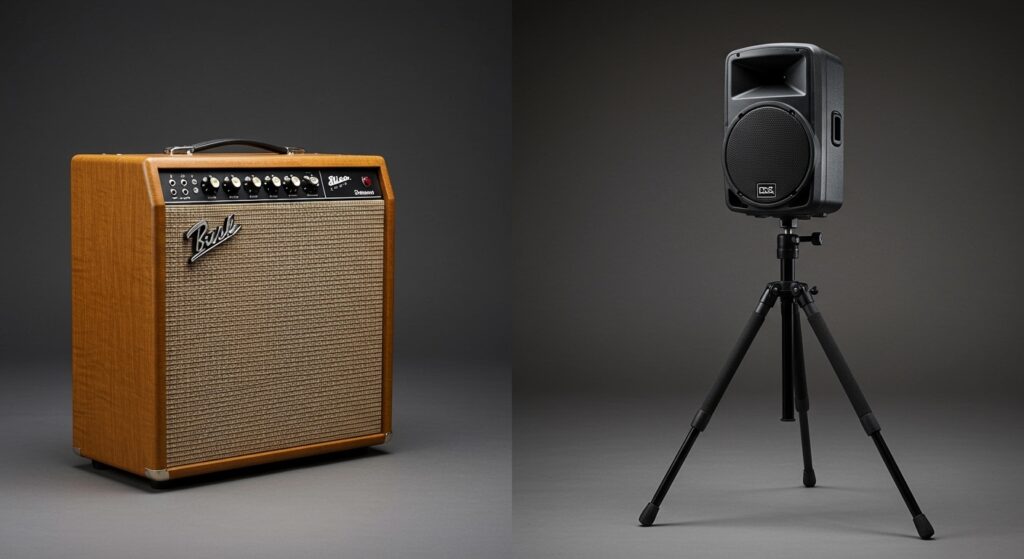
TL;DR: Key Takeaways
- Purpose: Guitar cabinets are part of the instrument’s tone; PA speakers are for transparent sound reinforcement.
- Frequency Range: Guitar speakers usually roll off sharply after 5kHz; PA speakers can reach 20kHz.
- Drivers: PA speakers use a woofer and a tweeter (two-way); guitar cabs use full-range drivers without crossovers.
- Durability: Guitar speakers are designed for “cone breakup” (harmonic distortion); PA speakers are designed to stay clean.
The Fundamental Differences: Color vs. Clarity
When I first started gigging, I once tried to plug my guitar directly into a PA speaker without a simulator. The result was thin, fizzy, and frankly, painful to the ears. This is because guitar amp cabinets and regular PA speakers serve two diametrically opposed masters.
A guitar cabinet is not just a box for speakers; it is a resonant chamber. It is designed to emphasize the “sweet spot” of the electric guitar (between 80Hz and 5kHz). Conversely, a PA (Public Address) speaker is designed to be an invisible messenger, delivering the sound of vocals, drums, and music tracks as accurately as possible.
Why Guitar Cabinets “Filter” Your Sound
If you were to play a distorted guitar signal through a high-fidelity PA speaker, you would hear a massive amount of high-end “fizz.” Guitar speakers, like the legendary Celestion Vintage 30, naturally roll off everything above 5,000Hz. This acts as a low-pass filter, turning harsh electronic clipping into the smooth, creamy overdrive we associate with rock and roll.
Technical Comparison: Guitar Cabs vs. PA Systems
To truly understand why are guitar amp cabinets regular PA speakers (or rather, why they aren’t), we need to look at the internal components.
| Feature | Guitar Amp Cabinet | Regular PA Speaker |
|---|---|---|
| Frequency Response | Narrow (Approx. 70Hz – 5kHz) | Wide (Approx. 40Hz – 20kHz) |
| Driver Type | Single, large-diameter drivers | Woofer + Compression Driver (Tweeter) |
| Crossover Network | None | Built-in (splits highs and lows) |
| Cabinet Design | Open or Closed back (Resonant) | Ported and Tuned (Neutral) |
| Tonal Goal | Harmonic saturation and “Character” | Transparency and High Fidelity |
The Role of the Crossover
In a regular PA speaker, a crossover circuit splits the incoming signal. It sends low frequencies to the woofer and high frequencies to the tweeter. Guitar cabinets almost never have crossovers. They rely on the physical limitations of the 10-inch or 12-inch speaker cone to naturally taper off the frequencies.
Anatomy of a Guitar Speaker Driver
We often think of speakers as simple devices, but the engineering in a guitar cabinet is specific to the instrument’s physics.
- The Voice Coil: In guitar speakers, these are often designed to handle heat but also to reach a point of “saturation.”
- The Paper Cone: Most guitar speakers use unfiltered paper cones with specific ribbing. This ribbing controls how the cone vibrates, adding those “pleasing” mids.
- The Surround: The edge of a guitar speaker (the surround) is usually made of treated paper or cloth, which is stiffer than the rubber surrounds found in PA woofers or home theater subs.
Expert Insight: Cone Breakup
One thing I’ve learned from years of recording is that cone breakup is the “secret sauce.” When you push a guitar amp cabinet hard, the speaker cone itself physically deforms slightly. This creates harmonic distortion that sounds musical. If a PA speaker does this, it’s considered a failure or a “blown” speaker.
Cabinet Construction: Open Back vs. Closed Back
When asking “are guitar amp cabinets regular PA speakers,” you have to look at the box itself. PA speakers are almost always sealed or ported to maximize efficiency and bass response.
Open-Back Cabinets
Many classic Fender and Vox amps use open-back designs. This allows sound to radiate from the rear, filling the room with a spacious, “airy” feel. You will almost never see an open-back PA speaker because it causes phase cancellation, which kills the low-end punch needed for a clean mix.
Closed-Back Cabinets
Marshall 4×12 cabinets are the gold standard for closed-back designs. These provide a directional, “thumping” bass response. While this is closer to a PA speaker design, the internal volume is rarely “tuned” to a specific frequency in the same way a QSC or JBL PA cabinet is.
Can You Use a PA Speaker for Guitar?
With the rise of Digital Modelers like the Line 6 Helix, Kemper, or Neural DSP Quad Cortex, the lines are blurring. These devices use Impulse Responses (IRs) to simulate the sound of a guitar amp cabinet.
If you are using a modeler, you actually want a regular PA speaker. This is often called an FRFR Monitor (Full Range Flat Response).
- The Modeler provides the “color” (the amp and cab sound).
- The PA Speaker provides the “volume” without adding extra coloring.
Warning: Never plug a standard guitar head directly into a PA speaker. The lack of a “cabinet simulation” will result in a sound that is thin, brittle, and potentially damaging to your hearing (and your reputation as a tone chaser!).
Impedance and Power Handling: A Critical Warning
One technical area where guitar amp cabinets differ from PA speakers is impedance (Ohms).
- Guitar Cabinets: Commonly found in 4, 8, or 16 Ohms.
- PA Speakers: Typically 8 Ohms, but active (powered) PA speakers have their own internal matching.
If you try to hook a tube amplifier into a passive PA speaker, you must match the impedance perfectly. Tube amps are incredibly sensitive to impedance mismatches. I’ve seen expensive Mesa Boogie heads literally smoke because they were plugged into the wrong load.
The “Acoustic Filter” Perspective
Think of a guitar amp cabinet as the “lens” on a camera. The amplifier is the “sensor,” but the lens determines the focus, the color, and the blur (bokeh). A PA speaker is like a high-quality window—its only job is to let you see exactly what is on the other side without distortion.
Why PA Speakers Sound “Bad” for Raw Guitar
- Excessive Highs: They reproduce frequencies up to 20kHz, making guitar distortion sound like “bees in a can.”
- Lack of Mids: PA speakers often have a “scooped” sound to make music feel bigger, but guitars live in the mid-range.
- Transient Response: PA speakers are designed to be fast and punchy. Guitar speakers have a bit of “sag,” which feels better under the fingers of a player.
Practical Advice for Your Rig
If you are looking to build a rig and wondering whether to buy a dedicated guitar cabinet or a powered PA speaker, follow this guide:
Choose a Guitar Cabinet if:
- You are using a traditional Tube or Solid-State head (e.g., Marshall, Orange, Boss Katana).
- You want the “organic” feel of a moving paper cone.
- You aren’t using digital “cab sims.”
Choose a PA Speaker (FRFR) if:
- You use plugins or digital modelers.
- You need a consistent sound that goes directly to the “Front of House” mixer.
- You want a lightweight, versatile setup for multiple instruments.
FAQ: Common Questions About Guitar Cabs and PA Speakers
Can I use a guitar speaker for a PA system?
I wouldn’t recommend it. Guitar speakers lack the high-frequency drivers (tweeters) necessary to make vocals or cymbals sound clear. Everything will sound muffled, like you are listening through a thick blanket.
Why are guitar cabinets so much heavier than PA speakers?
Guitar cabinets are often made of thick Baltic Birch plywood or MDF to handle the vibrations and provide specific resonance. While modern PA speakers use high-tech molded plastics to reduce weight while maintaining rigidity, guitarists often prefer the “heft” of traditional wood for its tonal properties.
Does the grill cloth on a guitar cab affect the sound?
Surprisingly, yes. In my testing, thicker grill cloths (like the classic “checkerboard” style) can subtly roll off even more high-end, whereas the thin mesh on a PA speaker is designed to be as acoustically transparent as possible.
Are “Active” guitar cabs just PA speakers?
Mostly, yes. Products like the Line 6 Powercab or Headrush FRFR are essentially PA speakers housed in a guitar-style box. However, some (like the Powercab) have “Speaker Modeling” that tries to mimic the physical movement of a real guitar driver.
Can I plug my phone into a guitar amp to play music?
You can, but it won’t sound like “regular speakers.” Because guitar amp cabinets are not PA speakers, they will cut out all the high-end “shimmer” of your favorite songs, making them sound dark and lo-fi.









