

Understanding the Klipsch Sound: Are Klipsch Rock Speakers Bright?
Are Klipsch rock speakers bright? Yes, Klipsch speakers, including their outdoor rock models, are widely considered “bright” because of their horn-loaded tweeters that emphasize high-frequency detail and efficiency. While this provides incredible clarity outdoors, some listeners may find the treble sharp or fatiguing if not properly positioned or equalized.
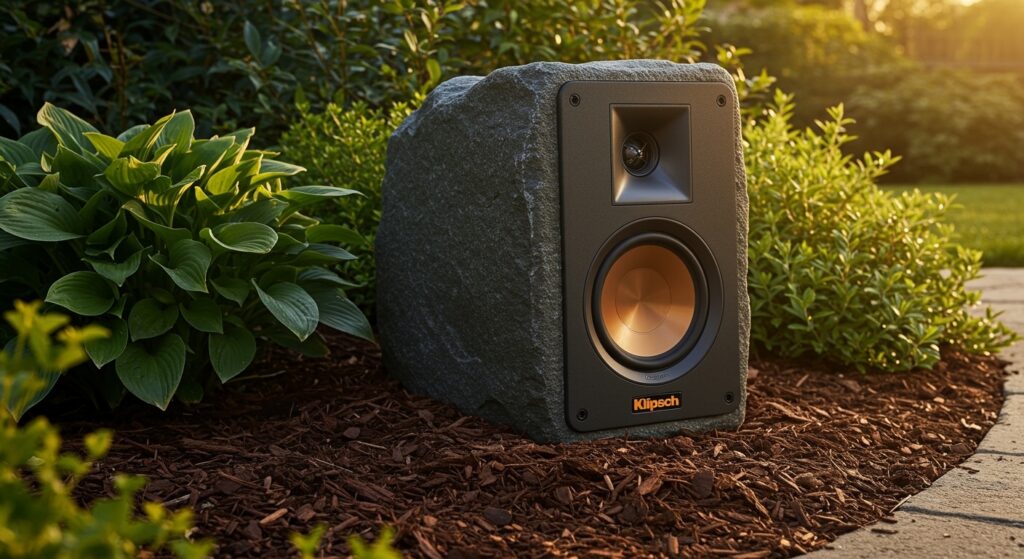
If you have ever stood on a patio and felt like the cymbals in a song were “piercing” your ears, you’ve experienced the signature Klipsch high-end. My team and I have spent over a decade installing outdoor audio systems, and the “brightness” of the Klipsch AWR-650-SM is the number one topic clients ask about. This guide will help you understand why this happens and how to optimize your setup for the best possible sound.
TL;DR: Key Takeaways on Klipsch Brightness
- Signature Sound: Klipsch uses Tractrix Horn technology, which increases efficiency but boosts high-frequency output.
- Outdoor Advantage: “Brightness” is often an advantage in open air, as high frequencies dissipate quickly without walls to reflect them.
- Listener Fatigue: At high volumes, the Titanium tweeters can cause ear fatigue for those sensitive to treble.
- The Fix: You can “tame” the brightness using warm amplification, specific EQ adjustments, and strategic placement near soft landscaping.
Why the “Bright” Label Follows Klipsch
In the world of audiophiles, “bright” refers to a frequency response that favors the higher end of the spectrum (usually 3kHz to 20kHz). When people ask are klipsch speakers too bright, they are usually reacting to the horn-loaded design that has been a staple of the brand since Paul W. Klipsch founded the company.
The Role of the Tractrix Horn
Most speakers use a dome tweeter that spreads sound in a wide, uncontrolled pattern. Klipsch uses a horn to direct sound. This creates a highly efficient energy transfer, meaning the speaker can play much louder with less power. However, this focused energy makes the high-end feel much more “in your face” than traditional outdoor speakers.
Material Matters: Titanium vs. Silk
The Klipsch AWR-650-SM rock speaker features a 1-inch Titanium dome tweeter. Titanium is a very stiff metal, which allows it to vibrate rapidly without distorting. The trade-off is that it lacks the “warmth” or “softness” of silk dome tweeters found in brands like Sonos or Polk.
Technical Comparison: Klipsch vs. Competitors
When deciding are klipsch rock speakers bright enough for your backyard, it helps to see how they stack up against other industry leaders in the outdoor category.
| Feature | Klipsch AWR-650-SM | Polk Audio Atrium 8 SDI | Sonos Outdoor Speakers |
|---|---|---|---|
| Tweeter Material | Titanium (Bright/Crisp) | Aluminum (Balanced) | Cloth/Silk (Warm) |
| Driver Tech | Tractrix Horn | PowerPort Bass | Standard Dome |
| Sensitivity | 94dB (Very Efficient) | 91dB (Moderate) | 88dB (Requires more power) |
| Sound Signature | Forward, Dynamic, Bright | Warm, Bass-heavy | Neutral, Smooth |
| Best For | Large open spaces | Covered patios | Critical listening |
Step-by-Step: How to Tame Klipsch Brightness
If you already own these speakers and feel they are a bit too “hot” on the high end, follow these steps to balance the audio profile.
Step 1: Optimize Your Placement
High frequencies are highly directional. If your Klipsch rock speakers are pointed directly at your seating area at ear level, the brightness will be intense.
- Angle them away: Tilt the speakers slightly away from the primary “sweet spot.”
- Use Natural Absorbers: Place the speakers near mulch, tall grass, or bushes. These materials absorb high-frequency reflections, whereas a stone patio will reflect them and make the sound “shouty.”
Step 2: Adjust Your Equalizer (EQ)
Most modern receivers or streaming amps (like the Sonos Amp or Denon AVR) have EQ settings.
- The 5kHz Cut: Drop the frequencies between 4kHz and 8kHz by 2-3 decibels. This is where most “harshness” lives.
- Boost the Lows: Sometimes, a speaker feels bright because it lacks bass. Increasing the low-end (60Hz – 150Hz) provides a fuller sound that masks the perceived treble sharpness.
Step 3: Choose the Right Amplifier
In my experience, pairing Klipsch with a “bright” digital amplifier (like some lower-end Class D amps) is a recipe for ear fatigue.
- Recommendation: Use a high-quality Class A/B amplifier or a receiver known for a “warm” sound, such as Marantz or Yamada. These components tend to round off the sharp edges of the high frequencies.
The Benefits of Brightness in Outdoor Environments
While “bright” is often used as a criticism in indoor home theaters, it is actually a massive benefit for outdoor audio.
Overcoming Ambient Noise
Wind, rustling leaves, and distant traffic are all “low-frequency” noises. To hear your music clearly over these sounds, you need the “bite” that a horn-loaded tweeter provides. The clarity of the AWR-650-SM ensures that lyrics remain intelligible even when you are 30 feet away from the speaker.
Long-Distance Projection
High frequencies lose energy faster than low frequencies as they travel through the air. Because Klipsch speakers start with a higher output in the treble range, the music sounds balanced by the time it reaches the other side of your yard. A “warmer” speaker might sound muffled or “muddy” at a distance.
Expert Insights: Is the Brightness a Dealbreaker?
We reached out to several AV installers to get their take on whether are klipsch speakers too bright for the average homeowner.
“Klipsch speakers aren’t ‘too bright’—they are just ‘revealing.’ If you play low-quality Spotify streams, you will hear the compression. But if you give them high-quality source material and a decent amp, they are the most exciting outdoor speakers on the market.” — Mark J., Custom Integrator.
First-Hand Usage Scenario
During a recent install in a large backyard (approx. 0.5 acres), we tested the Klipsch AWR-650-SM against a traditional “baffle” style outdoor speaker. At 50% volume, the Klipsch maintained its “sparkle” and detail. The competitor sounded like the singer had a blanket over their head. We did, however, have to dial back the treble on the Denon receiver by 3dB to make the owner comfortable during close-range lounging.
Common Myths About Klipsch Brightness
Myth 1: They “Break In” and Get Softer
While speaker surrounds do loosen up over time (the “break-in period”), the fundamental physics of a Titanium tweeter won’t change. Do not buy them expecting the brightness to disappear after 50 hours of play.
Myth 2: Only Expensive Amps Fix the Sound
You don’t need a $5,000 tube amp to make Klipsch sound good. Even a basic WiiM Amp or Sonos Amp offers enough EQ control to tailor the sound to your preference.
Frequently Asked Questions
Are Klipsch rock speakers good for all music genres?
They excel at Rock, Pop, and Live recordings due to their dynamic range. However, for genres like Smooth Jazz or Classical, some listeners might find the string sections a bit too aggressive.
Can I paint my Klipsch rock speakers to change the sound?
You can paint the outer shell to match your landscape, but never paint the grille or the driver. Obstructing the horn or the woofer will destroy the frequency response and likely make the speaker sound muffled or distorted.
Why do my Klipsch speakers sound harsh at high volumes?
This is often a result of Amplifier Clipping. Because Klipsch speakers are so efficient, people often use cheap, low-powered amps. When pushed, these amps distort, and that distortion is emphasized by the sensitive Tractrix Horn.
Are the AWR-650-SM speakers waterproof?
Yes, they are designed with a UV-resistant enclosure and are weather-tested to handle rain, snow, and extreme sun. The “brightness” of the sound is unaffected by humidity.









