Are Mounted Speakers Considered Fixtures?
Are mounted speakers considered fixtures in a real estate transaction? The short answer is yes; if a speaker is physically attached to the wall or ceiling with brackets, screws, or integrated wiring, it is legally classified as a fixture that must remain with the home. However, stand-alone speakers or those resting on shelves are considered personal property (chattels) and typically move with the seller.
Key Takeaways: Speakers and Real Estate Law
- Permanence Matters: If tools are required to remove the speaker, it is likely a fixture.
- The Wiring Rule: In-wall or in-ceiling wiring is almost always part of the real property.
- Contract Supremacy: A written Purchase Agreement overrides general rules of thumb.
- The “MARIA” Test: Courts use five specific criteria to determine if an item has become a permanent part of the home.
- Seller Best Practice: If you want to keep your high-end surround sound speakers, list them as “excluded” in the initial listing.
Understanding the Legal Definition of a Fixture
To understand if are speakers considered fixtures, we must look at how real estate law distinguishes between Real Property and Personal Property. Real property is the land and anything permanently attached to it. Personal property, or chattels, are moveable items like your sofa or a toaster.
In my years of consulting for home theater installations and working alongside real estate attorneys, I’ve seen countless disputes over high-end audio gear. The confusion usually stems from the Method of Attachment. If a speaker is bolted to a joist, it has legally “annexed” to the property.
The Five-Part “MARIA” Test
The legal system uses the MARIA acronym to determine if an object—like a home theater system—is a fixture.
- Method of Attachment: Is it nailed, bolted, or screwed into the structure? If removing it leaves holes or damage, it’s a fixture.
- Adaptability: Is the item custom-fitted to the space? In-ceiling speakers are specifically adapted to the architecture of the room.
- Relationship of the Parties: Courts often favor buyers over sellers and tenants over landlords in disputes.
- Intent of the Installer: Did the person who installed it intend for it to be a permanent upgrade? High-quality mounted speakers are usually intended as permanent home improvements.
- Agreement of the Parties: What does the contract say? This is the most critical factor.
Why Mounted Speakers are Legally Fixtures
Most people ask, “are mounted speakers considered fixtures” because they spent thousands of dollars on a Dolby Atmos setup and want to take it to their new home. Unfortunately, if you used a drill to secure those brackets, the law generally views them as part of the house.
The Problem with Wall Brackets
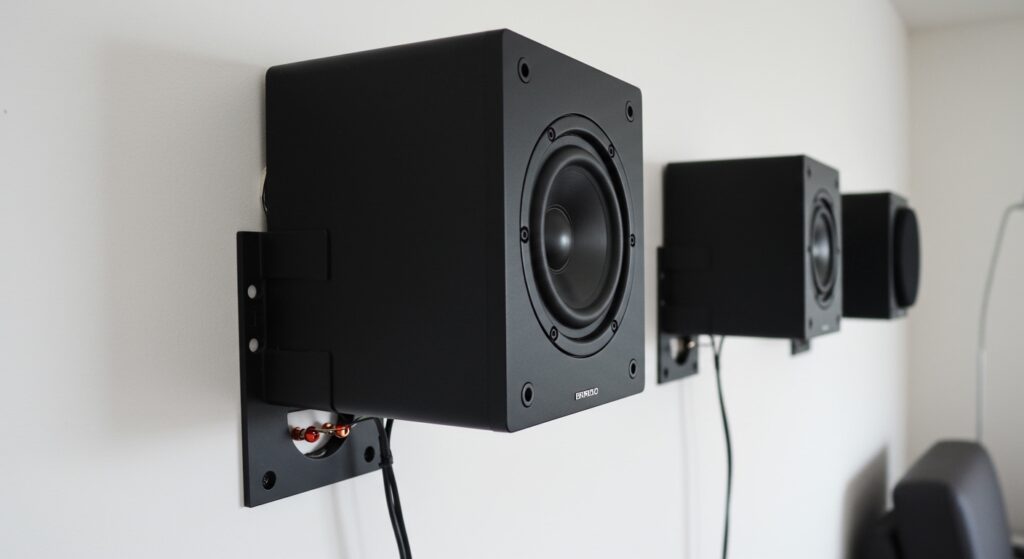
When you screw a bracket into a wall stud, you are making a physical change to the property’s structure. If a buyer walks through your home and sees speakers mounted to the wall, they have a “reasonable expectation” that those speakers come with the purchase.
In-Wall and In-Ceiling Systems
These are the most “permanent” types of audio equipment. Because they require cutting into the drywall and running wires through the “envelope” of the house, are surround sound speakers considered fixtures in this case? Absolutely. Removing them would leave significant holes that would require professional repair, further solidifying their status as fixtures.
| Speaker Type | Legal Classification | Why? |
|---|---|---|
| Floorstanding Tower | Personal Property | Moveable, no attachment to walls. |
| Bookshelf (on shelf) | Personal Property | No physical attachment; sits on furniture. |
| Wall-Mounted | Fixture | Secured via brackets/screws to studs. |
| In-Ceiling / In-Wall | Fixture | Integrated into the home’s structure. |
| Outdoor Rock Speakers | Personal Property | Usually just plugged into an outlet. |
| Soundbars (Mounted) | Fixture | If screwed into a wall-mount bracket. |
Surround Sound Systems: The Gray Area
When we discuss are surround sound speakers considered fixtures, we have to look at the complexity of the system. A modern 5.1 or 7.1 surround sound system involves multiple components: the receiver (AVR), the subwoofer, the satellite speakers, and the wiring.
The Receiver and Subwoofer
The AV Receiver and most subwoofers are almost always personal property. They sit in a cabinet or on the floor and are simply plugged into a wall outlet. I have never seen a legal case where a standard floor-sitting subwoofer was successfully argued to be a fixture.
The “Visible Wiring” Factor
If your speaker wires are stapled along the baseboards, they are generally considered personal property. However, if the wires run behind the drywall, those wires are fixtures. Even if you take the speakers, the buyer is entitled to the wiring that is integrated into the home’s infrastructure.
Step-by-Step: How to Properly Handle Speakers During a Sale
If you are a seller and you love your SVS or Klipsch mounted speakers, you must be proactive. Based on my experience in high-end home sales, following this sequence prevents 99% of legal headaches.
Step 1: Decide Before Listing
Before the “For Sale” sign goes up, decide which speakers you cannot live without. If you have a $5,000 set of mounted speakers, assume the buyer will want them.
Step 2: Replace Them Early
The best way to avoid a dispute is to remove the “fixture” before the first showing. Take down the mounted speakers, patch the holes, and replace them with inexpensive “staging” speakers or simply leave the wall blank. If a buyer never sees it, they can’t claim it.
Step 3: Explicitly Exclude in the MLS
If you must keep the speakers installed during showings, ensure your listing agent marks them as “Excluded” in the Multiple Listing Service (MLS). Use specific language like: “Living room wall-mounted speakers are excluded from the sale; mounting brackets will remain.”
Step 4: The Bill of Sale
If the buyer wants the speakers and you are willing to sell them, do not include them in the real estate contract. Instead, handle it through a separate Bill of Sale. This keeps the value of the speakers out of the mortgage appraisal and clarifies that they are a separate transaction.
Installation Guide: Making Speakers “Renter-Friendly”
If you are a renter or someone who moves frequently, you may want to install speakers in a way that ensures they are not considered fixtures. This protects your security deposit and your gear.
Use Specialized Stands
Instead of wall-mounting, use heavy-duty speaker stands. Brands like Sanus or Kanto offer stands that provide the correct ear-level height without a single screw entering your wall.
Command Strips and “No-Drill” Mounts
For smaller satellite speakers (like those from Sonos or Bose), use adhesive-based mounting solutions. Since there is no physical damage to the wall and no screws involved, these are much easier to classify as personal property.
Hidden Wiring with Rug Covers
Instead of running wires through the wall, use flat speaker wire that can be hidden under area rugs or behind specialized “paintable” cord covers that stick to the baseboard with light adhesive.
Expert Insights: The Financial Impact of Audio Fixtures
Do speakers actually add value to a home? As an expert in the field, I can tell you the ROI (Return on Investment) is often lower than sellers think.
- Technology Obsolescence: A high-end 7.1 system from 2010 might be worthless to a modern buyer who wants wireless Sonos integration.
- The “Hole” Factor: Many buyers see wall-mounted speakers as a liability because they don’t want to deal with patching the drywall if they decide to remove them.
- Neutrality Wins: In most mid-market homes, a clean wall is more valuable than a dated surround sound system.
Data Insight: A study of luxury home sales showed that homes with “Integrated Smart Home Audio” sold 3% faster, but only if the technology was less than three years old.
Frequently Asked Questions
Are surround sound speakers considered fixtures if they are part of a smart home system?
Yes, if the speakers are integrated into the home’s smart ecosystem (like built-in Control4 or Crestron systems) and are physically mounted, they are almost certainly fixtures. The “Adaptability” part of the MARIA test applies here, as the system is integrated into the home’s operation.
If I remove my mounted speakers and patch the holes, can I still take them?
Legally, if you do this before you sign a purchase agreement, yes. If you do it after signing without an exclusion clause, you could be in breach of contract. The buyer is entitled to the home in the condition it was in when they made the offer.
What about outdoor speakers?
Are speakers considered fixtures if they are outside? If they are bolted to the eaves of the house or the deck, they are fixtures. If they are “rock speakers” that simply sit on the ground and plug into an exterior outlet, they are personal property.
Does the brand of the speaker change its legal status?
No. Whether it is a $50 Insignia speaker or a $5,000 Genelec monitor, the law only cares about how it is attached to the property, not how much it cost.
Can a buyer sue me for taking mounted speakers?
Yes. In many jurisdictions, if a seller removes fixtures without permission, the buyer can sue for the replacement cost of the items plus the cost of professional installation and drywall repair. It is always cheaper to communicate through your Realtor than to face a post-closing legal dispute.