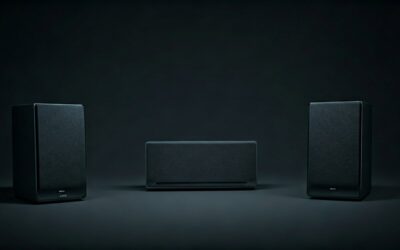
Yes, you can put PA speakers on the same side of the room, but it is generally only recommended for specific “Point Source” mono setups or narrow venues where wide stereo separation isn’t possible. While this configuration avoids certain stereo imaging issues, it significantly increases the risk of phase cancellation and uneven audience coverage if not executed with professional precision.
Can I Put PA Speakers on the Same Side of Room? The Direct Answer
In most professional live sound scenarios, we prefer to split speakers to opposite sides of the stage to create a balanced stereo field. However, if you are working in a long, narrow “bowling alley” style room, placing both speakers on the same side (often stacked or side-by-side in a mono sum) can actually provide more consistent horizontal coverage.
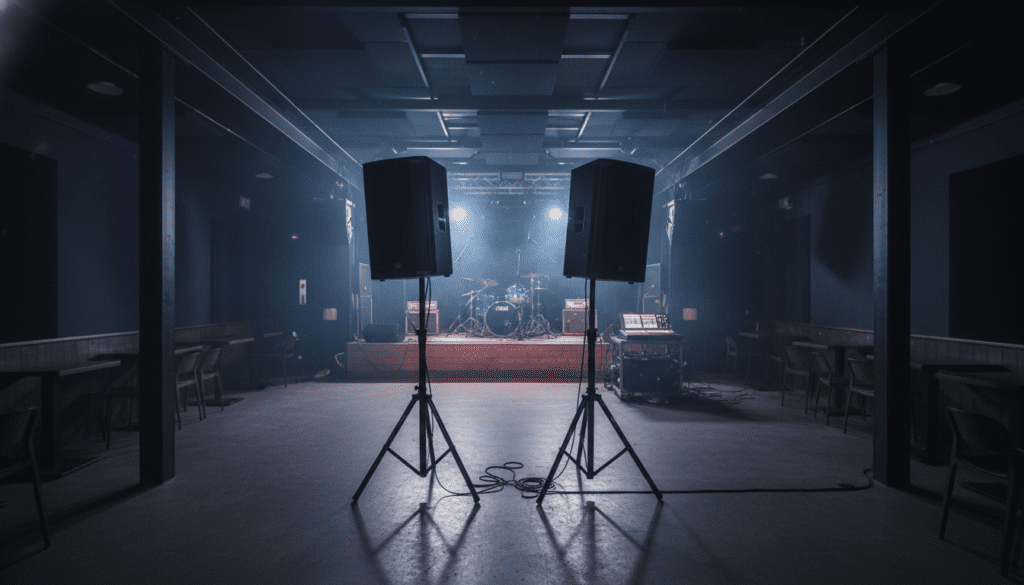
The primary danger of “same side” placement is comb filtering. When two speakers play the same signal in close proximity, the sound waves can overlap and cancel each other out at specific frequencies. This results in a “hollow” or “thin” sound for certain members of the audience.
TL;DR: Key Takeaways for PA Placement
- Best For: Narrow rooms, speech-only presentations, or side-fill monitoring.
- The Risk: Phase interference and “dead zones” where bass or vocals disappear.
- The Rule: If placing speakers together, ensure they are angled outward (splayed) to minimize overlap.
- Height Matters: Always get the high-frequency drivers (tweeters) above the audience’s ear level.
- Wiring: If speakers are on the same side, run your mixer in Mono to prevent losing half the audio signal.
Understanding the Physics of Same-Side Placement
When people ask, “can i put pa speakers on same side of room,” they are often trying to solve a space constraint. In my years of touring, I have seen many small cafes and corporate boardrooms where a traditional “Left-Right” split simply isn’t feasible.
Sound Dispersion and Coverage Angles
Every PA speaker has a specific dispersion pattern (e.g., 90° horizontal by 60° vertical). When you place two speakers on the same side, those patterns overlap.
- Constructive Interference: Some frequencies get louder (peaks).
- Destructive Interference: Some frequencies vanish (nulls).
To prevent this, we use a technique called Splaying. By angling the speakers away from each other (forming a “V” shape), you cover a wider area without the internal drivers “fighting” each other for the same air space.
Mono vs. Stereo Comparison Table
| Feature | Split Placement (L+R) | Same Side Placement (Mono Cluster) |
|---|---|---|
| Ideal Room Type | Wide halls, concert stages | Long, narrow rooms, corridors |
| Audio Image | Wide, immersive stereo | Focused, punchy mono |
| Feedback Risk | Lower (speakers away from mics) | Higher (if mics are near the cluster) |
| Setup Complexity | Standard | High (requires careful angling) |
| Phase Issues | Minimal at center | High risk of comb filtering |
Step-by-Step Guide to Positioning Your PA System
If you have decided that you must place your speakers on one side, follow these steps to ensure the best possible audio fidelity.
Step 1: Evaluate the Room’s Dimensions
Walk the room. If the space is wider than it is deep, “same side” placement will leave half the room in a “sonic shadow.” If the room is deep and narrow, a mono cluster on one side can actually throw sound further back more effectively.
Step 2: Set the Correct Height
I cannot stress this enough: get your speakers on stands. Human bodies are excellent sound absorbers. If your speakers are sitting on the floor or a low table, the first row of people will soak up all the high frequencies, leaving the rest of the room with a muddy, muffled mess. Aim to have the bottom of the speaker cabinet at least 6 feet high.
Step 3: Use the Splay Method
If putting two speakers on the same side, do not point them both straight forward.
- Place them side-by-side.
- Angle the “inside” speaker toward the center of the room.
- Angle the “outside” speaker toward the far wall.
- This creates a 120° to 180° coverage arc that fills the room without massive phase overlap.
Step 4: Time Alignment (Advanced)
If you are placing one speaker at the front and a second speaker further down the same wall (a “delay fill”), you must use a digital delay. Sound travels at roughly 1.1 feet per millisecond. Without a delay, the audience in the back will hear the sound twice—once from the front speaker and once from the speaker right next to them—creating an echo effect.
Can I Put PA Speakers on the Same Side of Room for Weddings or DJs?
For mobile DJs and wedding performers, the answer to “can i put pa speakers on same side of room” is usually no.
Weddings rely on the “dance floor” experience. When you place speakers on only one side, you create a “hot zone” where it is painfully loud for guests near the speakers, while guests on the opposite side of the dance floor struggle to hear the music.
Expert Insight: I once worked a wedding where the coordinator forced the DJ to put both QSC K12.2 speakers in a corner because of “aesthetics.” The result? The bridal party on the far side of the head table couldn’t hear the speeches, while the guests near the speakers were literally plugging their ears. Acoustic balance should always trump interior design.
Preventing Feedback and Interference
Placing speakers on one side often puts them closer to the microphone position. This is a recipe for feedback loops.
- Keep Mics Behind Speakers: Always ensure your microphones are behind the “front of house” line of the speakers.
- Use Directional Mics: Use Cardioid or Supercardioid microphones (like the Shure SM58) to reject sound coming from the speaker’s direction.
- EQ the Room: If you must have speakers on one side, use a graphic equalizer to “ring out” the room and cut the frequencies that are prone to howling.
The Role of Subwoofers in Same-Side Setups
Subwoofers are omnidirectional, meaning the bass travels in all directions simultaneously. Unlike top speakers, putting subwoofers on the same side (or even coupled together in the center) is actually a pro-level move.
When you place two subwoofers together (coupling), you gain an extra +3dB to +6dB of headroom. This provides a much tighter, more impactful low-end response compared to splitting them on opposite sides of the stage, where you might encounter “power alleys” and “bass valleys.”
Common Pitfalls to Avoid
- Parallel Walls: Placing a speaker right against a flat side wall causes early reflections. This makes the sound “smear” and lose clarity. Always pull the speaker at least 2-3 feet away from the side wall.
- Stereo Panning: If your speakers are on the same side, keep your mixer channels panned to the center. If you pan a guitar to the “left” and that speaker is 20 feet away from the “right” speaker on the same side, the balance will be totally skewed.
- Daisy Chaining Issues: Ensure your cables are rated for the distance. If you are running long XLR lines to speakers on one side, use high-quality shielded cables to prevent RFI (Radio Frequency Interference).
Frequently Asked Questions
Is it better to have speakers in corners?
Generally, no. Placing a PA speaker in a corner causes “corner loading,” which artificially boosts the bass but makes it sound boomy and indistinct. It also increases the likelihood of standing waves.
Can I mix different speaker brands on the same side?
I advise against this. Different brands (e.g., mixing a Mackie with a JBL) have different phase responses and crossover points. Using different models on the same side will almost certainly lead to comb filtering and a disjointed soundstage.
What if the room is L-shaped?
In an L-shaped room, putting speakers on the same side (at the “joint” of the L) is often the only way to get coverage into both sections. In this case, use one speaker for the “main” leg and the other as a “fill” for the side leg.
How many speakers can I cluster together?
Without professional line array technology, I wouldn’t recommend clustering more than two “point source” speakers together on one side. Beyond two, the interference patterns become too complex to manage without advanced DSP (Digital Signal Processing).
Does putting speakers on one side affect the audience’s experience?
Yes. It can feel “unbalanced” for people used to stereo sound. However, for speech-heavy events like conferences or auctions, a single-side “point source” is often clearer because it eliminates the “split-brain” effect of hearing the same voice from two different directions.