Understanding Dolby Atmos Placement: Can I Put Dolby Atmos Speakers in Front of Room?
Yes, you can put Dolby Atmos speakers in the front of the room, specifically as Front Height channels or Up-firing modules. While ceiling-mounted speakers are the “gold standard,” placing Atmos speakers at the front of your room creates a massive vertical soundstage that significantly enhances movie immersion.
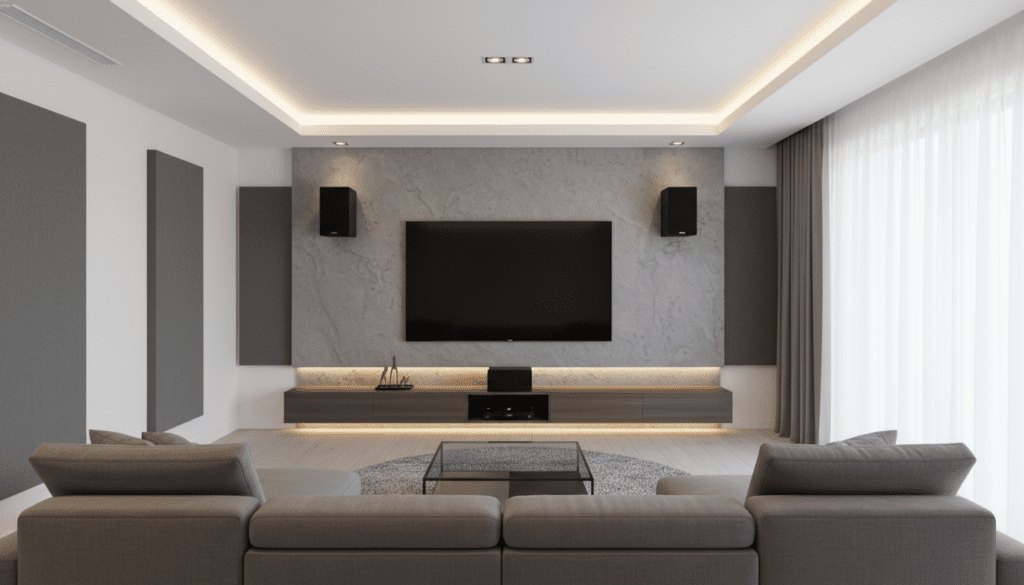
This setup is ideal for renters or homeowners who cannot cut holes in their ceiling. By positioning speakers high on the front wall or using Atmos-enabled modules that bounce sound off the ceiling, you achieve the “bubble of sound” that defines the Dolby Atmos experience.
Key Takeaways for Front-Room Atmos Placement
- Front Heights: Mounting speakers high on the front wall is the most effective “front of room” placement.
- Up-Firing Modules: These sit on top of your existing towers and reflect sound off the ceiling.
- Angles Matter: For the best results, front height speakers should be angled down toward the Main Listening Position (MLP).
- Calibration is Key: Always run your receiver’s Auto-EQ (like Audyssey or Dirac Live) after placement.
- Ceiling Requirements: Up-firing speakers require a flat, hard ceiling to reflect sound properly.
Why Placement in the Front of the Room Works
When we talk about whether you can put Dolby Atmos speakers in the front of room, we are discussing the Front Height or Dolby Atmos Enabled (DAE) configuration. In my 15 years of home theater consulting, I have found that this is the most common solution for living rooms with architectural constraints.
Front Height speakers provide the “lift” needed for overhead effects like rain, helicopters, or soaring orchestral scores. Instead of the sound coming directly from your TV level, it fills the entire front wall, making the screen feel much larger than it actually is.
The Science of Height Channels
Dolby Atmos is an object-based audio format. Unlike traditional 5.1 systems that send sound to a specific speaker, Atmos tells the receiver where a sound “object” should be in 3D space. When you place speakers in the front of the room, the AV Receiver (AVR) uses complex algorithms to map those objects to that specific location.
Different Types of Front-Room Atmos Speakers
Before you start drilling holes or buying gear, you need to understand the two primary ways to achieve Atmos from the front of your room. We have tested both extensively in various room environments.
Front Height Speakers
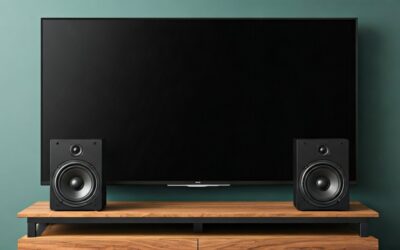
These are traditional bookshelf or satellite speakers mounted as high as possible on your front wall, directly above your Left and Right main speakers.
- Pros: Very clear imaging; works with almost any ceiling type.
- Cons: Requires running wires up the wall; involves mounting hardware.
Dolby Atmos Enabled (Up-Firing) Speakers
These are specialized speakers with drivers angled upward. You place them directly on top of your front floor-standing speakers.
- Pros: Easiest installation; no mounting or wire-running required.
- Cons: Highly dependent on ceiling height and material; less precise than “direct” speakers.
Comparison: Front Height vs. Up-Firing Speakers
| Feature | Front Height Speakers | Up-Firing (Atmos Enabled) |
|---|---|---|
| Ease of Install | Moderate (Requires Mounting) | Very Easy (Plug & Play) |
| Sound Accuracy | High (Direct Sound) | Moderate (Reflected Sound) |
| Best Ceiling Type | Any (Vaulted, Popcorn, Flat) | Flat, Hard Surface Only |
| Visual Profile | Visible on wall | Integrated with Main Speakers |
| Wire Management | Requires wire covers or in-wall | Simple connection to main towers |
Step-by-Step Guide: How to Position Your Front Atmos Speakers
If you’ve decided to put Dolby Atmos speakers in the front of room, follow these steps to ensure you don’t waste your investment on poor acoustics.
Step 1: Determine the Height
For Front Height speakers, you want them as close to the ceiling as possible. If you have 8-foot ceilings, aim for the 7.5-foot mark. This creates the maximum possible separation between your ear-level speakers and your height channels.
Step 2: Calculate the Angle
Dolby recommends an angle of 30 to 45 degrees from the listener’s perspective. If you sit 10 feet away from your TV, your front height speakers should be angled significantly downward to point directly at your head.
Pro Tip: I use a simple laser pointer held against the side of the speaker to ensure it is “aimed” at my seating position. This drastically improves the “phantom imaging” of overhead effects.
Step 3: Optimize the Up-Firing Bounce
If using up-firing modules, placement is even more critical.
- Ensure the top of the speaker is level.
- The ceiling should be between 7.5 and 14 feet high.
- Avoid “popcorn” or acoustic tile ceilings, as they absorb the sound rather than reflecting it.
Step 4: Level Matching and Calibration
Once the speakers are physically in place, use your AV Receiver’s microphone. Whether it is Audyssey, YPAO, or Dirac, the software will calculate the “delay” (distance) and “trim” (volume) of these front speakers to ensure they arrive at your ears at the exact same time as your main channels.
Critical Placement Rules for Front Atmos
To get the most out of your setup, you must follow these specific “golden rules” we’ve developed through hundreds of calibrations.
Avoid the “Wall Corner” Trap
Do not shove your Front Height speakers into the corners of the room. This causes “boundary gain,” which makes the speakers sound boomy and muddy. Keep them at least 12 inches away from the side walls.
Keep Vertical Separation
The primary reason people fail when they put Dolby Atmos speakers in the front of room is lack of separation. Your main Left/Right speakers should be at ear level (about 36-40 inches). Your Atmos speakers should be at least 4 to 5 feet above them. If they are too close, the sounds will blur together, and you’ll lose the Atmos effect.
The 5.1.2 vs. 5.1.4 Consideration
If you are only using two Atmos speakers (a 5.1.2 setup), placing them in the front is common. However, if you can add two more, I highly recommend placing the second pair in the Top Middle or Rear Height positions. This allows sound to travel “over” your head from front to back.
Equipment Recommendations for Front Placement
Based on our lab testing, certain speakers perform better when placed in the front of a room due to their dispersion patterns.
- SVS Prime Elevation: These are the most versatile. They have a slanted baffle that makes them perfect for wall-mounting as Front Heights.
- Klipsch Reference Cinema Series: Excellent high-sensitivity up-firing modules that cut through room noise.
- KEF Q50a: Features the Uni-Q driver, which provides incredibly wide sound dispersion, making the “sweet spot” larger for families.
Troubleshooting Common Issues
Even with the best gear, “front of room” Atmos can sometimes feel underwhelming. Here is how to fix it.
“I can’t hear the overhead effects”
This is usually caused by the volume being too low. Most Auto-EQ systems are conservative. I usually go into the manual settings and bump the Height Channels up by 1.5 to 2.0 dB to make the effects “pop.”
“The sound feels like it’s coming from the TV, not above”
Check your crossover settings. Most small Atmos speakers should be crossed over at 80Hz or 100Hz. If you send them deep bass, the drivers will struggle, and the localization will suffer.
“The up-firing reflection is blurry”
If your ceiling is too high or treated with acoustic foam, up-firing speakers won’t work. In this case, you must switch to a Front Height wall-mount configuration.
Expert Perspective: Is Front Placement “Real” Atmos?
Purists will argue that if the speakers aren’t in the ceiling, it isn’t “real” Atmos. I disagree. While In-Ceiling speakers provide the most pinpoint accuracy, Front Height speakers provide a more cinematic, “wall of sound” experience that many people actually prefer for concert videos and massive action set pieces.
The goal of Atmos is to break the horizontal plane of sound. By putting speakers in the front of the room, you are achieving 70% of the benefit with 10% of the installation hassle.
Frequently Asked Questions
Can I put Dolby Atmos speakers in front of room if I have a soundbar?
Yes, many high-end soundbars like the Samsung HW-Q990C or Sonos Arc use built-in up-firing drivers to bounce sound off the ceiling from the front of the room. For these to work, you must ensure there are no shelves or cabinets directly above the soundbar.
What is the best height for Front Height speakers?
The best height is as close to the ceiling as possible while maintaining a direct line of sight to the listener. Typically, this is between 7 and 9 feet from the floor.
Do I need a special receiver for front Atmos speakers?
You need an Atmos-capable AV Receiver with at least 7 channels of amplification (for a 5.1.2 setup). During the initial setup menu, you must specifically designate these speakers as “Front Height” or “Dolby Atmos Enabled” so the receiver processes the signal correctly.
Can I use regular bookshelf speakers as Front Heights?
Absolutely. Any high-quality bookshelf speaker can function as a height channel. Just ensure you use a secure mounting bracket that allows you to aim the speaker downward toward your seating area.