Quick Answer
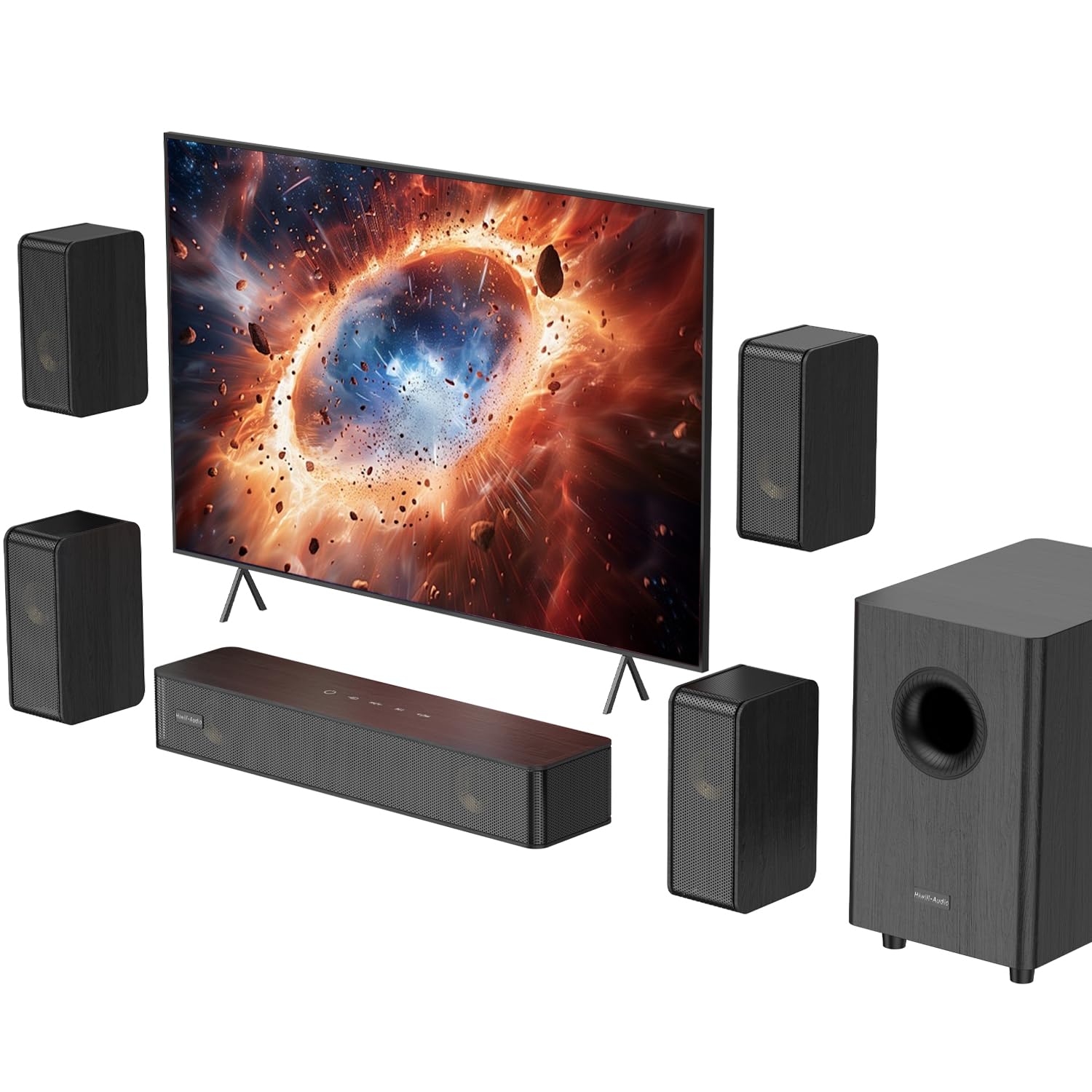
The best surround sound system for most homes in 2026 is the HiMuses M514. It is a true 5.1.4 Dolby Atmos setup with 900W of peak power, dedicated height channels, and HDMI eARC, so you skip a bulky AV receiver. If you want strong immersion for far less money, choose the ULTIMEA Aura A40 Pro.
Pros
- Flexible setup: use as a single bar or separate towers to fit various TV stands or room layouts
- Enhanced soundstage benefits movie and music lovers in open living areas
- Adjustable bass lets users fine-tune low-end without extra equipment
- Fire TV remote integration simplifies control for Fire TV owners
- Multiple connection options (HDMI-ARC, optical, AUX, Bluetooth) offer compatibility with various TVs and devices
Cons
- No visual indicator for bass level, making adjustments less precise
- TV remote control only works via HDMI-ARC; other connections may require separate remotes
- Not compatible with Insignia Roku TVs; other Roku models may need specific remotes
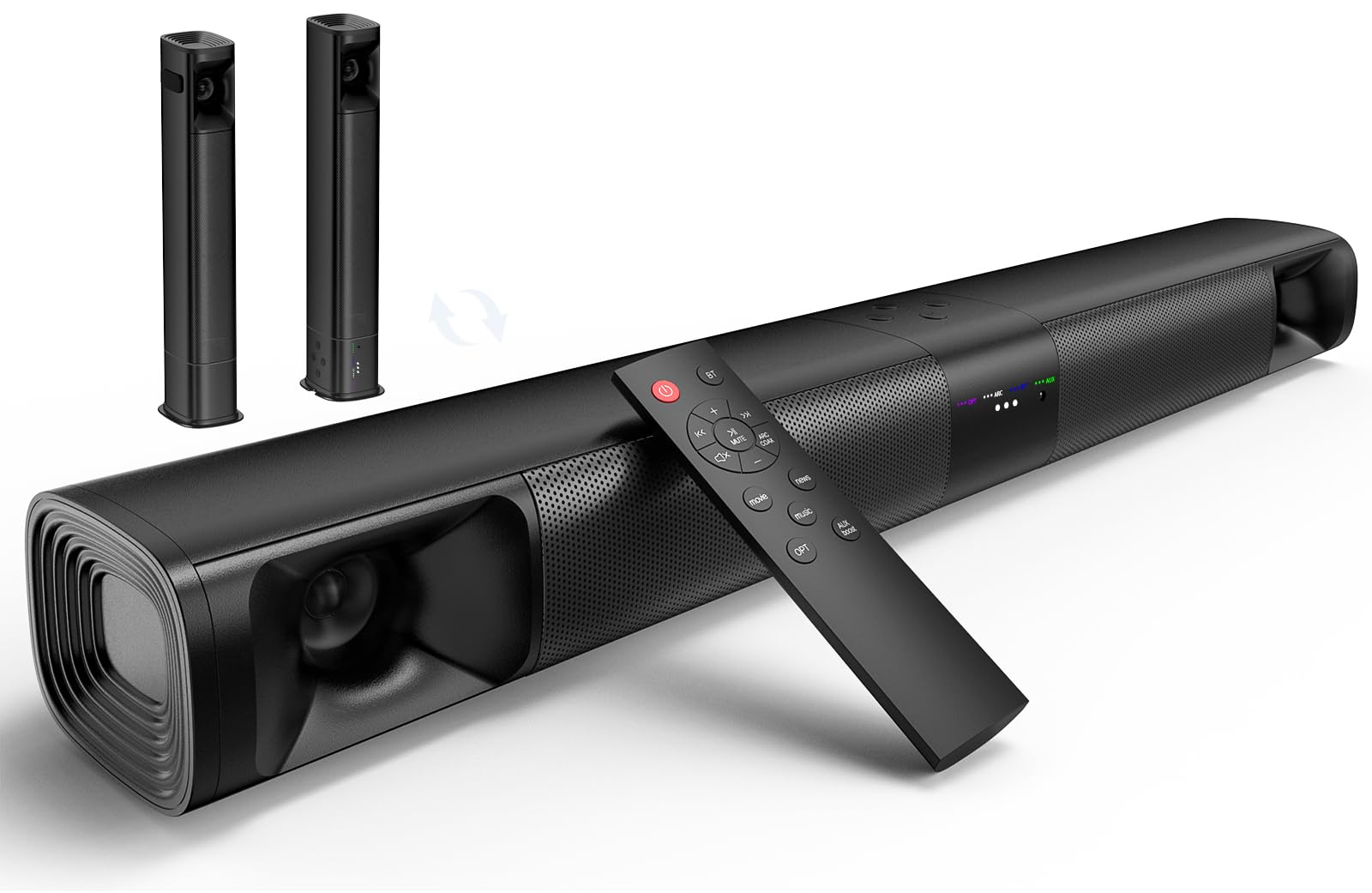
The Saiyin Sound Bar with Subwoofer (model B0DD3YWTT2) is a 100W detachable soundbar designed to serve as a flexible audio upgrade for smart TVs, especially in larger rooms. Its standout feature is the 2-in-1 design: you can use it as a single soundbar or separate it into two tower speakers using the included bases, which can create a wider stereo soundstage. This makes it a practical choice for buyers who want to adapt the speaker layout to their room or furniture without buying separate speakers.
In daily use, the horn tweeters and dual woofers aim to deliver clear dialogue and deep bass, which is beneficial for movies and music. The adjustable bass with 10 levels allows you to tailor low-end output, but the absence of an indicator means you might need to listen carefully to gauge the level. Bluetooth 5.3 enables easy streaming from your phone or tablet, and the DSP technology offers three sound modes (movies, music, news) to optimize audio for different content.
Connectivity is versatile with HDMI-ARC, optical, AUX, and Bluetooth, but note that TV remote control is only supported via HDMI-ARC (or with Fire TV/Roku remotes). If your TV lacks ARC, you'll rely on the included remote or the soundbar's buttons. The product is not compatible with Insignia Roku TVs, and other Roku devices may require a separate remote, which the seller can provide upon request.
Customer reviews (4.4 out of 5 stars from over 500 ratings) suggest general satisfaction with sound quality and value, but some users may have encountered setup or compatibility issues. It's important to verify your TV's ARC capability and physical dimensions before purchase, as the detachable towers will require extra floor space when separated.
This soundbar is best for buyers who want a budget-friendly, flexible audio solution for a medium-to-large room and are willing to verify compatibility with their TV. Avoid it if you need precise bass level adjustments or if your TV lacks ARC and you prefer unified remote control. Before buying, confirm your TV's HDMI-ARC port, measure the space for the towers, and check whether the included accessories (cables, wall mount) meet your needs.
Best Ownership Fit: This soundbar suits households with a medium-to-large living room or open-concept space where a wide stereo field is desired. It's ideal for renters or owners who want a flexible setup that can be rearranged without wall mounting. The detachable towers work well on either side of a TV console or on the floor, making it a good fit for those who prefer not to mount speakers on walls.
Daily Workflow: After initial setup, you'll likely use the soundbar for TV viewing, music streaming, and podcasts. You can switch between sound modes (movie, music, news) via the remote or buttons. If your TV supports ARC, you can control volume with your TV remote. For Bluetooth streaming, simply pair your phone or tablet. The detachable design means you can keep it as a single bar for daily use or separate the towers for movie nights to enhance the soundstage.
Likely Friction: The most notable friction is the lack of a bass level indicator, making it hard to know the exact setting. Also, if your TV doesn't have ARC, you'll need to use the included remote for volume, which adds an extra remote to your coffee table. The towers, when separated, require floor space and may be a tripping hazard if placed in walkways.
Before You Buy: Verify that your TV has an HDMI-ARC port for remote control integration. Measure the area where you plan to place the towers (when separated) to ensure they fit. Check the included accessories (optical cable, AUX cable, wall mount kit, remote) to see if they match your setup. Confirm the physical dimensions of the soundbar and towers to ensure they fit your TV stand or floor space.
Initial Setup: The soundbar can be used as a single bar or separated into two towers by attaching the included speaker bases. Connect to your TV via HDMI-ARC, optical, or AUX cable (cables included). For Bluetooth, pair your device. No setup is required for Fire TV remote compatibility, but other TVs may require ARC connection for remote control.
Controls: Use the included remote or the buttons on the soundbar to adjust volume, bass, and select sound modes. Note that the bass level has no indicator, so you'll need to listen to judge the level.
Cleaning: Periodically dust the speaker grilles and surfaces with a soft, dry cloth. Avoid using liquids or sprays that could damage the electronics.
Storage: When not in use, the soundbar can be kept as a single unit to save space. If you need to store the towers, keep the bases and any screws in a safe place for reattachment.
Maintenance and Replacements: The manufacturer offers a five-year warranty and free lifetime replacements for accessories like cables and remotes. If you need replacement parts, contact the after-sales team. No specific maintenance schedule is provided, but it's wise to keep the unit dry and away from heat sources.
TV Remote Compatibility: The soundbar works with Fire TV remotes out of the box. For Roku devices, you can request a compatible remote from the seller, but it is NOT compatible with Insignia Roku TVs. For other TV brands, remote control only works via HDMI-ARC connection.
Connection Options: HDMI-ARC, optical, AUX, and Bluetooth 5.3. Ensure your TV has at least one of these outputs. If you want to use the TV remote, HDMI-ARC is required.
Physical Fit: The soundbar can be placed on a TV stand or mounted on the wall using the included wall mount kit. When separated into towers, they need floor space. Measure the dimensions of the towers and the distance between your TV and seating area to ensure optimal soundstage.
Power Requirements: The soundbar is powered via AC adapter (included). Ensure you have a nearby outlet. The power cord length is not specified; verify if you need an extension cord.
Pros
- The 4-inch woven glass fiber driver and 1-inch tube-loaded aluminum dome tweeter target detail and treble clarity, which helps dialogue and film effects stay intelligible at moderate volume
- Multi-role flexibility means one model can fill every position in a 5.1 layout, giving you consistent tonal character across the front stage and surrounds
- The two-piece interlocking clamshell cabinet is engineered to control internal airflow and cabinet noise, a common weak point in small satellites
- Vertical, horizontal, tabletop, bookshelf, or floor stand mounting covers most furniture situations without forcing a room rearrangement
- Matte black finish and minimal styling make the speaker easy to place near a TV without visual clutter
Cons
- This listing is a single speaker, so stereo or surround buyers need to purchase two to five units and should calculate the full system cost before committing
- A 4-inch driver in a compact cabinet cannot deliver deep bass, so a subwoofer is effectively required for movies and bass-heavy music, adding another separate purchase
- These are passive speakers that need an amplifier or AV receiver with enough channels, which is an extra consideration for anyone coming from an all-in-one soundbar
The Bowers & Wilkins M-1 is a single compact satellite speaker built around a 4-inch woven glass fiber midrange driver and a 1-inch tube-loaded aluminum dome tweeter, and it is aimed at the buyer assembling a discreet home theater system rather than a traditional bookshelf stereo pair. The strongest reason to consider it is placement flexibility across every channel in a surround layout. The qualification is significant: it ships as one unit and needs a subwoofer to sound complete.
The driver pairing is the practical story here. A 4-inch glass fiber cone handles midrange and upper bass duties, while the separately housed aluminum dome tweeter, described as tube loaded and Nautilus inspired, handles treble. In daily use, that split matters most for dialogue and for the high-frequency detail in film effects and cymbals. What it does not do is reach low. Anyone expecting a small cabinet to reproduce cinematic rumble will be disappointed, which is why Bowers & Wilkins positions the ASW608 or PV1D subwoofer as a companion purchase.
Construction uses a clamshell cabinet formed from two interlocking sections, an approach intended to control airflow inside the enclosure and reduce cabinet resonance. Mounting is genuinely versatile. The speaker can sit vertically or horizontally on a table or bookshelf, the tabletop base adjusts so you can aim the speaker toward your seating position, and floor stands are supported for buyers who want to isolate the cabinet from furniture. Laying one on its side for center channel duty is an explicitly supported configuration.
The main compromises are structural rather than flaws in execution. Buying a single speaker means a stereo pair doubles the outlay and a five-channel setup multiplies it, then a subwoofer is added on top. These are passive speakers, so an AV receiver or amplifier with adequate channels is assumed. Anyone who wants one box, minimal wiring, and immediate results should look at a soundbar system instead.
Choose the M-1 if you want a small, tonally consistent speaker you can repeat across every surround position while keeping visual impact low. Hesitate if your budget cannot absorb multiple units plus a subwoofer, or if you want a single speaker that covers full range on its own. Buyers focused primarily on two-channel music at moderate cost are usually better served by a larger conventional bookshelf pair.
4-inch Woven Glass Fiber Driver: This handles midrange and upper bass, the range where voices and most instruments live. Glass fiber is used for cone stiffness, which helps a small driver stay controlled rather than smearing detail. The practical benefit is clearer dialogue from a cabinet small enough to sit beside a TV, though the size limits how low it can play without help.
1-inch Tube-Loaded Aluminum Dome Tweeter: The tweeter reproduces treble, and Bowers & Wilkins mounts it with tube loading derived from its Nautilus design work. The intent is to manage rear energy from the dome so it does not reflect back and color the sound. Listeners who care about the crispness of film effects, percussion, and vocal sibilance benefit most from this part of the design.
Interlocking Clamshell Cabinet: Two sections join to form an airtight enclosure engineered to control internal airflow and reduce unwanted cabinet noise. Small speakers are especially vulnerable to enclosure resonance because there is little internal volume to absorb energy. For the buyer, the payoff is a compact speaker that is meant to stay clean under load rather than sounding boxy at higher volumes.
Multi-Role Channel Assignment: One model can serve as a stereo pair, a horizontally mounted center channel, or any of the five positions in a surround system. Using identical speakers across channels keeps tonal character consistent as sound pans across the front stage. This suits buyers building a system gradually, since each added unit matches what is already installed.
Adjustable Tabletop Mounting: The base allows you to angle the speaker toward your seating position, and vertical or horizontal orientation is supported. Aiming matters because tweeters are directional, and an off-axis speaker loses treble detail. Anyone placing satellites on a media console below ear level, or on a high shelf above it, gains the most from this adjustment.
Subwoofer Pairing Path: Bowers & Wilkins identifies the ASW608 and PV1D powered subwoofers as intended partners, sold separately. This is less a bonus feature than a design assumption, since the M-1 is not built to cover deep bass. Budgeting for a subwoofer from the start is the realistic approach for movie watchers and anyone listening to bass-driven music.
Best For: Households building a discreet 3.1 or 5.1 home theater in a living room where large floorstanding speakers are not welcome. The compact matte black cabinet and multiple mounting options suit apartments, shared family spaces, and rooms where the TV wall doubles as the main decor. It also fits buyers who already own a Bowers & Wilkins subwoofer and want matching satellites.
Consider Alternatives If: You want full-range sound from a single pair without a subwoofer, in which case a larger bookshelf or floorstanding speaker makes more sense. Soundbar buyers who prioritize one-box simplicity and minimal wiring should stay in that category, since this is a passive speaker requiring an amplifier or AV receiver. Buyers working to a tight total budget should also price the complete system first, because a single unit is only one piece of it.
Setup and Daily Use: Plan channel roles before buying. Two units create a stereo pair, three cover a front stage with a horizontally placed center, and five fill a full surround layout. Each speaker connects to an amplifier channel with speaker wire, then sits on a table, bookshelf, or floor stand with the base angled toward your listening seat. Once positioned and wired, daily operation is handled entirely by your receiver.
What Sets It Apart: Most compact satellite systems are sold as fixed bundles, which locks you into a channel count. Selling the M-1 individually lets you start with a stereo pair, add a center later, and finish with surrounds, keeping tonal character identical throughout. The trade-off is that the flexibility comes with a per-unit cost structure and no included subwoofer.
Amplification Requirements: The M-1 is a passive speaker, so it needs an external amplifier or AV receiver channel to drive it. Count your channels before ordering. A stereo pair needs two, a front stage with center needs three, and a full 5.1 layout needs five plus a subwoofer output. Buyers replacing a powered soundbar will need to add a receiver to the plan.
Subwoofer Matching: Bowers & Wilkins names the ASW608 and PV1D powered subwoofers as intended partners, both sold separately. Because the 4-inch driver is not designed for deep bass, your receiver's crossover settings and a capable subwoofer do the heavy lifting below the satellite's usable range. Other subwoofers can work through a standard receiver, but the listed models are the ones the manufacturer references.
Mixing With Other Speakers: Using identical M-1 units across channels keeps timbre consistent when sound moves between speakers, which is the main audible advantage of a matched set. If you plan to mix the M-1 with a center channel or surrounds from a different series or brand, expect some tonal difference on panning effects, particularly across the front three channels.
Placement and Furniture: Vertical and horizontal orientation are both supported, along with tabletop, bookshelf, and floor stand placement. That range covers media consoles, wall shelving, and dedicated stands. The adjustable base helps when the speaker sits well above or below ear level, which is common on tall furniture or low TV cabinets.
Pros
- Sold individually, which lets you buy exactly the number of channels you need and add positions over time rather than committing to a fixed package.
- A single model used across front, center, and surround positions produces consistent timbre as sounds pan around the room, which is the main practical argument for matched satellite sets.
- The horizontal center-channel option means you do not have to source a different, wider cabinet to complete a 5.0 layout.
- Small cabinet plus stated table, bookshelf, and stand mounting options gives real placement freedom in rooms where floorstanders are not practical.
- The stated tweeter and cabinet construction details give a buyer something concrete to compare against other satellites instead of marketing adjectives alone.
Cons
- This listing is one speaker, not a pair or a system, so stereo requires two purchases and a 5.0 layout requires five, and the total cost scales accordingly at a per-unit price well into premium territory.
- No amplifier, receiver, sensitivity, impedance, power handling, frequency response, or dimension figures are supplied here, which are precisely the numbers needed to confirm your electronics and shelf can accommodate it.
- A 4-inch driver in a small sealed-style cabinet, combined with the manufacturer's own recommendation to add a subwoofer, signals that low bass is not part of the design brief; the rating shown is not accompanied by any published review excerpts here, so there is no user commentary to corroborate performance.
The Bowers & Wilkins M-1 satellite speaker in matte white, sold as a single unit under ASIN B00BK7PNIG, suits a buyer deliberately assembling a compact multi-channel system who already owns a receiver or amplifier and plans to add a subwoofer. Its strongest argument is a matched, multi-role cabinet that can fill every channel position. The principal reservation is that everything else in the chain is your responsibility and your expense.
The market position is legible from the product data itself. This is part of what the manufacturer calls a mini theater series, meaning small cabinets meant to disappear into a living room while a separate subwoofer carries the low end. That is a distinct category from a bookshelf pair intended to play full-range music on its own, and from an all-in-one soundbar or powered speaker set. It targets someone who has accepted the separates approach and wants small enclosures rather than large ones.
The verified features translate into fairly clear consequences. A 4-inch woven glass fiber woofer and 1-inch tube-loaded aluminum dome tweeter is a two-way arrangement in a compact box, so expect the design emphasis to fall on midrange clarity and treble detail rather than weight. The clamshell cabinet, described as two interlocking sections that control airflow and reduce noise, is a claim about cabinet-borne coloration, not about output. Vertical or horizontal orientation, an adjustable tabletop element for aiming, and floor stand compatibility mean placement is unusually adaptable for a speaker this size.
The limitations point some buyers elsewhere. If you want two channels of music with usable bass and no subwoofer, a larger bookshelf speaker is the more direct answer. If you want simplicity, a powered or active system removes the amplifier question entirely. If you need to verify that your receiver can drive this speaker, note that no impedance, sensitivity, or power handling figures appear in the supplied data, and no dimensions or weight are listed either, so shelf and bracket planning cannot be confirmed from this listing alone.
Qualified recommendation: worth shortlisting if you are building a matched satellite array around an existing amplifier and subwoofer and value a single cabinet that works in every position. Before buying, confirm the electrical specifications and physical dimensions with the manufacturer, and count how many units your intended layout actually requires, since the per-unit price compounds quickly.
Strong Match: The buyer building a compact 5.0 or 5.1 home theater who already owns a receiver and a subwoofer, and who wants every channel handled by the same cabinet. The M-1's multi-role design, covering left, right, surround, and horizontal center duty, is the clearest supported reason to choose it, because timbre stays consistent as effects move across the soundstage.
Also Consider It If: You are extending or repairing an existing setup rather than starting one. Because this is sold as a single unit, it works for adding a center channel to a stereo pair, adding rear surrounds to a front three, or replacing one damaged speaker in a matched array without disturbing the rest.
Also Consider It If: Placement is your binding constraint. A small clamshell cabinet with vertical or horizontal orientation, an adjustable tabletop for aiming at the seating position, and stand compatibility gives you more mounting paths than most conventional bookshelf designs.
Not the Best Fit: Anyone who wants full-range sound from the speaker alone, or who wants a plug-and-play solution. The manufacturer's own guidance is to add a separate powered subwoofer, and no amplification is included, so a buyer without electronics on hand faces additional purchases before hearing anything. Buyers who need confirmed impedance, sensitivity, or dimensional data before committing will also find this listing incomplete.
Decision in One Sentence: Buy the Bowers & Wilkins M-1 satellite speaker in matte white if you are assembling a matched compact surround array around an amplifier and subwoofer you already own, provided you first verify its electrical and physical specifications directly with the manufacturer and budget for every channel you intend to fill.
Consider It For:
- Building a timbre-matched multi-channel system where one model covers front, center, and surround positions.
- Adding a single channel to an existing setup, since the unit is sold individually rather than only in packaged sets.
- Rooms where cabinet size dictates the choice, given the compact clamshell enclosure and multiple mounting orientations.
- Buyers who want a defined in-brand subwoofer pairing path, with the ASW608 and PV1D named by the manufacturer.
- Listeners prioritizing midrange and treble detail, which is where a 4-inch glass fiber driver and 1-inch aluminum dome tweeter are aimed.
Pass If:
- You expect meaningful bass without a subwoofer, since the manufacturer positions a separate sub as part of the intended system.
- You need a powered or self-contained speaker, because no amplification is described as included in the supplied data.
- You are buying a full surround layout on a fixed budget, as the per-unit cost multiplies across five positions.
- You require published impedance, sensitivity, frequency response, or dimensional figures before purchase, none of which appear in the supplied product data.
What the supplied data confirms: The M-1 is described as a wired speaker intended to be added in pairs for stereo or in five units for a full surround layout, with one unit mountable horizontally to serve as a center channel. Mounting options listed include vertical or horizontal placement on a table or bookshelf, an adjustable tabletop element for aiming toward the listening position, and the use of floor stands to reduce unwanted resonance.
Subwoofer pairing: The manufacturer names the ASW608 and PV1D powered subwoofers as companions, both sold separately. That gives you a stated in-brand option, though it does not rule out other subwoofers and does not imply any tested crossover behavior.
What you must verify yourself: No impedance, sensitivity, recommended amplifier power, frequency response, connector type, cabinet dimensions, weight, or bracket standard is provided in the supplied data. Each of those is decision-relevant. Impedance and power handling determine whether your receiver can drive the speaker safely; dimensions and weight determine whether a shelf, stand, or wall bracket will hold it; connector type determines what cable terminations you need. Confirm all of these with Bowers & Wilkins or an authorized dealer before ordering, particularly if you are matching this unit to an existing array or a wall mount already installed.
Note on product identity: This listing is for a single M-1 satellite in matte white. If you intend a stereo pair or a five-channel layout, confirm the quantity in your cart and the finish on every unit, since a mismatched finish cannot be corrected after installation.
Pros
- Very small footprint at about 4.2 by 4.2 by 4.3 inches per cabinet, which makes them practical as rear or height channels in rooms where full-size speakers are impossible to place.
- Adjustable wall brackets covering 170 degrees horizontally and vertically allow precise aiming, useful when speakers must sit high on a wall and fire down toward seated listeners.
- The mounting hanger includes a shockproof element intended to reduce vibration transfer into the wall, which matters if you are mounting onto hollow drywall or a resonant panel.
- A 3-inch full-range driver handles the whole band from one cone, an approach the manufacturer connects to vocal clarity and one that keeps the enclosure simple.
- Included brackets, screws, screwdriver, and four bass port bungs mean the physical installation kit is complete out of the box.
Cons
- These are passive speakers with no built-in amplification and no Bluetooth, and speaker wire is not included, so anyone without an existing amplifier or receiver plus cable will need to budget for both before hearing any sound.
- The marine grade waterproof claim is conditional rather than automatic: the dual bass reflex ports must be sealed with waterproof sealant, which is not listed among the included items, and plugging those ports changes the vented tuning the bass performance is built around.
- Core matching specifications such as impedance, sensitivity, and frequency response are not published in the supplied product information, and the 15W figure suggests modest output, which leaves buyers with powerful receivers or large rooms guessing about a safe pairing.
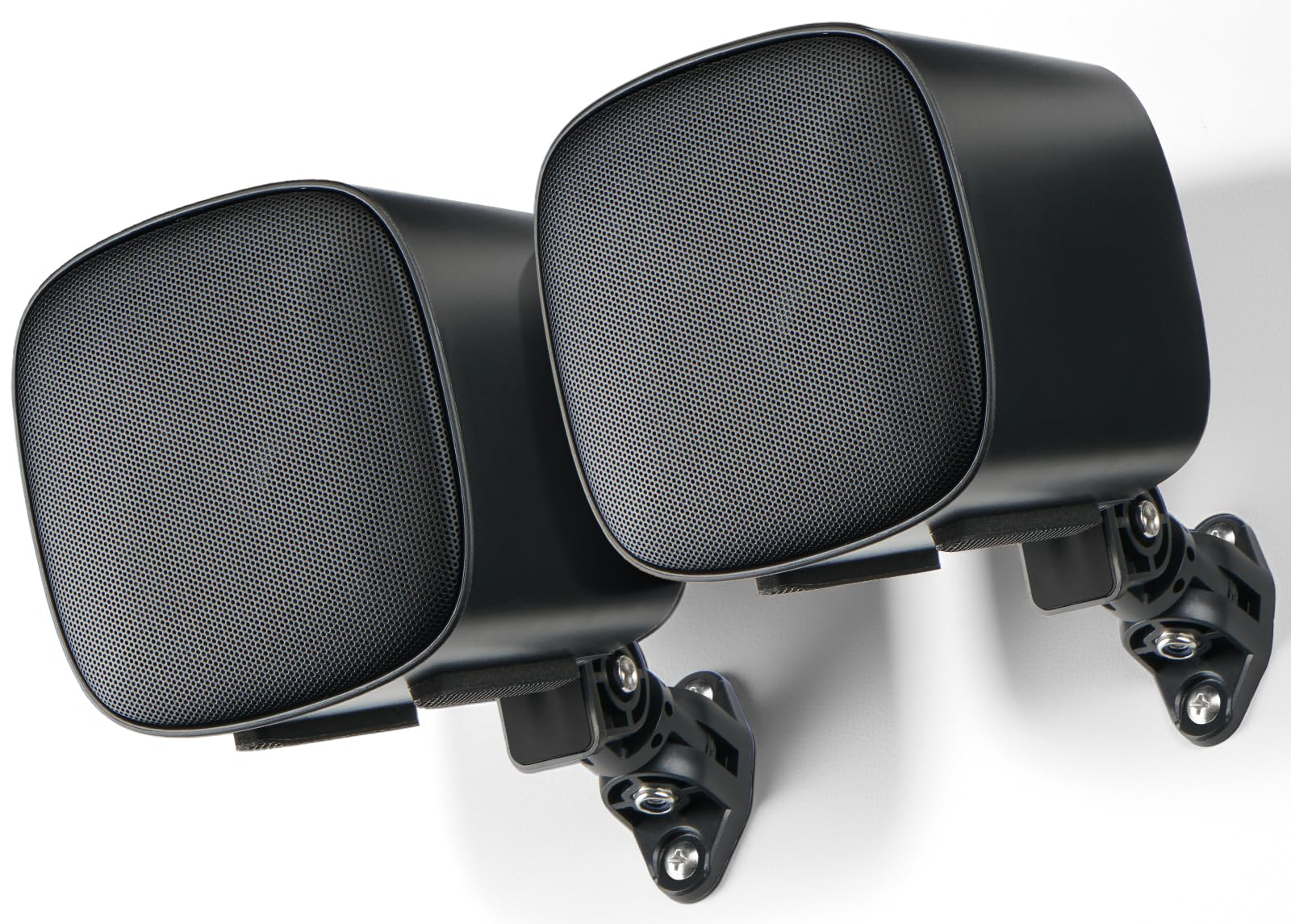
The Saiyin Passive Bookshelf Speakers are a compact stereo pair aimed at listeners who already own an amplifier or AV receiver and need small, wall-mountable satellites for a surround system, a secondary room, or a covered outdoor space. Their strongest argument is physical: each cabinet measures roughly 4.2 by 4.2 by 4.3 inches. The qualification is unavoidable, since they produce no sound without external amplification.
Each speaker uses a single 3-inch full-range driver rated at 15W, paired with a dual bass reflex port arrangement. A one-driver design skips the crossover entirely, which is part of why the manufacturer emphasizes vocal and midrange clarity. In practical terms, expect these to work best on dialogue, acoustic material, and background listening at moderate levels. The 15W rating and the driver size both point toward near-field or supporting roles rather than serving as the main left and right channels in a large living room.
Installation hardware is where this pair earns its keep. Two wall brackets are included with screws and a screwdriver, and the manufacturer specifies 170 degrees of adjustment both horizontally and vertically. That range matters when speakers sit high on a wall and need to be angled down toward seated listeners. A shockproof element built into the mounting hanger is intended to limit vibration passing into the mounting surface. Four bass port bungs also ship in the box.
The limitations are worth weighing carefully. No Bluetooth is included, speaker wire is not supplied, and the waterproof capability only applies after you seal the ports with waterproof sealant and fit the bungs, a step that converts a vented cabinet into a sealed one and will alter the bass character. Impedance, sensitivity, and frequency response figures are not provided, which complicates amplifier matching.
Buy these if you need genuinely small, aimable satellites to fill out an existing amplified system and value mounting flexibility over raw output. Hesitate if you want plug-and-play playback or reliable outdoor use without a sealing project. Anyone seeking a single-box wireless solution or full-range main speakers should look at a different product category.
3-Inch Full-Range Driver: One cone reproduces the entire frequency band, so there is no crossover splitting the signal between separate woofer and tweeter units. That simplicity is why the manufacturer highlights midrange and vocal reproduction. Listeners who mainly play dialogue-heavy movies, podcasts, or acoustic music benefit most, while anyone chasing sparkling treble extension or deep low end from a driver this size should temper expectations.
Dual Bass Reflex Ports: Two vents per cabinet move air to extend low-frequency output beyond what a sealed box of this volume would manage. The practical payoff is more perceived body from a very small enclosure. The trade-off is placement sensitivity, since ported designs generally interact with nearby walls and corners, so you may need to experiment with distance from the wall to avoid boomy or thin results.
15W Rating and 4.2-Inch Cabinet: The power rating and the roughly 4.2 by 4.2 by 4.3 inch footprint together define the realistic job for this pair: supporting channels, desktop listening, or a small secondary space. Buyers gain placement freedom on narrow shelves, wall corners, and above doorways. Anyone expecting main-channel volume in a large open-plan room is asking more than these dimensions suggest.
170-Degree Adjustable Wall Brackets: Both brackets swivel and tilt through 170 degrees horizontally and vertically, letting you aim each cabinet at the seating position after mounting rather than before. This solves the common surround-installation problem of speakers stuck firing across the ceiling. A shockproof element in the hanger is intended to keep cabinet vibration from transferring into drywall and creating rattles.
Port Bungs and Conditional Waterproofing: Four bungs are supplied so the reflex ports can be plugged, and the manufacturer states that waterproof performance requires sealing those ports with waterproof sealant in addition to fitting the bungs. This is a one-way modification in spirit, since sealing converts the cabinet from vented to closed. Outdoor buyers should plan the sealant purchase and accept a different bass balance afterward.
Amplification Is Mandatory: These are passive speakers, so they need a stereo amplifier, integrated amp, or AV receiver with speaker binding posts or spring clips. Connecting them to a phone, tablet, or a line-level output alone will produce nothing. Buyers replacing old wireless speakers should confirm they own suitable amplification first, because that component drives both the cost and the eventual sound quality more than the cabinets do.
No Wireless Path: Bluetooth is explicitly absent. Any streaming has to happen upstream through the amplifier, a receiver with network features, or a connected source device. This suits anyone building around existing gear and rules out buyers who want a self-contained wireless pair for a bedroom or office desk.
Cabling You Supply: Speaker wire is not included, so plan the run length from your amplifier to each mounting position before ordering. Wall-mounted rear channels usually need longer runs than shelf placement, and outdoor or patio installs add distance plus routing considerations. Buying cable in the right gauge and length at the same time avoids a stalled installation.
Amplifier Matching Caveat: Impedance and sensitivity are not published in the supplied information, and the stated rating is 15W. Owners of high-powered receivers should start at conservative volume levels and avoid driving these hard, particularly if used as surrounds in a system calibrated around larger main speakers. If your system routinely runs loud, a higher-rated satellite is the safer match.
Surround and Multi-Room Roles: The manufacturer positions this pair for home theater surround use, and the compact dimensions plus aimable brackets support that role. They also fit small desktop or workshop systems fed by a modest amplifier. Using them as front left and right channels in a sizable room is where the size and power rating start working against you.
Plan Placement Before Drilling: Start by choosing mounting points that keep both speakers roughly equidistant from the listening position and within reach of your amplifier via speaker wire. Because the brackets adjust through 170 degrees in both axes, exact wall height is less critical than usual, but port behavior means distance from the wall still affects bass. Test the sound with the speakers temporarily positioned before committing to holes.
Mounting Hardware Included: Two brackets, the necessary screws, and a screwdriver ship in the box, so basic installation does not require extra purchases beyond wall anchors appropriate to your surface. Drywall, brick, and wood each call for different fixings, and the supplied screws may not suit every substrate. The shockproof element in the hanger is there to reduce vibration transfer, which is most noticeable on thin hollow walls.
Wiring the Pair: Run speaker cable from your amplifier to each cabinet, keeping polarity consistent between the two channels so the stereo image holds together. Measure runs generously and route cable along baseboards, through conduit, or behind trim for a tidy result. Since no wire is supplied, this step needs to be sorted before installation day.
Outdoor Sealing Procedure: Waterproof use is not automatic. The manufacturer specifies sealing the dual bass reflex ports with waterproof sealant along with fitting the included bungs. Treat this as a deliberate modification rather than a reversible setting, and buy suitable sealant separately since it is not listed among the included items. Expect the low-end response to change once the ports are closed.
Ongoing Care: Outdoor or patio installations benefit from a covered position out of direct rain and sun, and periodic checks of the sealed ports and bracket fasteners are sensible after seasonal temperature swings. Indoors, upkeep is minimal: keep the driver free of dust, avoid pushing volume beyond comfortable levels given the 15W rating, and re-tighten bracket adjustments if repeated aiming loosens them.
Pros
- Easy setup for non-tech-savvy users: claims less than one minute to get 5.1 surround working without rear speakers.
- Dialogue clarity benefit for viewers who struggle to hear speech over effects, thanks to VoiceMX technology.
- App control provides deep tuning options (EQ, presets, surround levels) for users who want to tailor sound to their room.
- Bluetooth 5.4 offers stable, low-latency streaming for music and gaming, reducing sync issues.
- Compact design with built-in side-firing drivers saves space and avoids the clutter of rear speaker wiring.
Cons
- Wired subwoofer limits placement options; you'll need to route the cable from the soundbar to the sub's location.
- Physical dimensions and weight are not provided, so you must verify the soundbar fits your TV stand or wall mount before buying.
- No customer reviews yet, so long-term reliability and real-world performance are unverified; consider waiting or checking other sources.
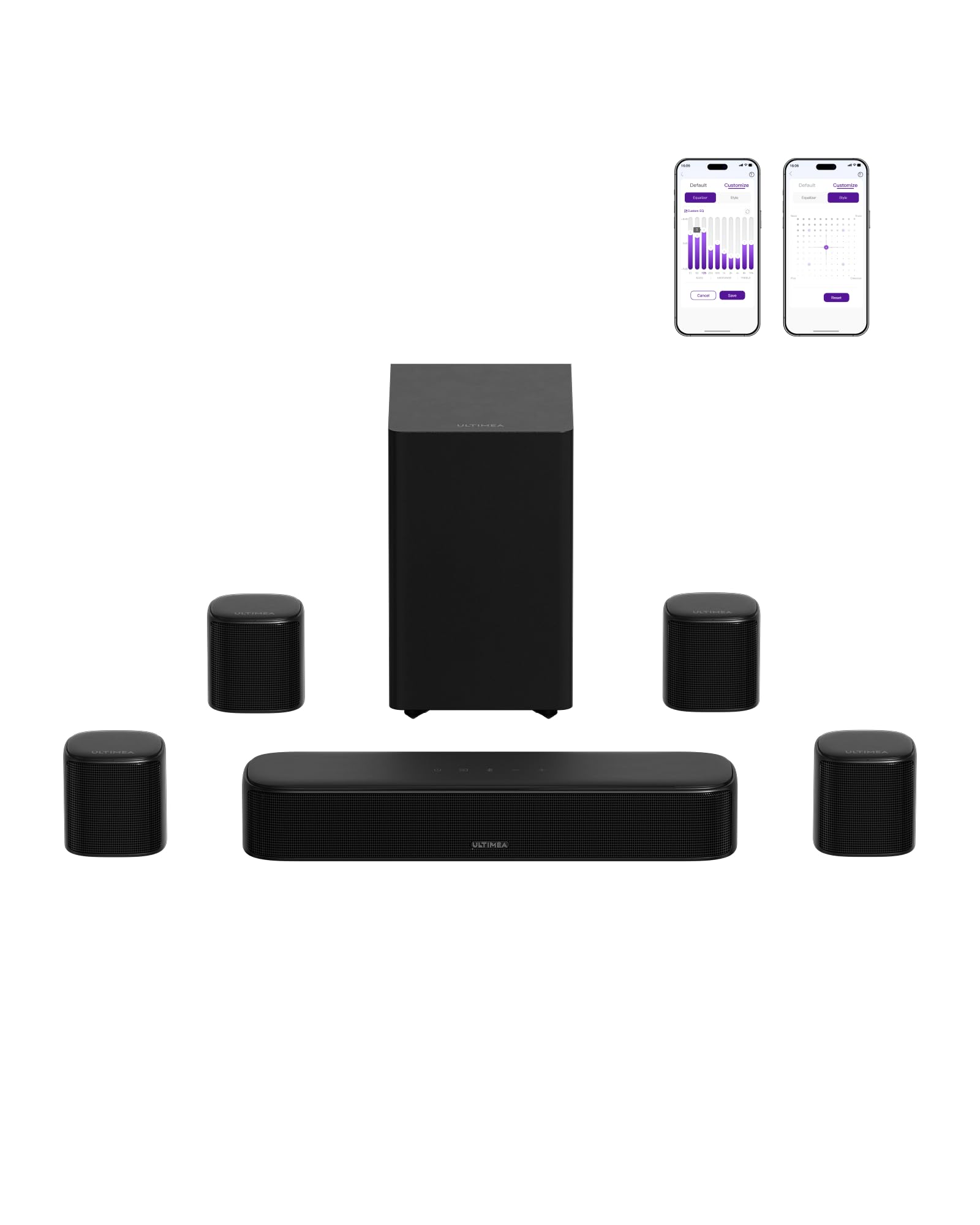
The ULTIMEA 5.1CH Surround Sound Bar with Dolby Atmos is designed for home theater enthusiasts who want an immersive 5.1-channel experience without the complexity of rear speakers. Its key selling point is a simplified setup: five built-in speakers, including side-firing drivers, create a wide soundstage, and the manufacturer claims setup takes under a minute. This makes it an attractive option for renters, apartment dwellers, or anyone who dislikes running speaker wires across the room.
For daily use, the soundbar's VoiceMX technology is a standout, automatically enhancing dialogue clarity by separating speech from background effects. This is particularly useful for watching movies with loud action sequences or listening at low volumes. The included wired wooden subwoofer, with an 18mm high-excursion driver, promises deep bass for cinematic impact, but its wired nature means you'll need to plan its placement carefully relative to a power outlet and your TV setup.
Connectivity is future-proofed with HDMI eARC, which supports lossless Dolby Atmos 5.1 audio at up to 37 Mbps, and Bluetooth 5.4 for stable wireless streaming. The Ultimea app adds a 10-band graphic EQ, 121 sound presets, and 13 adjustable surround levels, allowing you to fine-tune the audio to your room's acoustics. However, the app's functionality and reliability are not yet verified by customer reviews.
While the soundbar is positioned as a plug-and-play solution, there are critical unknowns: physical dimensions are not provided, so you must verify that it fits your TV stand or wall mount. Additionally, the wired subwoofer's cable length is not specified, which could affect placement flexibility. Since there are no customer reviews yet, long-term durability and real-world performance remain uncertain.
Who should buy this? If you're a renter or have a compact living space and want an easy 5.1-channel Atmos experience without rear speakers, this soundbar is worth considering. Who should avoid it? If you need a wireless subwoofer or have a large room that requires true rear speakers for optimal surround, this may not meet your expectations. Before purchasing, confirm your TV's eARC compatibility, measure your TV stand, and check the subwoofer cable length with the manufacturer.
Best Ownership Fit: This soundbar suits apartment dwellers, renters, or anyone with a small-to-medium living room who wants a 5.1-channel surround experience without the hassle of rear speakers. It's also a good fit for those who prefer app-based customization and have a TV with eARC support.
Daily Workflow: After a quick physical setup (placing the soundbar and subwoofer, connecting to TV via HDMI eARC), daily use involves turning on the TV and soundbar, which should auto-connect via CEC. For streaming music, you can pair your phone via Bluetooth 5.4. The Ultimea app allows you to adjust EQ and surround levels on the fly, and OTA updates keep the system current.
Likely Friction: The most significant friction is the wired subwoofer, which restricts placement options. You'll need to route the cable from the soundbar to the sub, which might not be ideal for all room layouts. Additionally, the lack of published dimensions means you might face fit issues with your TV stand or entertainment center.
Before You Buy: Verify your TV has an HDMI eARC port to take full advantage of Dolby Atmos. Measure the space where you plan to place the soundbar and subwoofer. Confirm the subwoofer cable length is sufficient for your setup. Check whether the soundbar includes a wall-mounting kit or if you need to purchase one separately, as this is not specified.
According to the manufacturer, setup is designed to take less than one minute. This likely involves connecting the soundbar to your TV via HDMI eARC, plugging in the subwoofer, and powering both. The soundbar has five built-in speakers, so no rear speaker placement is needed. However, the exact setup steps are not detailed in the product data, so you should refer to the user manual or manufacturer's instructions for precise guidance.
For daily operation, the soundbar supports HDMI CEC, allowing unified control with your TV remote. You can also use the Ultimea app to adjust sound settings, but the app's setup process (e.g., Wi-Fi connection, account creation) is not described. Bluetooth 5.4 enables easy pairing with phones or tablets for music streaming.
Maintenance is minimal: you may need to dust the soundbar and subwoofer periodically. The subwoofer is wired, so ensure the cable is not damaged. There are no replaceable parts mentioned, but the app supports OTA updates, which can be performed as needed. For cleaning, use a soft, dry cloth; avoid liquids. Since no specific cleaning instructions are provided, always consult the manual.
If you have questions about wall-mounting, cable management, or the app setup, contact ULTIMEA's customer support before purchase to ensure the product fits your needs.
TV Compatibility: For full Dolby Atmos, your TV must have an HDMI eARC port. If your TV only has ARC, you may still get standard Dolby Atmos but not lossless quality. Check your TV's manual to confirm eARC support.
Physical Fit: The soundbar's dimensions are not provided, so measure your TV stand or wall space to ensure it fits. The wired subwoofer also has a footprint that needs to be accommodated.
Bluetooth: With Bluetooth 5.4, you can stream from any Bluetooth-enabled device, but it's not specified if it supports multipoint or codecs like aptX.
App Compatibility: The Ultimea app is required for advanced controls; check if it's available for your smartphone's OS (iOS/Android) and if it requires a network connection to function.
Pros
- Real height channels provide authentic overhead effects, ideal for Dolby Atmos content.
- Dedicated center speaker ensures clear dialogue, beneficial for dialogue-heavy movies and TV.
- 900W peak power can fill a large room, suitable for big living spaces.
- Wooden cabinets improve sound quality and aesthetics, appealing to design-conscious buyers.
- Separate speakers allow flexible placement, fitting various room layouts.
Cons
- Requires multiple speakers and a wired subwoofer, needing ample space and wiring, not ideal for small apartments.
- No built-in streaming or wireless connectivity, so external sources are needed, limiting convenience.
- Only 11 reviews so far, so long-term reliability and performance are less established.
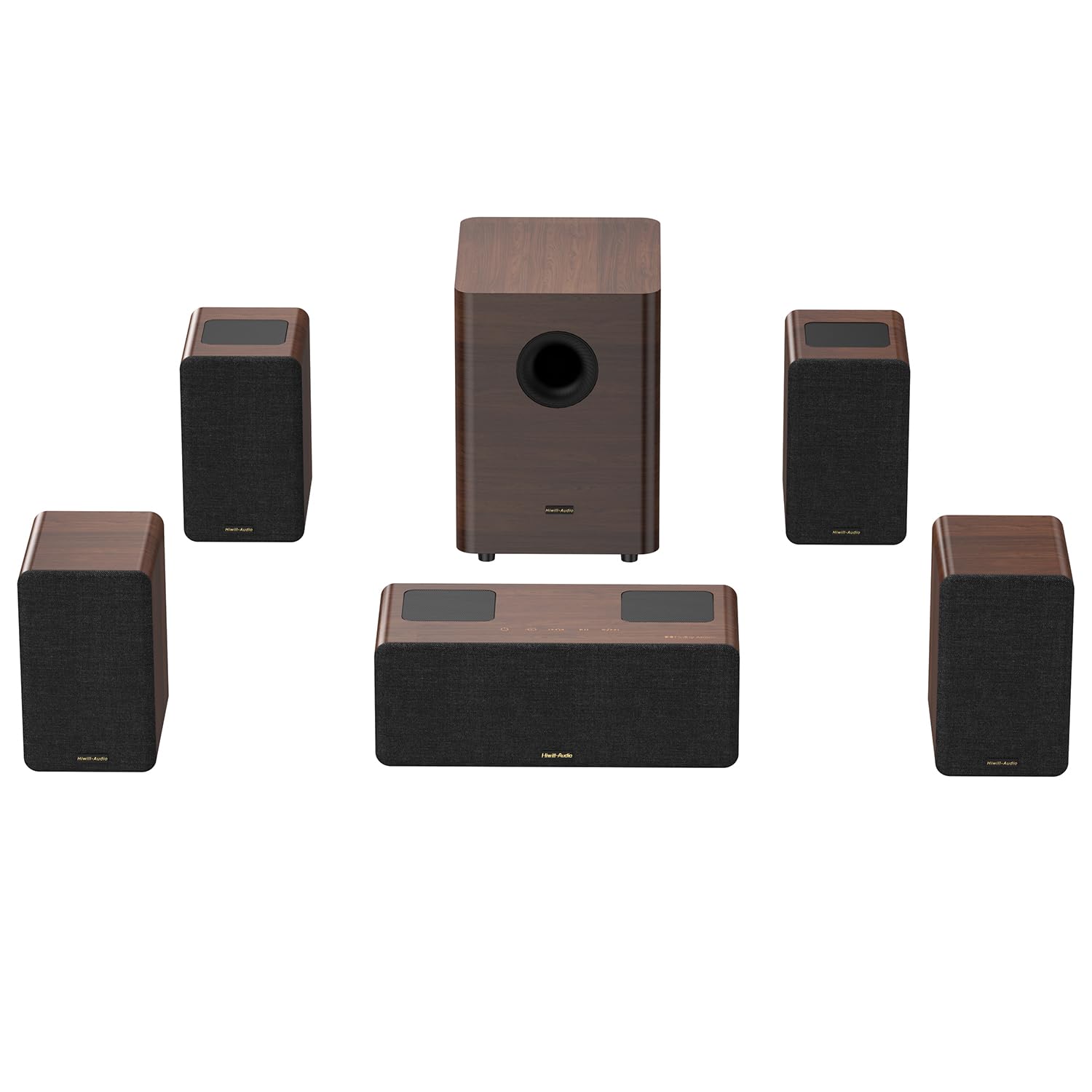
The HiMuses M514 is a true 5.1.4 channel Dolby Atmos home theater system designed for movie enthusiasts who want an immersive, cinematic audio experience without the limitations of a soundbar. With 16 drivers and 900W peak power, it delivers room-filling sound with precise channel separation. The best-fit buyer is someone with a dedicated media room or large living area who values authentic surround sound and is willing to accommodate a multi-speaker setup.
Key features include four up-firing height channels that create real 3D Atmos effects, a dedicated center channel for clear dialogue, and a 13.5L subwoofer that reaches 25Hz for deep bass. The independent crossovers ensure each driver handles the right frequencies, reducing distortion and preserving tonal balance. This translates to a wide soundstage and detailed audio for movies, music, and gaming.
Setup involves placing five satellite speakers, a center channel, and a wired subwoofer, which requires ample space and cable management. The system is designed for easy connection to an AV receiver (not included) and is best for users comfortable with traditional home theater configurations. The handcrafted wooden cabinets add a premium look but also add weight, so proper shelving or stands are needed.
Overall, the M514 offers excellent value for those seeking genuine Atmos performance. The main trade-off is the space and wiring required compared to a soundbar. If you prioritize simplicity and minimal footprint, a soundbar might be a better choice. However, for an authentic home theater experience, the M514 is a strong contender.
Best For: Home theater enthusiasts who have a dedicated room or large living space and want a genuine 5.1.4 Dolby Atmos setup with separate speakers.
Why It Fits: The system includes four up-firing height channels, a dedicated center speaker, and a subwoofer, delivering authentic 3D audio that soundbars cannot match.
Think Twice If: You live in a small apartment, prefer a minimalist setup, or dislike managing multiple speakers and wires.
Bottom Line: Choose the HiMuses M514 for a true Atmos experience, but be prepared for the space and wiring commitment.
True 5.1.4 Channel Layout: Includes an independent center speaker, four surround speakers, and four up-firing height channels for a genuine Dolby Atmos experience.
16 Drivers: Rose-gold aluminum-magnesium alloy drivers provide fast response and low distortion, revealing micro-details in audio.
Independent Crossovers: Each speaker has a precisely tuned crossover to direct frequencies correctly, reducing distortion and preserving tonal balance.
Handcrafted Wooden Cabinets: Enhance acoustic warmth and reduce resonance, while adding a premium aesthetic.
900W Peak Power: Delivers room-filling sound with cinematic scale, suitable for larger rooms.
Pros
- Immersive 7.1-channel surround: Four physical surround speakers (two front, two rear) create a more enveloping soundstage than typical soundbars.
- Dialogue clarity: VoiceMX technology isolates and boosts vocal frequencies, reducing the need to rewind to catch dialogue.
- Customizable audio: The Ultimea app offers a 10-band EQ and 121 presets, allowing you to fine-tune sound to your room and preferences.
- Strong bass response: The subwoofer's 18mm driver and tuned cabinet deliver deep bass down to 45 Hz for action scenes and music.
- Wireless rear speaker: The right rear speaker connects wirelessly, reducing cable clutter compared to fully wired systems.
Cons
- Wired rear speaker setup: The left rear speaker must be wired to the right rear speaker, which may limit placement flexibility in some rooms.
- Requires space: With four surround speakers plus a subwoofer, you need enough room to place them properly for optimal effect.
- No mention of Dolby Atmos or DTS:X: The system is 7.1ch, but it does not specify support for object-based audio formats, which may matter to some buyers.
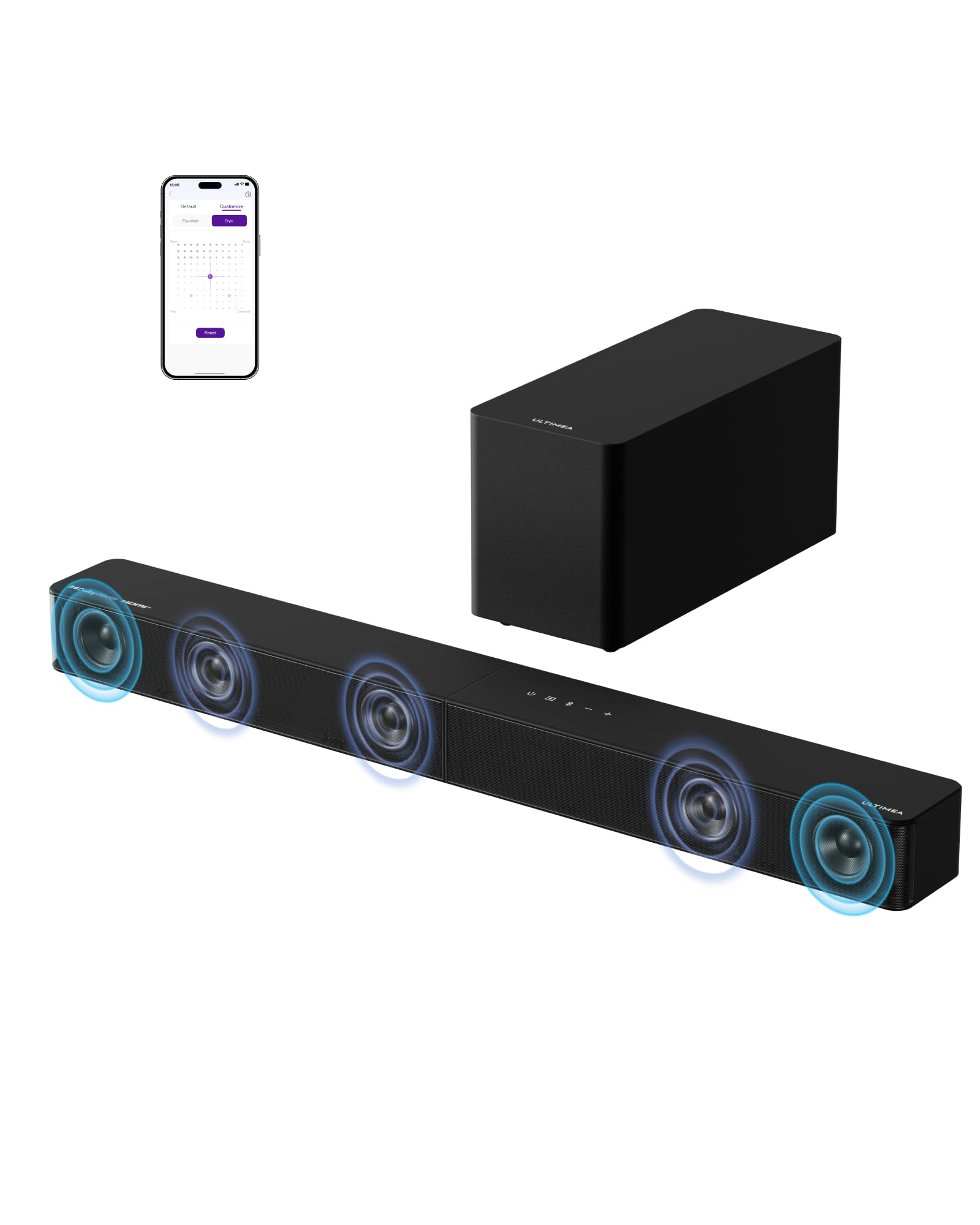
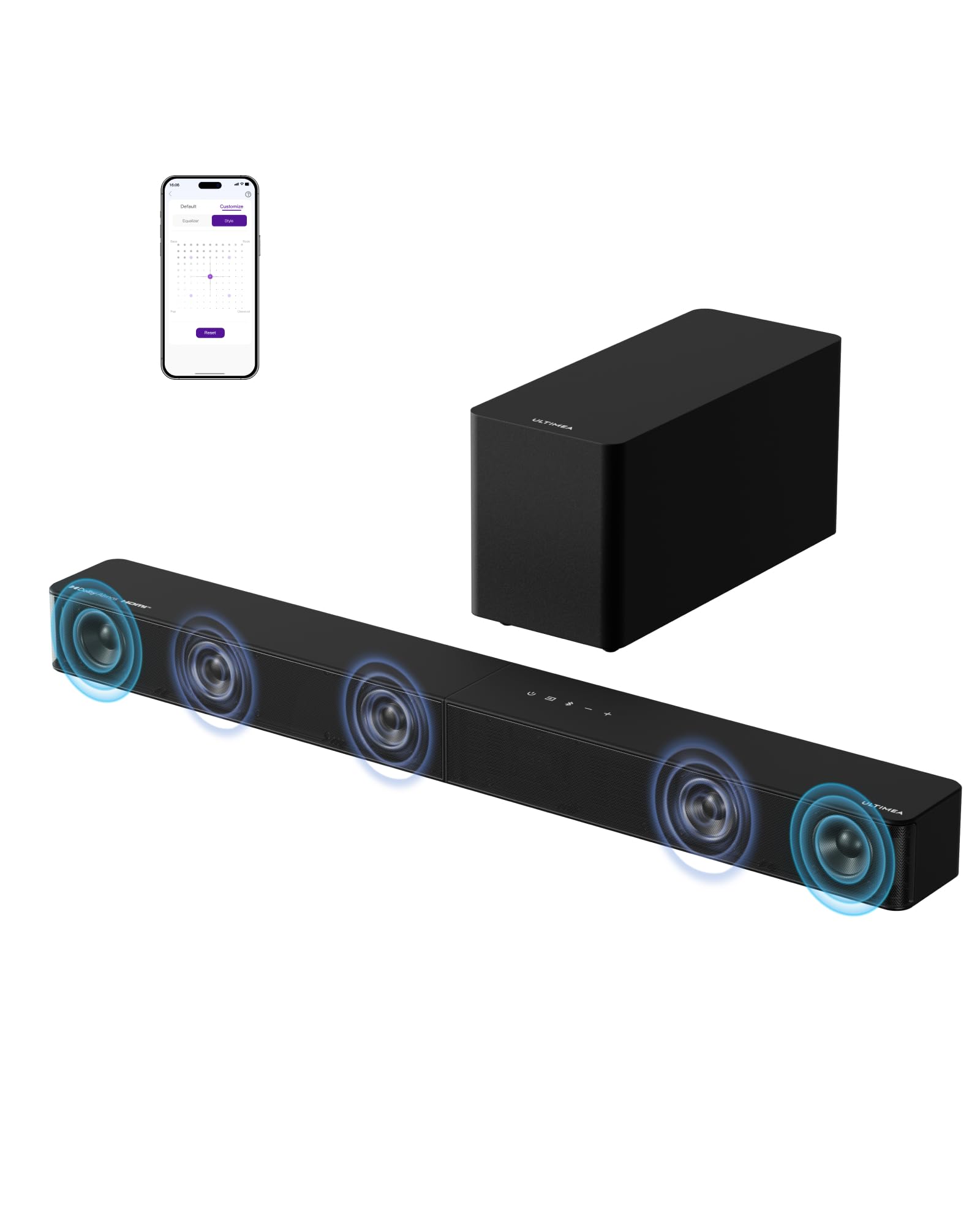
The ULTIMEA Aura A40 Pro is a 7.1-channel soundbar system designed for TV and movie enthusiasts who want a true surround sound experience without the complexity of a full AV receiver and separate speakers. It includes a soundbar with three main channels, two wired front surround speakers, two rear surround speakers (one wireless, one wired), and a wireless subwoofer. This system is best suited for medium to large living rooms where you can place the surround speakers behind or to the sides of your seating area.
The standout feature is the combination of VocalMatrix and VoiceMX technologies, which work to extract and enhance dialogue. This is particularly useful for movies and TV shows with quiet dialogue and loud effects, as it reduces the need to constantly adjust volume. The BassMX subwoofer adds deep, punchy bass down to 45 Hz, making action scenes and music more impactful. The 7.1-channel configuration with four physical surround speakers provides a more immersive soundstage than a typical 5.1 soundbar, with audio coming from all directions.
Setup is relatively straightforward: the soundbar connects to your TV via HDMI ARC, optical, or auxiliary. The front surround speakers plug directly into the soundbar, while the right rear speaker connects wirelessly to the soundbar, and the left rear speaker wires to the right rear speaker. This hybrid approach reduces some cable clutter but still requires placing the rear speakers near power outlets and running a wire between them. The included Bluetooth 6.0 ensures stable wireless streaming from your phone or tablet, and the Ultimea app provides extensive control over sound settings.
One limitation is the wired connection between the rear speakers, which may limit placement flexibility if you want to position them far apart. Additionally, the system does not explicitly support Dolby Atmos or DTS:X, so if you are looking for object-based audio, you may need to consider other options. The system also requires adequate space for all speakers to achieve the full effect, so it may not be ideal for small apartments or minimalist setups.
Overall, the ULTIMEA Aura A40 Pro offers a compelling package for its price, delivering a true 7.1-channel surround experience with excellent dialogue clarity and deep bass. The main reason to buy is the immersive audio and vocal enhancement, while the main reason to hesitate is the wired rear speaker setup and lack of object-based audio support. If you have the space and want a dedicated surround system without breaking the bank, this is a solid choice. If you prefer a simpler soundbar or need Atmos support, you might look elsewhere.
VocalMatrix Algorithm: This technology intelligently extracts vocals from the original audio and redistributes them across the rear surround channels. It maintains accurate vocal positioning while preserving ambient sounds, making dialogue clearer and more focused, especially in scenes with heavy background noise.
7.1ch Surround Sound System: The system includes three main channels and four surround speakers, providing a true 7.1-channel experience. This creates a more immersive soundstage than a 5.1 system, with audio coming from all directions, ideal for movies and gaming.
VoiceMX Technology: This uses advanced DSP to isolate and enhance vocal frequencies in real time, boosting the 120Hz-6kHz range. It ensures clear dialogue in any scene, reducing the need to rewind or turn on subtitles.
BassMX Technology: The subwoofer features an 18mm high-excursion driver and a 6.1L tuned cabinet, delivering bass down to 45 Hz. This provides deeper punch and better control for action scenes, explosions, and music beats, enhancing the overall impact.
Bluetooth 6.0: Offers a more stable and responsive connection than Bluetooth 5.3, with faster syncing and stronger resistance to interference. This ensures smooth audio streaming and low latency, perfect for movies, music, and gaming.
Advanced App Control: The Ultimea app allows you to fine-tune your listening experience with a 10-band graphic EQ, 121 sound presets, and 13 adjustable surround levels. You can tailor audio to your room layout and personal preferences, and OTA updates keep the system current.
Best For: The ULTIMEA Aura A40 Pro is ideal for home theater enthusiasts who want a true 7.1-channel surround sound experience without the complexity of a full AV receiver setup. It is also great for people who struggle to hear dialogue clearly and want a system that enhances vocal clarity.
Consider Alternatives If: If you have a small room or limited floor space, the multiple speakers may be overkill. Also, if you require Dolby Atmos or DTS:X support for object-based audio, this system does not mention those formats, so you may need to look at other options.
Setup and Daily Use: The soundbar connects to your TV via HDMI ARC, optical, or auxiliary. You will need to place the front surround speakers near the soundbar, and the rear speakers behind or to the sides of your seating area. The right rear speaker connects wirelessly, but the left rear speaker must be wired to the right rear speaker, so plan accordingly.
Maintenance Requirements: No specific maintenance is mentioned, but as with any audio equipment, keep the speakers and subwoofer clean and dust-free. The subwoofer's large cabinet may require occasional dusting.
What Sets It Apart: The combination of four physical surround speakers and advanced vocal enhancement technologies sets it apart from typical soundbars. The app control with 121 presets and 13 surround levels offers a high degree of customization that is rare at this price point.
Movies and TV Shows: The 7.1-channel surround with four physical speakers creates an immersive experience, and the vocal enhancement ensures you never miss dialogue. Action scenes benefit from the deep bass and surround effects.
Music: With the BassMX subwoofer and customizable EQ, music sounds punchy and detailed. The Bluetooth 6.0 connection provides stable streaming from your phone or tablet.
Gaming: The low-latency Bluetooth and surround sound enhance gaming immersion, allowing you to hear directional cues clearly. The app's presets can be tailored for gaming.
Sports and Live Events: The crowd noise and commentary are well separated, making you feel like you are in the stadium. The vocal enhancement keeps commentary clear.
Pros
- Clear dialogue and detailed highs due to dedicated tweeters and alloy drivers
- Deep, adjustable bass from the 5.25" subwoofer enhances action scenes and music
- Stable hybrid wireless connection for rear speakers minimizes dropouts and pairing hassles
- Flexible EQ presets and manual adjustments for bass, treble, and rear volume
- Wide connectivity: ARC, Optical, AUX, USB, Bluetooth 5.3 for easy integration
Cons
- Does not support Dolby Atmos or DTS, so it won't decode those formats (though it can still play them in stereo)
- Rear speakers are not fully wireless; they require a cable linking them, which may limit placement options
- Designed for small rooms; may not fill large open spaces with the same impact
The N512 is a 5.1.2 virtual surround sound system engineered for small to medium rooms where a full wired home theater setup is impractical. It’s best for viewers who want an immersive, room-filling audio experience without the complexity of a true multi-speaker receiver setup, and who value build quality and stable connectivity over format licensing. The system includes a soundbar, four surround speakers, and a 5.25-inch subwoofer, all powered by 11 drivers.
The most important features are the 11 drivers, including dedicated tweeters, full-range, and up-firing drivers, housed in solid wood cabinets with aluminum-magnesium alloy diaphragms. This material choice is designed to deliver clear, powerful, and immersive sound for everyday content, not just Dolby-encoded movies. The Discrete Spatial Expansion technology and four surround speakers expand the horizontal soundstage, enhancing directionality and depth. The up-firing drivers add a vertical dimension, creating a more spacious 3D audio effect. The 5.25-inch down-firing subwoofer provides adjustable bass (-6 to +6) for customizable low-end punch.
Design and controls are user-friendly. The system supports ARC, Optical, AUX, USB, and Bluetooth 5.3, making it compatible with most TVs and devices. Setup is straightforward: the rear speakers connect wirelessly to the main unit but are linked together with a single cable, ensuring a stable, loss-free signal without pairing or dropouts. The included remote allows quick input switching, preset EQ modes (Movie, Music, News, Game), and fine-tuning of bass, treble, and rear surround volume. A Night Mode and LED display off option are also available.
While the N512 excels in many areas, it has limitations. It does not support Dolby Atmos or DTS decoding, so you won't get object-based surround from those formats, though it can still play them in stereo. The rear speakers are not fully wireless; they require a cable between them, which may restrict placement in some rooms. Additionally, the system is optimized for small rooms; larger open spaces may not benefit from the same immersive effect.
In summary, the N512 is a strong choice for small-room owners who prioritize clear dialogue, deep bass, and a stable, wired-reliable connection. Its premium build and adjustable sound settings make it a versatile performer for movies, music, and gaming. However, if you are a Dolby Atmos enthusiast or need a fully wireless setup, you may want to consider other options. For the right buyer, it offers excellent value in its category.
11 Premium Drivers: The N512 uses 11 drivers with aluminum-magnesium alloy diaphragms, including tweeters, full-range, and up-firing drivers. This material choice reduces distortion and improves clarity, making dialogue crisp and music detailed. It’s a step up from typical plastic drivers, benefiting anyone who notices harsh highs or muddy mids.
Discrete Spatial Expansion Technology: This proprietary tech uses the four surround speakers to widen the soundstage and enhance directional cues. It creates a more enveloping experience for movies and games, even without native surround formats. Ideal for viewers who want a sense of immersion from everyday content like TV shows and sports.
Upward-Firing Drivers: Two upward-firing drivers bounce sound off the ceiling to add height and depth, simulating a 3D effect. This makes action scenes feel more expansive and adds realism to overhead effects. Great for small rooms where wall-mounted surround speakers are not feasible.
Hybrid Wireless Rear Speakers: Rear speakers connect wirelessly to the main unit but are linked together with a single cable. This hybrid design ensures a stable, loss-free signal without pairing or dropouts, while still allowing flexible placement. It solves the common issue of wireless rear speakers disconnecting or lagging.
Adjustable Bass and EQ Modes: The 5.25" down-firing subwoofer has a bass control (-6 to +6) to tailor low-end output. Preset EQ modes (Movie, Music, News, Game) optimize audio for different content. Users can also adjust treble and rear surround volume, giving full control over the sound signature.
Best For: The N512 is ideal for small to medium-sized rooms where a full wired home theater system is overkill. It suits apartment dwellers, bedroom TV viewers, or anyone wanting an easy-to-setup surround experience without running wires across the room. It’s also great for those who value build quality and clear dialogue.
Consider Alternatives If: You are a home theater enthusiast who demands Dolby Atmos or DTS decoding, as this system does not support those formats. Also, if you need fully wireless rear speakers, the hybrid design (with a cable linking the rears) may not meet your expectations. For very large open spaces, a more powerful system might be necessary.
Setup and Daily Use: Setup is straightforward: connect the soundbar to your TV via ARC or Optical, plug in the subwoofer, and position the rear speakers. The rear speakers connect wirelessly to the main unit but need a cable between them. The remote allows quick switching between inputs and adjusting settings. Daily use involves selecting the appropriate EQ mode for your content and adjusting volume as needed.
Maintenance Requirements: No special maintenance is required beyond occasional dusting of the speakers and ensuring the subwoofer’s down-firing port is not blocked. The wood cabinets may need gentle cleaning with a dry cloth. The system is designed for long-term use with no consumables.
What Sets It Apart: Unlike many soundbars that use plastic enclosures and generic drivers, the N512 uses solid wood and aluminum-magnesium alloy drivers, which typically produce clearer, more durable sound. The hybrid wireless rear speakers also offer a unique balance of stability and placement flexibility. It focuses on everyday audio quality rather than chasing format support.
Initial Setup: The N512 is designed for simple plug-and-play installation. Connect the main soundbar to your TV using ARC (if available) or an Optical cable. The subwoofer and rear speakers are powered and connect wirelessly to the main unit, but the rear speakers must be linked together with the provided cable. There is no complex pairing process; the system is ready to use once powered on.
Placement Tips: For best surround effect, place the rear speakers behind your seating position, ideally at ear level. The subwoofer can be placed on the floor, but ensure the down-firing port has at least a few inches of clearance. The up-firing drivers should not be obstructed, so avoid placing objects on top of the soundbar.
Daily Use: Use the remote to switch between inputs (ARC, Optical, AUX, USB, Bluetooth) and select EQ modes. Adjust bass, treble, and rear volume to suit your content or preference. Night Mode reduces dynamic range for quiet late-night listening, and you can turn off the LED display if it distracts you.
Maintenance: Dust the wood cabinets and speaker grilles regularly with a soft, dry cloth. Avoid using liquid cleaners. Ensure the subwoofer’s port is free of dust and debris. The system has no user-serviceable parts, so if issues arise, contact support.
Pros
- Complete 5.0 speaker system at an entry-level price point, ideal for budget home theater setups
- Wall-mounting capability saves floor space and allows optimal speaker placement
- Horn tweeters provide efficient high-frequency output, beneficial for dialogue clarity
- Compact size suits smaller rooms or apartments without sacrificing surround sound
- Vintage design adds aesthetic appeal to living spaces
Cons
- Passive design requires an external AV receiver or amplifier; not included
- Speaker wires not included, adding to initial setup cost and planning
- No impedance or sensitivity specs provided, making amplifier matching uncertain
The Saiyin 5.0 Surround Sound Speakers are a five-speaker passive set designed for budget-conscious home theater enthusiasts who already own an AV receiver or amplifier. This set includes four identical satellite speakers (40W peak each) and a center channel (75W peak) for a total of 235W peak power, aiming to deliver a cinematic surround experience. The included wall-mounting hardware and keyhole/threaded inserts offer flexible placement, which is a practical advantage for saving floor space and achieving optimal sound positioning.
For daily use, the horn tweeter design is engineered to produce clear and dynamic highs, potentially improving dialogue clarity in movies and TV shows. The MDF cabinets with vintage-inspired finish are claimed to reduce resonance, which may contribute to fuller low frequencies. However, as a passive speaker set, it requires external amplification, and the lack of included speaker wire means you must factor in additional purchases and cable management.
Customer ratings (4.4 out of 5) suggest general satisfaction, but individual experiences vary. Some users may find the compact size ideal for small to medium rooms, while others might expect more bass from the satellites, which are not subwoofers. The absence of a subwoofer in this 5.0 system means low-end depth is limited, but that's typical for such packages.
Before purchasing, verify the impedance and sensitivity specs with the manufacturer to ensure compatibility with your receiver. Also, measure your room and speaker placement to confirm the included mounting kit fits your walls. This set is best for those who already have an AV receiver and want an affordable, space-saving 5.0 setup. Avoid if you need a powered system or expect a subwoofer for deep bass.
Best Ownership Fit: This speaker set is ideal for DIY home theater builders on a budget who already own an AV receiver or amplifier and prefer a compact, wall-mounted solution for small to medium-sized rooms.
Daily Workflow: Expect to connect each speaker to your receiver using speaker wire (not included). Once set up, you'll use your receiver to control volume and input. The speakers are passive, so they only require speaker wire connections; no power cords are needed.
Likely Friction: The biggest friction is the need to supply your own speaker wire and ensure your receiver can drive the speakers adequately. Additionally, without impedance ratings, you may need to research compatibility to avoid overdriving the speakers.
Before You Buy: Verify the impedance and sensitivity specifications with the manufacturer to ensure they match your receiver's output. Check the included mounting kit's hardware type (screws, anchors) against your wall material. Measure your room and speaker placement to ensure the compact size and mounting options work. Confirm that your receiver supports 5.0 channels and has enough power per channel.
Setup: This is a passive speaker set, so you must connect it to an external AV receiver or amplifier. Speaker wire is not included, so you'll need to purchase the appropriate gauge and length. The speakers feature keyhole mounts and threaded inserts on the back; the mounting kit is included, but you'll need tools for wall installation.
Compatibility: Before setup, confirm the impedance (typically 4-8 ohms) and power handling of the speakers with the manufacturer to ensure your receiver can drive them without distortion. Also, verify that your receiver has enough channels (at least 5) and supports the impedance.
Maintenance: The MDF cabinets can be dusted with a soft cloth. Avoid moisture and direct sunlight to preserve the finish. There are no user-serviceable parts; if a driver fails, contact the manufacturer for support. No specific cleaning instructions are provided, so handle with care.
Replacement Parts: No replacement parts are listed, so for any issues, you'd need to contact the manufacturer. This is a point to consider for long-term support.
Pros
- Versatile connectivity: Bluetooth, ARC, optical, and more ensure easy hookup to TVs, phones, and other devices
- Karaoke-ready with two mic inputs and echo control, ideal for family gatherings
- Switchable 5.1/2.1 modes allow adapting to content or room size
- Included cables (ARC, optical, antenna, AUX) reduce hidden costs
- Remote control provides independent volume adjustment for each speaker and subwoofer
Cons
- Peak power rating is misleading; real-world output is likely much lower, so manage expectations for loudness and bass depth
- No verified customer reviews yet, making it hard to gauge actual sound quality and durability
- Plastic front panels may feel less premium compared to all-wood designs
The Bobtot Home Theater Surround Sound System (ASIN B0DX1P33DP) is a budget-friendly 5.1-channel speaker package aimed at shoppers who want a more immersive TV and music experience without breaking the bank. With its 6.5-inch subwoofer, 800W peak power claim, and a host of inputs, it appears designed for casual home entertainment, movie nights, and even karaoke parties. However, the lack of verified customer reviews and the typical exaggeration of peak wattage in this price range mean you should approach with measured expectations.
This system positions itself as an all-in-one audio hub. The built-in receiver supports Bluetooth 5.3, ARC, optical, coaxial, AUX, USB, and SD card inputs, making it easy to connect a TV, phone, computer, or gaming console. The inclusion of ARC and optical cables in the box is a thoughtful touch, saving you from extra purchases. The 5.1/2.1 mode switch lets you choose between full surround and a simpler stereo-plus-subwoofer setup, which is useful for smaller rooms or when you prefer a more focused soundstage.
The subwoofer, with its 6.5-inch driver, is the centerpiece for bass. In practice, you can expect a noticeable rumble for explosions and music, but it won't match the depth of larger, more expensive subs. The satellite speakers, housed in MDF wood cabinets, should provide clear dialogue and effects, though the plastic front panels may feel less sturdy. The LED lighting and digital display add a party vibe, and the built-in FM radio with good reception is a bonus for those who still enjoy terrestrial radio.
However, there are significant limitations. The 800W peak power is a marketing figure; real-world RMS output is likely a fraction of that, so don't expect ear-shattering volume. Also, with zero customer reviews available, you can't rely on others' experiences for sound quality, reliability, or ease of setup. If you're an audiophile or need a system for a large room, you'd be better off with a more established brand or a soundbar with a wireless sub. But for a small to medium-sized living room, this could be a decent entry-level option.
In conclusion, the Bobtot Home Theater System offers a compelling mix of features for the price, especially if you value connectivity and karaoke. The main pre-purchase check is to confirm your TV has an ARC or optical output to take advantage of the best audio quality. If you're willing to accept that peak wattage is exaggerated and you're not expecting high-end fidelity, this system could be a fun, affordable addition to your home entertainment setup.
Strong Match: Budget-conscious shoppers who want an easy-to-set-up surround sound system for a small to medium-sized room, especially for TV shows, movies, and casual music listening.
Also Consider It If: You enjoy hosting karaoke nights or parties, thanks to the dual microphone inputs with echo and the LED lighting effects that create a festive atmosphere.
Not the Best Fit: If you're a home theater enthusiast seeking reference-quality sound, deep, authoritative bass, or a system that can fill a large open space, this likely won't satisfy. Also, if you prefer a minimalist setup, a soundbar might be more suitable.
Decision in One Sentence: The Bobtot Home Theater System is a feature-rich, budget-friendly choice for casual viewers and karaoke lovers, but be prepared for its power rating to be inflated and its performance to be modest.
Consider It For:
- Its wide range of connectivity options, including Bluetooth 5.3, ARC, optical, and USB, making it compatible with most TVs and devices.
- The karaoke feature with two mic inputs and echo control, which is rare at this price point.
- The included cables (ARC, optical, antenna, AUX) mean you don't have to buy extras.
- The 5.1/2.1 mode switch allows you to adapt the sound to your content or room size.
- The subwoofer and satellite speakers can produce a reasonably immersive experience for movies and music.
Pass If:
- You demand accurate, high-fidelity audio or powerful, room-shaking bass—this budget system won't match more expensive setups.
- You're concerned about reliability and performance without any verified customer reviews to back up the manufacturer's claims.
- You prefer a wireless, clutter-free setup—this system requires speaker wire connections.
- You have a very large room and need to fill it with sound—the system's actual output may be insufficient.
Comparison Table
| Product | Key Spec | Best For | Price Tier |
|---|---|---|---|
| HiMuses M514 Dolby Atmos System | 5.1.4 channels, 900W peak, HDMI eARC, upward-firing height drivers | Turnkey Atmos home theater without a separate AV receiver | Premium ($300–$1,000+) |
| ULTIMEA Aura A40 Pro | Four physical surround speakers, VocalMatrix dialogue DSP, active system | Movie nights that need clear voices and real rear speakers on a budget | Mid-range (under $150) |
| Bowers & Wilkins M-1 | Glass fiber drivers, aluminum dome tweeters, modular satellites | Custom rooms that already have (or will add) an AV receiver and subwoofer | Premium luxury (over $500 per pair) |
| Saiyin 5.0 Channel Retro Wood | Passive 5.0 satellites, wood cabinets, no built-in active subwoofer | Replacing thin TV or old passive speakers when an amplifier is already on hand | Entry-level (under $80 / under $100) |
These four options cover the real split in today’s market: complete active Atmos, value active surround, audiophile satellites, and a budget passive 5.0 set. Other listings in the widget below may be color, bundle, or generation variants of the same idea. Judge them by channel layout, whether amplification is built in, and whether bass is included.
The Differences Explained
Channel Count: 5.1.4 Height Versus Physical Surrounds Versus 5.0
The numbers on the box are not decoration. In a 5.1 system, the first digit is five ear-level speakers (left, center, right, and two surrounds) and the “.1” is a subwoofer. A 7.1 system adds two more side or rear speakers. A 5.1.4 Dolby Atmos system, which is the HiMuses M514 configuration, keeps that 5.1 bed and adds four height channels. Those extra drivers are physical upward-firing speakers that bounce object-based audio off the ceiling, so a cue can sit above you instead of only sliding left to right.
The ULTIMEA Aura A40 Pro does not match that 5.1.4 height count. It puts four physical surround speakers in the room, then uses digital signal processing, including its VocalMatrix dialogue algorithm, to keep voices locked in and to simulate height. That is still a large step beyond a single soundbar that only “virtualizes” rear channels, because speakers behind you outperform phantom surrounds. The Saiyin kit is a straight 5.0 array: five passive satellites and no dedicated active subwoofer, so you get real channel separation without a true .1 low-frequency channel unless you add a sub later. The Bowers & Wilkins M-1 speakers are not a complete theater. They are modular satellites you can stand vertically as surrounds or mount horizontally as a center, then pair with a separate subwoofer and receiver.
If the room can hide rear speakers, physical surrounds beat virtualization. If you also want a vertical soundstage from one boxed system, the M514 is the only full 5.1.4 Atmos package in this group.
Active Power Versus a Separate AV Receiver
The HiMuses M514 and the ULTIMEA Aura A40 Pro are active. Amplification lives in the system. You connect them to the TV and listen. The M514’s 900W figure is peak power for that integrated chain, not a receiver you still have to buy. That is why these kits fit living rooms that do not already have a rack of gear, and why the M514 can use high-fidelity crossovers inside the package instead of asking you to set them on an AVR.
The Saiyin 5.0 Retro Wood system and the Bowers & Wilkins M-1 are passive. They need speaker wire and an external amplifier or AV receiver. That extra box adds cost, heat, and setup, and it must match speaker impedance. Most home receivers are rated for 4, 6, or 8 ohms; a mismatch can overheat the amp or stress the drivers. The payoff is control: you choose the processor, the wattage, the subwoofer crossover, and the role of each satellite.
Budget math changes once the receiver is included. Saiyin satellites can land under $80 only if amplification already exists. B&W M-1 pairs cost over $500, and you still need a receiver plus a subwoofer before a movie has a full-range floor. For passive speakers, a useful shopping target is sensitivity of 85dB or higher; that rating is about how loud a speaker plays per watt, not a published number for every model here.
HDMI eARC Versus Optical Versus Speaker Wire
Format support follows the cable. Optical TOSLINK is limited to compressed 5.1. It cannot carry lossless Dolby TrueHD or a full Dolby Atmos bitstream. If you want object-based audio, HDMI eARC (Enhanced Audio Return Channel) is the path that matters. The HiMuses M514 is built around that idea: eARC from the TV into the system, with no separate receiver in the middle.
Passive satellites never decode Atmos by themselves. The B&W M-1 and Saiyin 5.0 speakers only reproduce what the receiver feeds them. Atmos, DTS:X, or plain Dolby Digital is the AVR’s job. That is more flexible, and more work. Optical remains fine for compressed TV shows; it is the wrong exclusive link if the selling point is height or lossless cinema tracks.
“Wireless” surround marketing needs the same caution. You often skip a long copper run from the TV to the rears, but the rear enclosures almost always need power from a wall outlet, or a short cable from a hub or subwoofer. Battery rears exist, but they need charging. Plan for power at every box even when the long speaker wire is gone.
What Each Price Tier Actually Buys
Entry-level, under $100, is the Saiyin 5.0’s home. Expect a clear upgrade over built-in TV speakers, wood cabinets that are denser than thin plastic, and authentic left/center/right/surround placement. Do not expect Dolby Atmos decoding or deep bass below about 50Hz from a 5.0 kit with no active sub.
Mid-range, about $100 to $300, is where the Aura A40 Pro sits. It is listed under $150, roughly 70% less than premium Dolby Atmos systems, while still delivering about 90% of the perceived spatial immersion for typical movie use. That value comes from four physical surrounds, an active design with a dedicated subwoofer in ULTIMEA’s 5.1-to-7.1 approach, and VocalMatrix dialogue processing, not from matching the M514’s four height channels.
Premium, $300 to $1,000 and up, is where true object-based kits and audiophile satellites live. The M514 spends that money on 5.1.4 architecture, 900W peak power, integrated crossovers, a wood-grain finish, and eARC. The M-1 spends it on glass fiber drivers and aluminum dome tweeters, then leaves bass, power, and decoding to the rest of your rack. As a general target, a strong surround chain wants a sub that reaches down to about 35Hz and satellites that stay clean toward 20kHz (human hearing runs from 20Hz to 20kHz). Only the complete active systems here try to cover that range out of the box.
Individual Reviews
HiMuses M514 Dolby Atmos System
The M514 is the all-in-one pick if you want a cinema-style dome of sound without building a component rack. It is a true 5.1.4-channel Dolby Atmos system: five ear-level speakers, one subwoofer channel, and four dedicated height drivers, with 900W of peak power, high-fidelity crossovers, HDMI eARC, and a wood-grain finish that looks closer to furniture than a plastic bar. Because the amplifiers and crossovers are in the system, you are not also shopping for a hot, bulky AV receiver just to parse an Atmos soundtrack.
The advantages are the ones most living rooms actually need. Physical height channels can place effects above the seat instead of only around it. eARC is the right TV connection for uncompressed, high-bitrate formats that optical cannot carry. The integrated layout also balances the frequency range as a set, rather than leaving you to mate tiny satellites to a random sub. For a plug-in theater that still uses real speakers, this is the strongest complete package in the group.
The trade-offs are price and flexibility. This is a premium system in the $300 to $1,000+ band, so it will not win a pure value contest against the Aura A40 Pro. You also give up the mix-and-match freedom of separate satellites: you cannot swap in a different center or a reference sub the way you can with Bowers & Wilkins speakers and an AVR. If you already own a serious receiver, the M514’s convenience is less of a gift and more of a duplicate.
ULTIMEA Aura A40 Pro
The Aura A40 Pro is the value pick for people who watch movies more than they tweak crossovers. It is an active system, so it plugs in without a separate receiver, and it is built around four physical surround speakers plus VocalMatrix, ULTIMEA’s dialogue algorithm. In this comparison it sits under $150, in the mid-range $100 to $300 band, and is described as costing about 70% less than premium Dolby Atmos systems while keeping about 90% of the perceived spatial immersion for everyday viewing.
Its real win is intelligibility plus placement. A dedicated dialogue process keeps speech from disappearing under explosions, which is the complaint that makes people ride the volume remote. Four real surround speakers still create a wraparound stage that a virtualized bar cannot match. ULTIMEA’s mid-range kits in this class also use DSP to simulate height and typically include a dedicated subwoofer, so you get a .1 bass foundation the Saiyin 5.0 set does not include.
It is not a substitute for true 5.1.4 Atmos. Height is processed, not delivered by four physical upward-firing channels like the M514. Cabinets and drivers are not in the same material class as Bowers & Wilkins glass fiber cones and aluminum dome tweeters. If you need object-based overhead precision or reference-grade midrange, spend up. If you need a living-room upgrade that solves muddy dialogue and missing rears without a four-figure invoice, this is the rational buy.
Bowers & Wilkins M-1
The M-1 is a satellite speaker, not a home-theater-in-a-box. It is aimed at people who already think in terms of an AV receiver, speaker wire, and a separate subwoofer. The drivers are the point: glass fiber cones for midrange clarity and aluminum dome tweeters for clean highs with very low advertised distortion. Each pair costs over $500, which puts even a modest five-channel layout deep into premium, audiophile-only territory before you add a sub or amplification.
The design is genuinely modular. You can place a unit vertically as a front or surround satellite or mount it horizontally as a center channel, which is useful when you want one voicing around the screen and around the sofa. Because these are passive, the receiver handles Dolby Atmos, DTS:X, or whatever codec your discs and apps provide. That is the high road if you care about swapping processors later, bi-amping, or building a dedicated room instead of dressing a TV stand.
The drawbacks are total cost and incomplete bass. High-end satellites like the M-1 are not meant to fill the low end; you need a dedicated subwoofer, and you must match the receiver’s 4-, 6-, or 8-ohm rating to the speakers. Setup is copper, calibration, and patience, not eARC into a single branded hub. Buy these when the room and the rack already exist. Do not buy them as a first surround system if you wanted something that works the night it arrives.
Saiyin 5.0 Channel Retro Wood System
The Saiyin 5.0 Retro Wood set is the budget passive kit for owners who already have an amplifier or AV receiver and want real channel separation for under $80. It is a 5.0 system: five satellites, wooden cabinets, and no dedicated active subwoofer in the package. The pitch is simple. TV speakers are tiny and centered in the chassis; five physically placed channels, even at this price, give you a left, a center, a right, and surrounds that actually come from the sides or rear.
Wood is the practical upgrade over cheap plastic boxes. Denser cabinets reduce some of the hollow resonance that makes low-cost speakers sound thin and shouty, and the retro styling is meant to look like small furniture rather than gadgets. If your old passive speakers are tired and you do not want to abandon a receiver you already own, this is an honest entry-level swap. It is still a large step up from a 2.0 detachable bar in terms of directional placement.
You must be clear about what is missing. There is no built-in amp, so this is not a TV-only plug-in. There is no dedicated active sub, so do not expect chest-hitting bass or a clean 35Hz floor; entry-level 5.0 sets in this tier are not the place to hunt for output below about 50Hz. There is no Dolby Atmos decoder in the speakers. Match impedance to the receiver, run speaker wire, and add a sub later if the mix feels thin. At under $100, that limitation is the point of the tier, not a surprise.
Which One Should You Buy?
If you want one system that behaves like a small cinema and you do not already own an AV receiver, buy the HiMuses M514. The 5.1.4 layout, 900W peak power, upward-firing height channels, and eARC connection are the shortest path to object-based audio with real speakers. It is the right answer for a main TV room where you will watch streaming Atmos titles and do not want to learn crossovers or pull speaker wire through the walls.
If the budget is the constraint, buy the ULTIMEA Aura A40 Pro. Under $150 it still gives you four physical surround speakers and VocalMatrix dialogue control, which solves the two problems that make cheap bars frustrating: no rear stage and voices that vanish under effects. Casual viewers who want immersion without a premium Atmos invoice should stop here rather than stretching for height drivers they will not calibrate.
If you are building a dedicated room around a receiver, the Bowers & Wilkins M-1 satellites are the specialist tool: glass fiber drivers, aluminum tweeters, and flexible horizontal or vertical placement, at over $500 per pair plus a subwoofer. If you only need to replace tinny passive speakers and you already have an amp, the Saiyin 5.0 Retro Wood set under $80 is the entry ticket. Do not pair either passive option with a TV optical output alone and expect a complete theater; the receiver and, for full-range movies, a subwoofer are part of the system.
FAQ
What is the difference between 5.1, 7.1, and 5.1.4 surround sound?
The first digit is the number of ear-level speakers (fronts, center, and surrounds). The second digit is the number of subwoofers, so “.1” means one sub. The third digit, used on Dolby Atmos systems, is the number of overhead or upward-firing height speakers. A 5.1 system is horizontal surround only. A 7.1 system adds two extra ear-level speakers. A 5.1.4 system, such as the HiMuses M514, adds four height channels on top of a 5.1 bed and can create a three-dimensional dome rather than a flat ring of sound.
Do wireless surround sound systems require any wires at all?
Usually, yes. “Wireless” almost always means you do not run a long speaker cable from the TV or soundbar to the rear of the room. The rear speakers themselves still need power. In most kits they plug into a wall outlet, or they take a short cable from a wireless hub or the subwoofer. True battery-powered rears exist, but they need regular charging. Assume every enclosure needs a power plan even when the long copper run is gone.
Is HDMI eARC required, or is an optical cable enough?
Optical is enough for compressed 5.1 TV audio. It is not enough for lossless Dolby TrueHD or a full Dolby Atmos bitstream. If the system’s selling point is Atmos or other object-based formats, connect the TV to the audio system with HDMI eARC. Passive speakers such as the B&W M-1 and Saiyin 5.0 do not replace that need; the AV receiver in front of them is what must receive eARC or another HDMI bitstream.
Can I use the Saiyin or Bowers & Wilkins speakers without an AV receiver?
Not as a complete, self-powered theater. Both are passive. They need an amplifier or AV receiver and speaker wire, and the receiver’s impedance rating (typically 4, 6, or 8 ohms) should match the speakers. The HiMuses M514 and ULTIMEA Aura A40 Pro are the options in this comparison that include amplification and can connect more directly to a TV.
Do I still need a dedicated subwoofer?
For movies with real low-frequency effects, yes, unless the package already includes an active sub. The Saiyin set is 5.0 and has no dedicated active subwoofer. The B&W M-1 satellites are designed to be crossed over to a separate sub. A useful target when you add one is extension down to about 35Hz. Avoid parking a strong sub in a corner if the bass turns muddy; move it (the “subwoofer crawl”) until the low end is even at the seat.
Affiliate Disclosure
As an Amazon Associate, we may earn a commission from qualifying purchases made through links in this article, at no extra cost to you. Rankings and recommendations are based on the published configurations and specifications compared above, including channel layout, amplification type, connectivity, and listed price tiers. Prices, bundles, and firmware features can change; confirm the current listing, included pieces, and connection ports before you buy.