Can I Use 70 Volt Speakers for Stereo Sound?
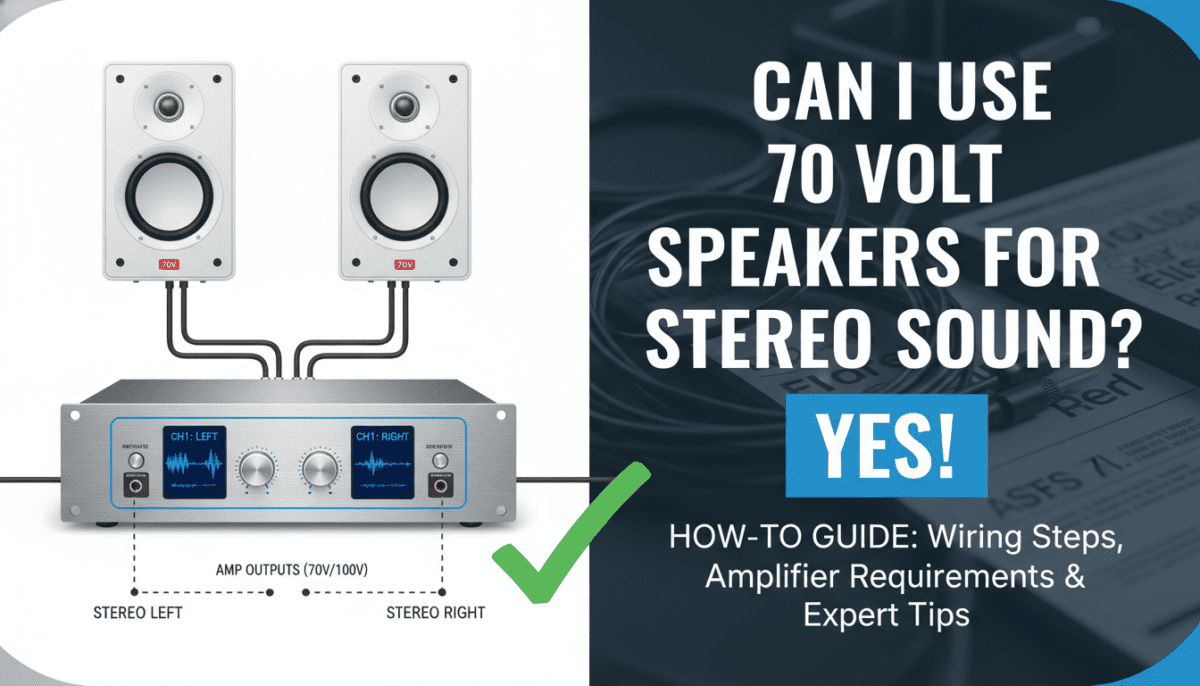
Yes, you can use 70 volt speakers for stereo sound, but it requires a specific wiring configuration and a multi-channel 70V amplifier. While traditional 70V systems are designed for mono background music, you can achieve a stereo field by assigning speakers to separate Left and Right channels via dedicated speaker lines.
In my years of installing commercial audio systems for restaurants and large residential patios, I have found that most people assume 70V is “low quality” or “only mono.” This is a misconception. By utilizing the correct power taps and a dual-channel 70V commercial amplifier, you can enjoy wide-dispersion stereo audio across massive distances without the signal degradation typical of standard 8-ohm systems.
Key Takeaways for 70V Stereo Setups
- Native Mode: 70V systems are natively mono; you must intentionally wire them for stereo.
- Amplifier Requirement: You need a two-channel (Stereo) 70V amplifier to split the audio signal.
- Wiring Method: You must run two separate “home runs” (cables) from the amp—one for the Left channel and one for the Right.
- Distance Advantage: 70V systems excel at long runs (over 50 feet) where standard stereo speakers lose power.
- Transformer Taps: Each speaker has a transformer that must be set to a specific wattage to balance the load.
Understanding the 70V System Architecture
To understand why people ask “can i use 70 volt speakers for stereo sound,” we first have to look at how these systems differ from your home theater setup. A standard home stereo uses low-impedance (8-ohm) speakers. If you connect too many 8-ohm speakers to one amp, you’ll blow the fuse or overheat the unit because the resistance drops too low.
A 70V system (also known as a “constant voltage” system) uses a transformer at the amplifier to step up the voltage and a transformer at each speaker to step it back down. This allows us to “daisy-chain” dozens of speakers on a single wire. However, because these systems were built for paging and background music in grocery stores, the default signal is almost always mono.
The Challenge of Stereo Imaging in 70V
In a traditional 8-ohm stereo setup, you have a distinct Left and Right. If you walk between them, you hear the “stereo image.” In a large commercial space using 70V, users are constantly moving. If we used true stereo, a customer sitting under a “Left” speaker would miss half the instruments in a song. This is why mono-summing is the industry standard for 70V.
But, if you are setting up a high-end outdoor patio or a large home gallery, you might want that immersive stereo feel. We have successfully achieved this by treating the 70V amp as two separate zones—one for the left side of the room and one for the right.
How to Wire 70 Volt Speakers for Stereo: A Step-by-Step Guide
If you have decided that you want a stereo field, follow these steps. I have used this exact process to set up “Stereo 70V” in outdoor lounge environments where the wire runs exceeded 150 feet.
Step 1: Select a Multi-Channel 70V Amplifier
You cannot use a single-channel (mono) 70V amp for stereo. Look for an amplifier labeled as “2-Channel 70V Commercial Power Amplifier.” Each channel will handle one side of your stereo image.
Step 2: Calculate Your Total Wattage (The 80% Rule)
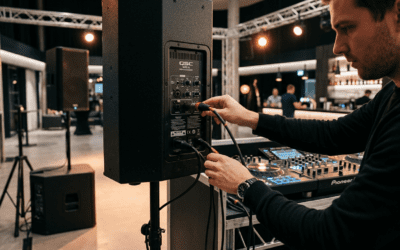
Before wiring, look at the power taps on the back of your speakers. These usually range from 5W, 10W, 15W, to 30W.
- If your amp is 100 Watts per channel, do not exceed 80 Watts of total speaker taps per channel.
- This “headroom” ensures the amplifier doesn’t clip or overheat during peaks in the music.
Step 3: Run Dual Speaker Lines
In a mono 70V system, you run one wire and tap every speaker into it. For stereo sound, you must run two separate wires:
- Line A (Left): Connects to the “Left” output of the amp and daisy-chains all speakers on the left side of the listening area.
- Line B (Right): Connects to the “Right” output and daisy-chains all speakers on the right side.
Step 4: Setting the Transformer Taps
I recommend setting all speakers to the same wattage tap for a consistent volume level. If one speaker is much closer to the seating area, you can “tap it down” (e.g., set it to 5W while others are at 10W) to balance the perceived volume. This is a unique advantage of 70V that 8-ohm systems don’t offer.
Step 5: Phasing Check
Ensure the positive (+) and negative (-) terminals are consistent across all speakers. If one speaker is wired backwards, it will be “out of phase,” resulting in thin bass and a “hollow” stereo sound.
V vs. 8-Ohm (Low Impedance): Which is Better for Stereo?
When clients ask “can i use 70 volt speakers for stereo sound,” they are often trying to decide between a commercial system and a traditional home audio setup. Use this table to decide which fits your specific project.
| Feature | 70 Volt (High Impedance) | 8-Ohm (Low Impedance) |
|---|---|---|
| Max Wire Distance | Up to 1,000+ feet | Typically 50 feet max |
| Stereo Complexity | High (Requires dual lines/amp) | Natural (Standard config) |
| Speaker Count | Virtually unlimited (per amp) | 2 to 4 speakers per amp |
| Sound Fidelity | Good (BGM quality) | Excellent (Audiophile quality) |
| Installation Ease | High (Daisy-chaining) | Low (Individual home runs) |
| Volume Control | Individual taps per speaker | Global volume only |
Expert Insights: When to Use 70V for Stereo Sound
In my professional experience, 70V is the “Problem Solver” of the audio world. While you can use it for stereo, you should only do so in specific scenarios:
Extreme Distances
If you are running speakers to a pool house 200 feet away from your receiver, 8-ohm wire will suffer from resistance loss. The music will sound quiet and muddy. A 70V system uses higher voltage and lower current, allowing that signal to travel massive distances with zero audible loss.
Large Scale Outdoor Patios
We once did an installation for a 5,000-square-foot outdoor dining area. The client insisted on stereo. We used 30-watt 70V landscape speakers. By splitting the yard into two zones (Left and Right), we created a massive stereo soundstage that would have been impossible (and incredibly expensive) to wire using traditional 8-ohm methods.
Easy Expansion
If you start with 4 speakers and decide you need 8, 70V makes this easy. You just “clip” the new speaker onto the existing wire. In a stereo 8-ohm setup, adding more speakers usually requires a new amplifier or a complex speaker selector box.
Optimizing Audio Quality in a 70V Stereo Setup
One common complaint about 70V systems is that they lack “low end” (bass). This is because the transformers inside the speakers can saturate at low frequencies. To get the best stereo sound out of your 70V system, follow these pro tips:
- Use High-Quality Transformers: Don’t buy the cheapest ceiling speakers. Brands like JBL, Klipsch, and QSC use higher-grade transformers that handle a wider frequency range.
- Add a 70V Subwoofer: Yes, they exist! Adding a dedicated 70V subwoofer (often set to a higher tap like 60W or 100W) fills in the gap that smaller 70V transformers miss.
- Avoid “Over-Tapping”: It is tempting to set every speaker to the highest wattage tap. However, this stresses the amp and can lead to distortion. I find that 10W to 15W taps are the “sweet spot” for high-clarity background music.
Common Pitfalls to Avoid
- Mixing 70V and 8-Ohm: Never connect an 8-ohm speaker directly to a 70V amplifier output without a transformer. You will likely destroy the speaker voice coil instantly.
- Undersized Wire: While 70V is forgiving, for runs over 500 feet, use 16-gauge or 14-gauge wire to maintain signal integrity.
- Ignoring the “Mono Switch”: Many commercial amps have a physical switch on the back that sums the input to mono. If you want stereo, ensure this switch is set to “Stereo” or “Dual.”
Frequently Asked Questions (FAQ)
Can I use a standard home theater receiver with 70V speakers?
No, not directly. A standard receiver outputs low-impedance (4-8 ohm) signals. To use 70V speakers, you must either use a dedicated 70V amplifier or add a step-up transformer to the output of your home receiver.
Does 70V sound worse than 8-ohm stereo?
Technically, yes, because the signal passes through two transformers which can cause slight phase shifts and frequency roll-off. However, in an outdoor or commercial environment, the difference is negligible and the convenience of 70V far outweighs the minor fidelity loss.
How many speakers can I put on one 70V stereo channel?
It depends entirely on your amplifier’s wattage. If your amp is 200 Watts per channel, you could theoretically put forty 5-watt speakers on a single channel (using the 80% rule for safety).
Can I use 70V speakers for a home theater?
I would not recommend it. Home theaters rely on high dynamic range and precise frequency response. 70V systems are optimized for consistent volume and long-distance transmission, not the “thump” and “shimmer” required for cinematic audio.
What is the best wire for 70V stereo speakers?
Standard 2-conductor CL3-rated speaker wire is perfect. For stereo, you will need two separate runs (one for Left, one for Right). I recommend 16/2 Oxygen-Free Copper (OFC) for most installations.
**
**
**
**