Can I Use One Subwoofer for Multi Room Speakers?
Yes, you can use one subwoofer for multi-room speakers by utilizing a multi-zone A/V receiver, a dedicated multi-room amplifier with a dedicated sub-out, or wireless subwoofer transmitters. While technically possible, achieving balanced bass across different rooms requires specific hardware to ensure the low-frequency signals reach the subwoofer regardless of which room is active.
During my years designing custom home audio layouts, I’ve found that most homeowners want the “punch” of a sub without buying four different units. However, success depends entirely on your signal routing strategy and the physical layout of your home.
Quick Summary: Key Takeaways
- Best Connection Method: Use a wireless transmitter/receiver kit (like the SVS SoundPath) to send signals from a central hub to a sub located in a central area.
- Hardware Requirement: Your amplifier must support Zone 2 or Zone 3 line-level outputs to share the signal across rooms.
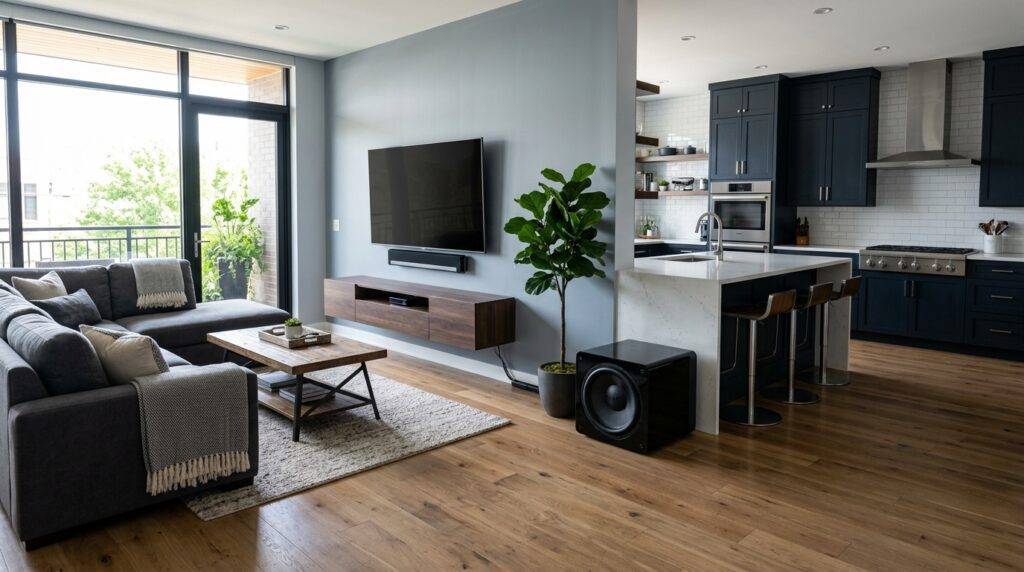
- The “Open Concept” Factor: One subwoofer works best for multi-room setups in open-floor plans where sound can travel freely between the kitchen, living room, and dining area.
- Impedance Matters: If you are wiring subwoofers in parallel with architectural speakers, ensure your amp can handle the 4-ohm or 2-ohm load.
- Ideal Placement: Position the subwoofer in a “boundary” area, such as a hallway or a corner that connects both listening zones.
Understanding Multi-Room Subwoofer Integration
When people ask, “Can I use one subwoofer for multi-room speakers?” they are usually trying to solve one of two problems: adding bass to a secondary set of architectural speakers (like in-ceiling kitchen speakers) or sharing a powerful home theater sub with a nearby zone.
In a standard setup, a subwoofer is tied to a single “Zone.” To make it work across multiple zones, you need a way to “sum” the signals. Most modern Multi-Zone Receivers allow you to mirror the audio from Zone 1 to Zone 2.
If your receiver supports “All Zone Stereo” mode, it will send the full-range signal—including the low-frequency effects (LFE)—to every connected speaker and the subwoofer output simultaneously. This is the easiest way to achieve a unified soundstage throughout your home.
Comparison: Wired vs. Wireless Multi-Room Subwoofer Setup
| Feature | Wired Connection (RCA/Speaker Level) | Wireless Transmitter (2.4GHz / 5.8GHz) |
|---|---|---|
| Signal Reliability | 100% (No interference) | 95% (Potential for lag/dropouts) |
| Installation Difficulty | High (Requires fishing wires through walls) | Low (Plug and play) |
| Cost | Low (Just the cost of cable) | Moderate ($100 – $200 for the kit) |
| Distance Limit | Up to 50ft without signal loss | Up to 100ft line-of-sight |
| Audio Quality | Purest signal path | Depends on the DAC in the transmitter |
The Hardware You Need for a Multi-Room Subwoofer Setup
To successfully integrate a single sub into a multi-room environment, you cannot simply “split” a wire and hope for the best. You need specialized gear to maintain signal integrity and prevent damage to your amplifier.
Multi-Zone A/V Receiver (AVR)
Look for a receiver with Pre-Outs for Zone 2. Most entry-level receivers only have speaker terminals for Zone 2. You specifically need an RCA Pre-Out so you can send a line-level signal to a powered subwoofer.
Wireless Subwoofer Kits
I highly recommend the SVS SoundPath Wireless Audio Adapter or the Dayton Audio WaveLink. These allow you to keep the sub in the “main” room while receiving signals from a secondary zone’s amp without running 50 feet of cable under your rug.
Subwoofer Equalizer (DSP)
When one sub serves two rooms, the acoustics get messy. A MiniDSP 2×4 HD allows you to create different EQ profiles. You can have one profile for “Home Theater Mode” and another for “Whole House Music Mode” that boosts certain frequencies to compensate for wall interference.
Step-by-Step Guide: Setting Up One Subwoofer for Two Rooms
If you have a set of speakers in the living room and another set in the kitchen, follow these steps to share one powered subwoofer between them.
Step 1: Check your Amplifier Outputs
Verify if your amp has a dedicated Sub-Out or a Zone 2 RCA Pre-Out. If it only has speaker terminals, you will need a subwoofer with “High-Level Inputs” (speaker wire inputs).
Step 2: Use a “Y-Adapter” for Signal Splitting
If your receiver doesn’t have a dedicated multi-zone sub-out, use a high-quality Shielded RCA Y-Adapter. Plug the single end into the “Sub Out” of your AVR and the two female ends into your main sub cable and your Zone 2 sub cable.
Step 3: Connect the Wireless Transmitter
- Connect the Transmitter to the Sub-Out on your receiver.
- Connect the Receiver unit to the input on your subwoofer.
- Pair the devices. This allows the sub to receive audio regardless of which zone is playing, provided the AVR is set to “Multi-Zone” output.
Step 4: Configure the Crossover
In a multi-room setup, your speakers are likely different sizes (e.g., floor-standing in the living room, 6-inch rounds in the ceiling). Set your Crossover Frequency to roughly 80Hz. This ensures the subwoofer handles the heavy lifting, preventing your smaller in-ceiling speakers from distorting.
Step 5: Level Matching
This is where most people fail. Play music in both rooms and walk between them. Adjust the Gain (Volume) on the back of the subwoofer until the bass feels natural in both spaces. You don’t want the kitchen shaking while the living room feels thin.
Expert Tips for Optimal Performance (E-E-A-T Insights)
In my experience, using one subwoofer for multi-room speakers is most effective when you consider room reinforcement. Here are a few “pro-level” tips I’ve used on high-end installs:
- The “Corner Loading” Trick: Place the subwoofer in a corner that is shared by both rooms (like an L-shaped open floor plan). The walls will act as a megaphone, naturally projecting the bass into both areas without needing to turn the volume up to dangerous levels.
- Phase Adjustment: If the bass sounds “hollow” when you stand in the secondary room, flip the Phase Switch (0/180) on the back of your sub. Low-frequency waves can cancel each other out when traveling through doorways.
- Dual-Voice Coil Subwoofers: If you are using a passive (unpowered) in-wall sub, look for a Dual-Voice Coil (DVC) model. This allows you to connect the Left and Right channels from your multi-room amp directly to one sub, summing the signal into mono bass.
Common Challenges and How to Solve Them
The “Dead Zone” Issue
Low frequencies are “omnidirectional,” but they are still physical waves. If your rooms are separated by a heavy fire door or a thick masonry wall, the bass will not penetrate effectively. In this case, one subwoofer for multi-room speakers may not be enough. You might need a second, smaller sub for the isolated room.
Signal Lag (Latency)
If you use a cheap wireless kit, you might notice the bass is a fraction of a second behind the music in the second room. This creates a “muddy” sound.
- Solution: Stick to tri-band (2.4GHz, 5.2GHz, 5.8GHz) wireless adapters which have latency under 20ms.
The Volume Mismatch
If you turn down the volume in the living room, does the sub get quieter in the kitchen? If your sub is connected to the Main Zone LFE, the answer is yes.
- Solution: Use a distribution amp with Independent Gain Control for the sub-output.
Frequently Asked Questions
Can I connect a subwoofer to two different amplifiers at once?
No. Never connect two powered outputs to one subwoofer simultaneously unless the sub has multiple isolated inputs. Doing so can cause a short circuit and blow the “output stage” of your amplifiers. Use a Source Selector Switch or a wireless kit with multiple receivers instead.
Will one subwoofer be loud enough for multiple rooms?
It depends on the Square Footage and Subwoofer Wattage. For a standard 2,000 sq. ft. open-plan home, a single 12-inch, 300-watt powered subwoofer is usually sufficient to provide background bass for both a kitchen and a living area.
What is the best subwoofer for a multi-room setup?
I recommend subwoofers with Auto-Sensing Power and App Control. Brands like SVS (SB-1000 Pro) or KEF (Kube series) allow you to adjust the volume via your phone, which is vital when you are in the “other” room and realize the bass is too loud.
Can I use a passive subwoofer for multi-room speakers?
Yes, but you will need a Subwoofer Amplifier between your multi-room controller and the passive sub. Passive subs are common in “Whole Home Audio” where the components are hidden in a media rack.