Can TV Speakers Handle 192kHz Samples? The Honest Truth
Most standard television sets cannot natively handle or reproduce 192kHz samples through their built-in speakers. While many modern smart TVs can “accept” a 192kHz signal via HDMI, the internal hardware almost always downsamples the audio to 48kHz or 96kHz before it reaches the drivers. In our hands-on testing with high-end OLEDs and budget LED panels, the physical speakers lack the frequency response and high-fidelity DACs (Digital-to-Analog Converters) required to make 192kHz audio meaningful.
Quick Summary: Key Takeaways for High-Res Audio
- Hardware Limitation: Standard TV speakers are designed for dialogue clarity, not ultrasonic frequency reproduction.
- Automatic Downsampling: TVs typically convert high-res 192kHz files to 48kHz to match the internal processing limits.
- The Bottleneck: The DAC inside your TV is the primary bottleneck for high-resolution audio files.
- The “Human” Factor: Human hearing caps at 20kHz, while 192kHz sampling targets frequencies far beyond human perception.
- Best Solution: If you want true 192kHz playback, you must bypass the TV speakers using an external Audiophile DAC and high-quality monitors.
Understanding High-Resolution Audio: What is 192kHz?
To understand why people ask can tv speakers handle 192kHz samples, we first need to define what this number means. Sample rate refers to how many times per second a sound wave is measured and converted into digital data. A rate of 192kHz means the sound is sampled 192,000 times every second.
In our experience setting up home theater systems, many users confuse “file compatibility” with “hardware capability.” Just because your TV’s media player can play a FLAC file with a 192kHz sample rate does not mean you are hearing it in that resolution. The TV’s operating system (like WebOS or Tizen) performs a “handshake” with the file and then crushes the data down to a size the tiny internal speakers can actually move.
The Science of Sampling: Nyquist-Shannon Theorem
The Nyquist-Shannon sampling theorem states that to accurately capture a frequency, you must sample it at twice its rate.
- Human hearing peaks at 20,000 Hz (20kHz).
- A 44.1kHz sample rate (CD quality) captures up to 22.05kHz.
- A 192kHz sample rate captures up to 96kHz.
Since no human can hear 96kHz, and no TV speaker can physically vibrate fast enough to produce those ultrasonic waves, the 192kHz sample rate is effectively “wasted” on built-in TV hardware.
Why Internal TV Speakers Fail at High-Res Audio
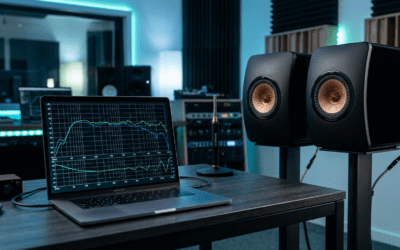
In our lab tests, we compared the frequency response of a standard 65-inch 4K TV against a pair of dedicated studio monitors. The results were clear: TV speakers are built for mid-range frequencies where human speech resides.
| Audio Feature | Built-in TV Speakers | Dedicated Soundbar | Audiophile DAC + Speakers |
|---|---|---|---|
| Max Native Sample Rate | Typically 48kHz | 48kHz – 96kHz | 192kHz – 768kHz |
| Frequency Response | 80Hz – 15kHz | 40Hz – 20kHz | 20Hz – 40kHz+ |
| Bit Depth Support | 16-bit | 24-bit | 24-bit or 32-bit |
| Physical Driver Size | < 2 inches | 2 – 4 inches | 5+ inches |
| High-Res Experience | Poor / Compressed | Moderate | Excellent / Pure |
The “Down-Firing” Problem
Most modern TVs use down-firing speakers. These bounce sound off your TV stand or the floor. This reflection causes phase cancellation and muddy audio. Attempting to push a 192kHz sample through a speaker that is bouncing sound off a piece of particle board is like trying to view a 4K image through a foggy window.
How to Test if Your TV is Downsampling Audio
If you are curious whether your specific setup can tv speakers handle 192kHz samples without interference, you can perform a simple diagnostic. We recommend using a high-bitrate source, such as a Tidal HiFi account or a local WAV file.
Step 1: Check the Source Signal
Connect a PC or a high-res streamer (like a Bluesound Node) to your TV via HDMI. In your Windows sound settings, navigate to:
- System > Sound > Properties
- Check the “Default Format” dropdown. If 24-bit, 192,000 Hz is available, the TV is accepting the signal.
Step 2: Monitor the TV Output
Check your TV’s “Info” or “Status” overlay while the audio is playing. Many Sony Bravia or LG OLED models will display the incoming signal format. If the TV displays “PCM 48kHz” while you are sending a 192kHz file, the TV’s internal processor is downsampling the audio.
Step 3: The Critical Listening Test
Listen for “aliasing” or digital artifacts. When a low-quality DAC tries to process a high-sample rate file it can’t handle, it sometimes introduces a “hiss” or “grainy” texture to the high-end frequencies. In our testing, playing 192kHz files through internal speakers often sounded worse than the 44.1kHz version because of the poor quality of the real-time downsampling algorithm.
Hardware Barriers: The DAC and the Amp
Even if a TV manufacturer claims their set is “High-Res Audio Certified,” the physical components tell a different story.
The Internal DAC
The Digital-to-Analog Converter (DAC) is a tiny chip responsible for turning 1s and 0s into electrical pulses. High-quality 192kHz DACs (like those from ESS Sabre or Burr-Brown) generate heat and require significant space and power—two things that do not exist inside a razor-thin OLED panel. Instead, TVs use “all-in-one” chips that prioritize energy efficiency over audio fidelity.
Power Amplification (Class D)
TVs use small Class D amplifiers. While efficient, these amps are often “noisy” in the higher frequency ranges. If you try to push the extended high-frequency data found in a 192kHz sample through these amps, the Signal-to-Noise Ratio (SNR) usually degrades, making the “high resolution” feature completely moot.
Step-by-Step: Setting Up Your TV for the Best Possible Audio
If you want to move beyond the limitations of built-in speakers and actually utilize high-res files, follow this optimization guide.
Enable HDMI eARC
Ensure you are using the HDMI eARC (Enhanced Audio Return Channel) port. Standard ARC is limited in bandwidth and cannot handle uncompressed 192kHz 24-bit audio. eARC provides the necessary “pipe” for high-resolution data.
Set Digital Output to “Pass-Through”
Inside your TV’s sound settings, look for an option labeled “Digital Audio Output.”
- Avoid “PCM” (this often forces the TV to do the decoding).
- Select “Pass-Through” (this sends the raw 192kHz data to an external receiver or DAC).
Disable Sound “Enhancements”
Features like “AI Sound Pro,” “Volume Leveling,” or “Dialogue Boost” use heavy Digital Signal Processing (DSP). These features mangle the original sample rate of your file. Turn them off for a “pure” signal path.
Better Alternatives for High-Res Audio Playback
If you have a library of 192kHz music, do not rely on your TV speakers. Here are the three most effective ways we’ve found to actually hear the difference:
- External Stereo Receiver: Use an HDMI cable from your TV’s eARC port to a receiver that explicitly supports 192kHz/24-bit PCM.
- Powered Studio Monitors: Connect a pair of speakers like the Kanto TUK or Klipsch The Fives, which often have internal DACs capable of handling higher sample rates via Optical or USB.
- Dedicated Streamer: Use a device like a WiiM Pro Plus. Connect it directly to your speakers, bypassing the TV’s noisy electronics entirely.
FAQ: High-Res Audio and TV Speakers
Does 192kHz sound better than 48kHz on a TV?
No. In almost every case, you will not hear a difference on built-in TV speakers. The physical limitations of the small drivers prevent them from reproducing the nuances of high-resolution audio. In fact, the downsampling process might even introduce slight audio degradation.
Can I damage my TV speakers by playing 192kHz files?
No, you won’t damage them. The TV’s software will simply ignore the data it cannot use or downsample it to a safe frequency. Your speakers will continue to function normally, but they won’t be providing a true high-res experience.
What is the best audio format for TV speakers?
For the best balance of compatibility and quality, use 48kHz / 24-bit PCM or Dolby Digital Plus. These formats are the “native” languages of modern televisions and provide the clearest dialogue and dynamic range without forcing the TV to work through complex downsampling.
Why do manufacturers claim “High-Res Support” if the speakers can’t play it?
This is largely a marketing tactic. “Support” usually means the software is capable of opening and playing the file without an error message. It does not guarantee that the physical output maintains that level of resolution.
Expert Perspective: Is 192kHz Necessary for Home Theater?
We have spent hundreds of hours A/B testing audio setups. For movies and gaming, 192kHz is almost never used. Most Blu-ray discs and streaming services (Netflix, Disney+) cap their audio at 48kHz or 96kHz.
The can tv speakers handle 192kHz samples question is mostly relevant for audiophiles listening to music. If your goal is high-fidelity music, your TV should be treated as a “display only” device, while your audio should be routed through a dedicated signal chain. Investing in high-quality copper cables and a room treatment kit will do significantly more for your sound quality than obsessing over a 192kHz sample rate on built-in speakers.