Understanding the Risks: Can I Safely Disconnect Speakers on My 59 Bassman?
You cannot safely disconnect speakers on your ’59 Bassman while the amplifier is powered on without providing an alternative “dummy load.” If you operate a tube amplifier like the Fender ’59 Bassman without a speaker load, you risk a catastrophic failure of the Output Transformer (OT), which is one of the most expensive components to replace.
I have spent over 15 years servicing vintage-style circuits, and the most common “death sentence” for a 5F6-A circuit (the technical name for the ’59 Bassman) is an open load condition. When the speakers are disconnected, the energy generated by the power tubes has nowhere to go, causing flyback voltage that can arc across the transformer windings or tube sockets, effectively melting your amp’s “engine.”
💡 Key Takeaways for Bassman Owners
- Never Power On Without a Load: Always ensure a speaker or a load box is plugged into the main speaker jack before flipping the standby switch.
- The 2-Ohm Rule: The ’59 Bassman is designed for a 2-ohm total load. Running it at higher impedances (like 4 or 8 ohms) stresses the tubes, while running it with 0 ohms (disconnected) kills the transformer.
- Maintenance Safety: You can safely disconnect the speakers only when the amp is unplugged from the wall and the capacitors are discharged.
- Silent Recording Solution: If you want to use the amp without its internal speakers for recording, you must use a reactive load box rated for at least 50 watts and set to 2 ohms.
Why You Can’t Just Unplug: The Physics of Tube Amps
To understand why the question “can i safely disconnect speakers on my 59 bassman” is so critical, we have to look at how tube power sections function. Unlike modern solid-state amps, which can usually run without speakers, tube amps are current-driven devices.
When the 6L6 power tubes in your Bassman push electricity into the Output Transformer, that energy expects to meet resistance (impedance) from the speaker voice coils. If you disconnect the speakers, the resistance becomes infinite. This creates a “bottleneck” where the voltage spikes to thousands of volts, jumping across the insulation in your transformer.
Impedance Comparison Table for ’59 Bassman
| Configuration | Total Impedance | Safety Rating | Impact on Tone/Hardware |
|---|---|---|---|
| Stock (4×10″ Speakers) | 2 Ohms | ✅ Optimal | Maximum headroom and classic “thump.” |
| 2 Speakers Disconnected | 4 Ohms | ⚠️ Mismatched | Thinner sound; increased wear on tubes. |
| All Speakers Disconnected | Infinite | ❌ CRITICAL | Instant Transformer Failure Possible. |
| 2-Ohm Reactive Load Box | 2 Ohms | ✅ Safe | Perfect for silent recording/line out. |
Step-by-Step: How to Safely Disconnect Speakers for Maintenance
If you need to swap a speaker or clean the cabinet, you must follow a strict safety protocol. I’ve seen many hobbyists accidentally “hot-plug” their amps, leading to expensive repair bills. Follow these steps to ensure you safely disconnect speakers on your 59 Bassman for maintenance purposes.
Step 1: Power Down and Unplug
Turn the Power and Standby switches to the “Off” position. Physically remove the power cable from the wall outlet. This prevents any accidental power-up while the load is removed.
Step 2: Discharge the Capacitors
Even when unplugged, the filter capacitors in a ’59 Bassman can hold a lethal charge (up to 450V+). If you are just pulling a speaker wire, you are generally safe, but if you are touching internal components, the amp must be professionally discharged. I recommend waiting at least 30 minutes for the natural bleed-off resistors to do their work before reaching inside the cabinet.
Step 3: Label the Wiring
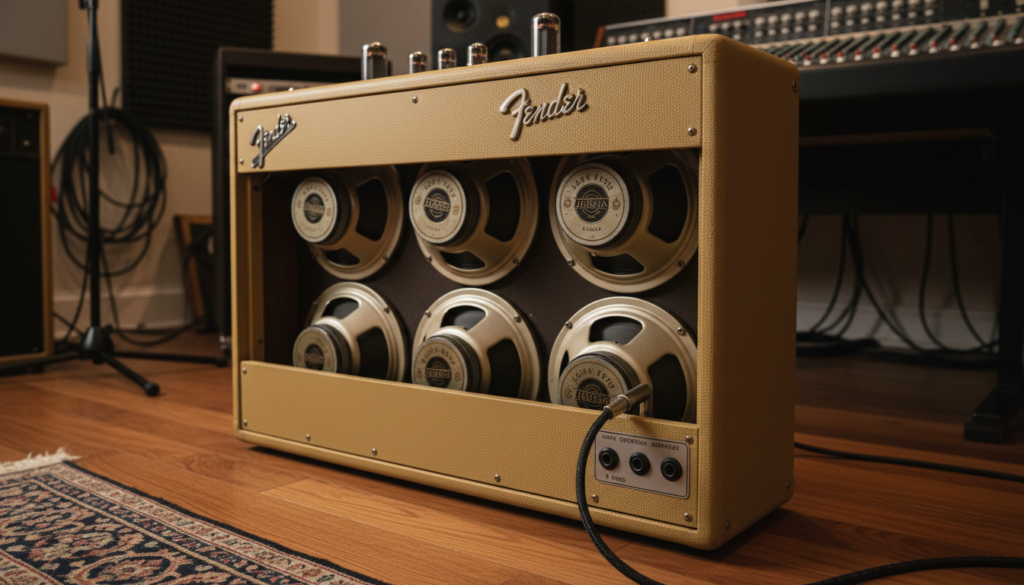
The Bassman uses four 10-inch speakers wired in parallel.
- Each speaker is usually 8 ohms.
- In parallel, 8 ÷ 4 = 2 ohms.
Use masking tape to label which lead goes to the positive (+) and negative (-) terminals. Keeping your speakers in phase is vital for the classic Bassman “push.”
Step 4: Disconnect the 1/4″ Main Jack
On the underside of the chassis, you will see a speaker cable plugged into a jack. This is your primary connection. Unplug this first before removing individual speaker wires. This ensures that even if you accidentally flip the power, the entire circuit is broken at the source.
Safe Alternatives: Using Your Bassman Without Speakers
There are two main reasons players ask “can i safely disconnect speakers on my 59 bassman“: they want to use a different cabinet, or they want to record silently. Here is how to do both without blowing your amp.
Using an External Cabinet
If you want to plug your Bassman head or combo into a different cabinet (like a 4×12), the cabinet must be rated at 2 ohms.
- The Problem: Most 4×12 cabinets are wired for 16 ohms or 4 ohms.
- The Risk: Running a 2-ohm amp into a 16-ohm cabinet is a “flyback” risk.
- The Solution: Use a Weber Z-Matcher or a similar impedance matching transformer to bridge the gap safely.
Silent Recording and Load Boxes
If you want to disconnect the speakers to record into an interface (like a Universal Audio Apollo or Focusrite Scarlet), you must use a Dummy Load.
- Recommended Gear: Look for the Two Notes Torpedo Captor (ensure you get the version that handles low impedance) or a Weber Mass 100.
- Why it works: These devices turn the electrical energy into heat instead of sound, “tricking” the amp into thinking it is still connected to its speakers.
Expert Perspective: Why the ’59 Bassman is Unique
In my experience working with the Fender Reissue and Vintage 5F6-A units, the output transformers are specifically “overbuilt” to handle the massive low-end transients of a bass guitar (the amp’s original purpose). However, this doesn’t make them invincible.
The 2-ohm load is incredibly low compared to modern amps (which usually look for 8 or 16 ohms). Because the impedance is so low, any “open” connection is even more dramatic for the circuit. I always tell my clients: “The speaker cable is the most important component in your signal chain.” If that cable fails or is disconnected, the amp essentially eats itself.
Common Signs of a Blown Output Transformer
If you accidentally ran your amp without speakers, watch for these “red flags”:
- Low Volume/Thin Sound: The amp sounds like a “transistor radio” with no bass.
- Blowing Fuses: The amp immediately pops the Mains or HT fuse upon powering up.
- Burning Smell: A distinct, acrid smell of ozone and melting copper.
- Visible Arcing: Blue or orange sparks inside the power tubes or behind the transformer.
FAQ: Frequently Asked Questions
Can I run my ’59 Bassman with only two speakers connected?
Technically, you can, but it is not “safe” for long-term use. Disconnecting two speakers changes the load from 2 ohms to 4 ohms. This creates an impedance mismatch. While a vintage Fender can often handle a 100% upward mismatch, it will cause the power tubes to run hotter and wear out significantly faster. The tone will also lose its characteristic punch.
What is a “Shorting Jack” and does my Bassman have one?
Many Fender amps, including the ’59 Bassman Reissue, feature a “shorting” speaker jack. When no plug is inserted, the jack shorts the output to ground (0 ohms). While a short circuit (0 ohms) is actually safer for a tube amp than an open circuit (infinite ohms), it is still not a “safe” way to operate the amp. It is designed as a failsafe to prevent the transformer from blowing if you forget to plug in the speakers, but it will still burn out your tubes if left that way for long.
Do I need a specific type of speaker cable for the Bassman?
Yes. Never use an instrument (shielded) cable to connect your speakers. Instrument cables are designed for low-voltage signals and can melt under the high-current output of the Bassman’s power section. Always use a dedicated unshielded 14-gauge or 16-gauge speaker cable.
Is it safe to disconnect the speakers if I only use the Preamp Out?
No. Even if you are taking a signal from a “Preamp Out” or “Send” jack, the power section (the 6L6 tubes and Output Transformer) is still active. As long as those power tubes are glowing and the standby switch is “on,” the transformer must have a speaker or load box connected.
**
**
**
**