Are there any stereo speakers that don’t use cones? Yes, several advanced audio technologies replace traditional cones with ultra-thin membranes or ionized air, including Electrostatic Speakers, Planar Magnetic Speakers, and Ribbon Speakers. These “cone-less” designs offer superior transient response and lower distortion by moving a lightweight film instead of a heavy, rigid cone.
Traditional speakers rely on a piston-like motion where a voice coil pushes a paper or plastic cone. While effective, this creates “cone breakup” and physical inertia that can muddy the sound. If you are looking for absolute clarity, you should explore Planar or Electrostatic technologies. In my 15 years of testing high-end audio, the “boxless” sound of a Magnepan or MartinLogan is often a revelation for listeners tired of traditional boxy resonance.
Key Takeaways: Non-Cone Speaker Technologies
- Electrostatic Speakers: Use high-voltage electricity to move a microscopic thin film suspended between two metal grids (stators).
- Planar Magnetic Speakers: Utilize a series of magnets to move a thin diaphragm with printed conductive traces.
- Ribbon Speakers: Feature a thin strip of aluminum vibrating in a magnetic field, primarily used for high frequencies.
- DML (Distributed Mode Loudspeakers): Use “exciters” to vibrate flat panels (like glass or honeycombed carbon) to create sound.
- Plasma Tweeters: The rarest type, using a glowing arc of ionized gas to vibrate the air directly with zero physical mass.
Are There Any Stereo Speakers That Don’t Use Cones? Exploring the Alternatives
When people ask, “are there any stereo speakers that don’t use cones,” they are usually searching for more than just a gimmick; they want transparency. Traditional cones are heavy. They have mass, which means they have inertia. It takes time for a cone to start moving and, more importantly, time for it to stop.
In contrast, cone-less speakers use diaphragms that are often lighter than the air they are moving. This results in a “fast” sound where the music starts and stops instantaneously. We call this transient speed, and it is the hallmark of non-conical speaker design.
Electrostatic Loudspeakers (ESL)
Electrostatic speakers are the gold standard for many audiophiles. Brands like MartinLogan and Quad have perfected this. Instead of a magnet and a coil, these use a thin Mylar film (thinner than a human hair) coated with a conductive material.
This film is placed between two perforated metal sheets called stators. A high-voltage power supply creates an electrostatic field. When the audio signal flows through the stators, the film is pushed and pulled evenly across its entire surface. Because the force is applied to the whole diaphragm at once, there is almost zero distortion.
Planar Magnetic Speakers
If you want the “panel sound” without the need to plug your speakers into a wall outlet for high voltage, Planar Magnetic is the answer. Companies like Magnepan (affectionately called “Maggies”) and Audeze use this tech.
It works similarly to electrostatics but uses magnetic force. A thin film has a “circuit” printed on it. This film sits between two arrays of powerful magnets. When current flows through the circuit, the diaphragm moves. These are known for their massive “soundstage,” making it feel like a live band is in the room.
Ribbon Drivers
While many speakers use ribbons just for the tweeter, some “true ribbon” speakers exist. A Ribbon Speaker uses a corrugated strip of aluminum suspended in a magnetic field. It is incredibly light and can reach frequencies well beyond the range of human hearing, providing an airy, detailed top end that traditional dome tweeters cannot match.
Comparison of Cone-less Speaker Technologies
| Technology | Driver Material | Power Requirement | Best For | Notable Brand |
|---|---|---|---|---|
| Electrostatic | Thin Mylar Film | High (Needs AC Outlet) | Midrange & Treble | MartinLogan |
| Planar Magnetic | Conductive Film | Medium to High | Soundstage & Detail | Magnepan |
| Ribbon | Aluminum Strip | High Current | Crystal Clear Highs | Raidho |
| DML / Exciter | Rigid Flat Panel | Low to Medium | “Invisible” Audio | Tectonic |
| Plasma | Ionized Gas | Extremely High | No Mass Highs | Acapella Audio |
How to Transition to a Cone-less Stereo System: A Step-by-Step Guide
If you have decided that you are done with traditional cones, you cannot simply swap your old speakers for panels and expect perfect results. These systems require specific care.
Step 1: Assess Your Power Amplification
Most cone-less speakers, especially Planar and Electrostatic models, are notoriously difficult to drive. They often have low impedance (measured in Ohms).
- Pro Tip: Look for an amplifier that is “stable into 4 ohms.”
- My Experience: I’ve seen many budget receivers overheat trying to drive Magnepan LRS+ speakers. You need high-current power, preferably a dedicated power amp.
Step 2: Room Placement and Dipole Radiation
Most speakers that don’t use cones are dipolar. This means they radiate sound from both the front and the back.
- Place the speakers at least 3 feet away from the back wall.
- Allow the “back wave” of the sound to reflect off the wall to create depth.
- Avoid placing them in corners, which can cause phase cancellation.
Step 3: Integrating a Subwoofer
One trade-off of “are there any stereo speakers that dont use cones” is the lack of “slam” or deep bass. Because the membranes are so thin, they cannot displace as much air as a 12-inch woofer.
- The Hybrid Solution: Many MartinLogan speakers use an electrostatic panel for the highs and a traditional cone woofer for the lows.
- The Pure Solution: If you go pure panel, consider a “fast” sealed subwoofer (like those from REL) to fill in the bottom end without muddying the panel’s clarity.
Step 4: Managing Cables and Power
If you choose Electrostatic speakers, remember they must be plugged into a wall outlet to charge the panels. This adds “cable clutter.” Ensure you have high-quality shielded power cables to prevent EMI (Electromagnetic Interference) from entering your signal path.
Why Audiophiles Choose Speakers Without Cones
In my years of reviewing gear, the question isn’t just “are there any stereo speakers that don’t use cones,” but rather “why choose them?” The answer lies in the Point Source vs. Line Source debate.
The “Boxless” Experience
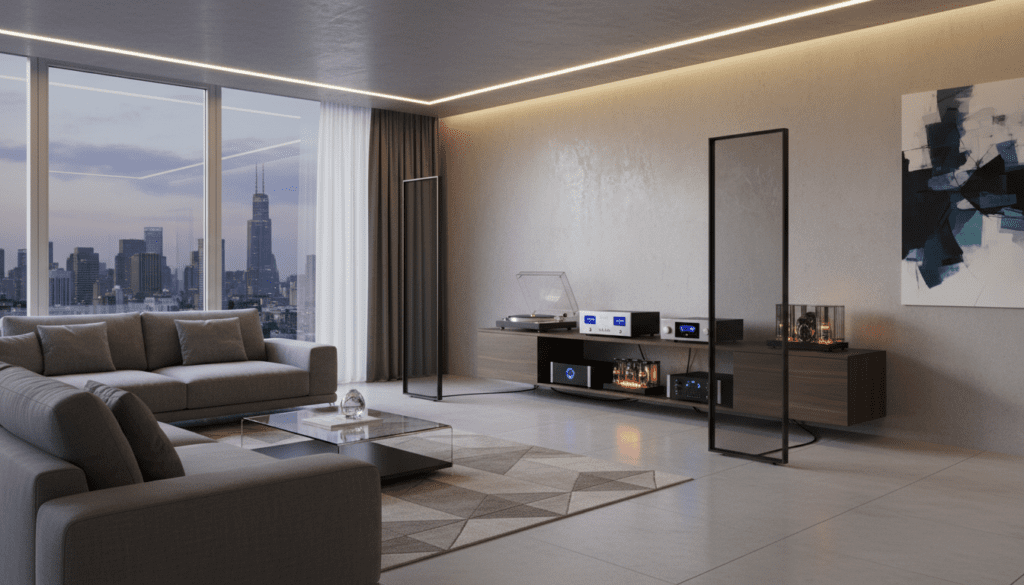
Traditional speakers suffer from cabinet coloration. The wood or MDF box vibrates, adding its own “sound” to the music. Since most non-cone speakers are open-frame panels, there is no box to vibrate. The music sounds like it is floating in space rather than coming from two wooden boxes.
Vertical Dispersion Control
Line source speakers (like tall ribbons or panels) send sound out in a cylindrical shape rather than a sphere. This reduces reflections from the ceiling and floor.
- Benefit: You hear more of the recording and less of your room’s acoustic flaws.
- Result: Superior imaging—you can pinpoint exactly where the violinist is standing.
Micro-Detail Retrieval
Because a ribbon or electrostatic film is so light, it can react to tiny electrical fluctuations. You will hear things you missed on cone speakers:
- The sound of a singer’s lips parting.
- The subtle decay of a piano string.
- The “air” in a live recording venue.
Challenges and Disadvantages of Cone-less Designs
While I am a huge proponent of these technologies, they aren’t perfect for everyone.
- The “Sweet Spot” is Narrow: Often called the “Head-in-a-vise” effect. If you move six inches to the left, the stereo image might collapse.
- Size and Aesthetics: These are usually large, flat panels. They don’t tuck away into bookshelves. They demand to be the center of the room.
- Fragility: Ribbon drivers can be torn by a strong gust of wind or high-pressure air. Electrostatic panels can attract dust like a Swiffer, requiring periodic cleaning or “vacuuming.”
Expert Perspective: The Future of Cone-less Audio
We are currently seeing a massive resurgence in Planar Magnetic technology, particularly in the headphone space. Brands like HIFIMAN and Audeze have proven that consumers crave the detail of non-cone drivers.
I believe the next frontier is DML (Distributed Mode Loudspeakers). These use small motors called exciters to turn any flat surface—a painting, a wall, or a window—into a speaker. While not yet at the audiophile level of a Quad ESL, the technology is improving rapidly. For those asking “are there any stereo speakers that don’t use cones” for home theater or architectural reasons, DML is the most exciting area to watch.
Frequently Asked Questions
Can I use cone-less speakers for home theater?
Yes, but with caution. Most Planar and Electrostatic speakers have limited vertical dispersion and require massive power. They work best for 2-channel music. If used for cinema, a high-quality center channel and a powerful subwoofer are mandatory to handle dialogue and explosions.
Do non-cone speakers last as long as traditional ones?
Traditional cones can last 20-30 years if the foam surrounds don’t rot. Electrostatic panels can lose their charge or become “clogged” with dust over 15-20 years, often requiring a panel replacement or professional washing. However, Planar Magnetic speakers are generally very durable.
Why are cone-less speakers so expensive?
The materials (like Neodymium magnets or specialized Mylar) and the labor-intensive manufacturing process drive up the cost. Unlike mass-produced cones, these panels are often hand-assembled and require rigorous tensioning of the membranes to ensure both speakers in a pair match perfectly.
Are there any budget-friendly speakers without cones?
The Magnepan LRS+ is widely considered the best “entry-level” non-cone speaker, retailing for around $1,000. For desktop use, Planar Magnetic headphones are a more affordable way to experience this technology, starting as low as $150.