Introduction
For decades, home theater enthusiasts have recognized Onkyo as a powerhouse in the audio-visual industry. Following a brief period of restructuring and a highly anticipated comeback, the brand has returned to the forefront of the home entertainment scene with a vengeance. Leading this charge is their premium RZ series, designed to deliver high-current, audiophile-grade performance without the astronomical price tag historically associated with elite theater gear.
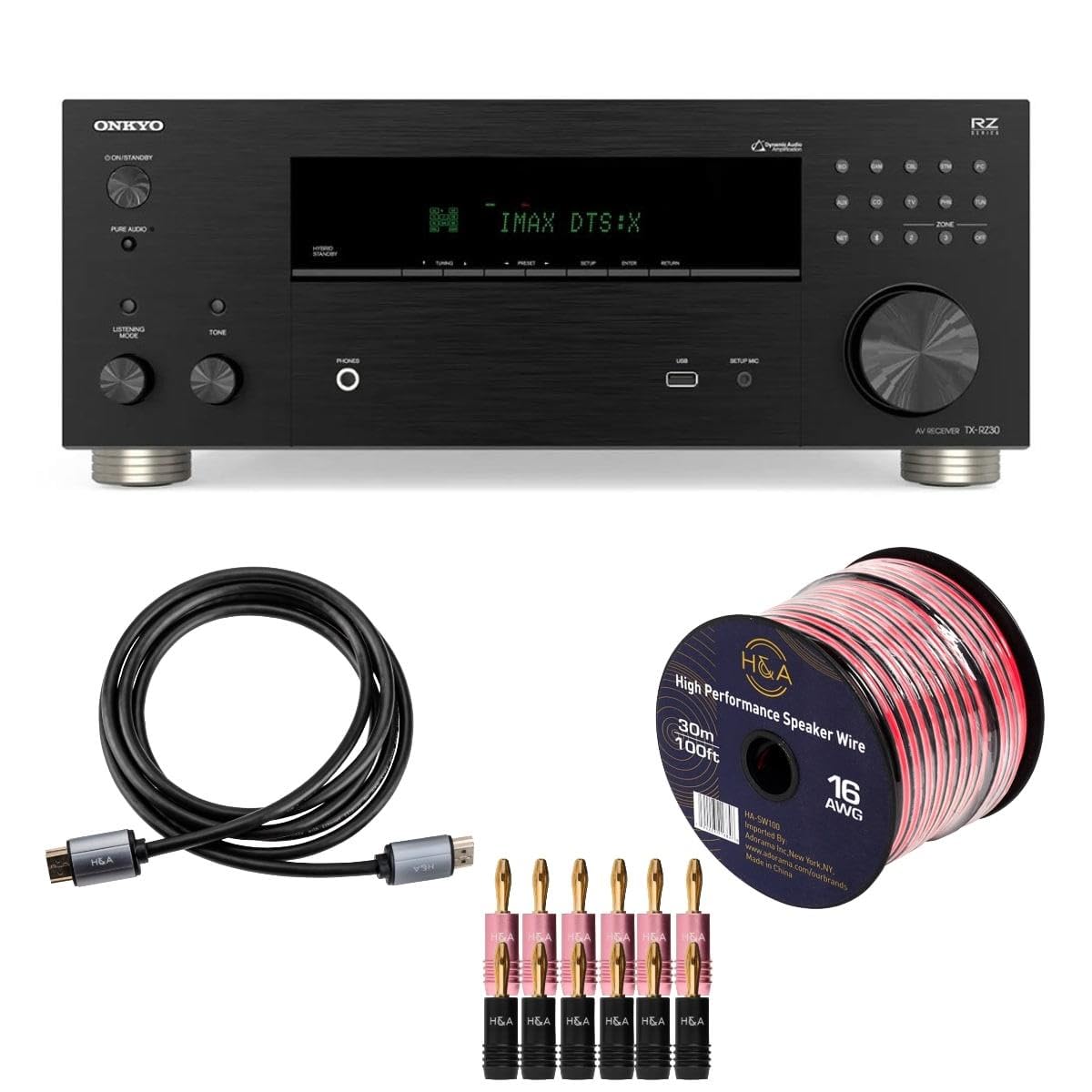
The Onkyo TX-RZ30 9.2-Channel Network AV Receiver represents a pivotal addition to this flagship lineup. Priced competitively at $999, the TX-RZ30 positions itself as an incredibly disruptive force in the mid-range AVR market. It bridges the gap between consumer-level receivers and expensive custom-install equipment, promising massive sound, pristine 8K/4K video pass-through, and arguably the best room calibration software in the world: Dirac Live.
But does this 9.2-channel powerhouse truly deliver on its promise of theater-reference sound, or does it compromise in crucial areas to maintain its under-$1,000 price point? In this comprehensive, in-depth review, we will dissect the design, features, pros, cons, and customer feedback of the Onkyo TX-RZ30 to help you decide if it is the ultimate brain for your home theater setup.
Whether you are a seasoned audiophile upgrading from an older system, an avid console gamer wanting the latest HDMI 2.1a specifications, or someone building a modern Dolby Atmos layout from scratch, this review will detail everything you need to know about the TX-RZ30.
—
Product Overview
The Onkyo TX-RZ30 is a 9.2-channel network AV receiver that pumps out a robust 100 watts per channel (at 8 Ohms, 20 Hz–20 kHz, 0.08% THD, with 2 channels driven) using dynamic, high-current Class A/B amplification. For more demanding dynamic bursts, such as action movie explosions or sudden symphonic swells, it is capable of pushing up to 170 watts per channel into 6 Ohms (1 channel driven). This makes it more than capable of driving large, low-impedance tower speakers with exceptional control and authority.
Aesthetically, the TX-RZ30 features a clean, industrial design in matte black. While it lacks the physical flip-down door found on its larger sibling, the TX-RZ70, it compensates with an incredibly clean layout where the headphone jack, setup microphone input, and front-facing USB port are laid bare for easy access. The chassis feels exceptionally rigid and well-built, weighing in at a substantial 25.4 pounds and measuring 17.1 inches wide, 15.1 inches deep, and 7 inches tall.
What truly sets the TX-RZ30 apart from its immediate competition, however, is its internal technology suite. Under the hood, Onkyo has packed custom low-noise power transformers and oversized smoothing capacitors. This custom circuitry allows the receiver to achieve an ultra-wide frequency response of 5 Hz to 100 kHz. This design ensures deep, rumbling low-end bass and pristine, airy highs that typical mid-range receivers struggle to reproduce without distortion.
Key Specifications at a Glance:
- Amplification: 9.2 Channels of Class A/B power, 100W per channel (8 Ohms)
- Video Processing: 8K/60Hz and 4K/120Hz pass-through with HDMI 2.1a, HDCP 2.3, Dolby Vision, HDR10+, and HLG
- Audio Formats: Dolby Atmos, DTS:X, Dolby Atmos Height Virtualization, DTS Neural:X, and IMAX Enhanced
- Room Correction: Full Bandwidth Dirac Live license included out-of-the-box (no hidden upgrades required)
- Bass Management: Dual independent subwoofer outputs with support for optional Dirac Live Bass Control (DLBC)
- Smart Streaming: Wi-Fi, Bluetooth (with aptX HD), Apple AirPlay 2, Chromecast Built-in, Spotify Connect, Tidal, and Works with Sonos
- Certification: THX Certified Select for theater-reference playback
—
Pros
Standard Full-Bandwidth Dirac Live License Included
Perhaps the single biggest selling point of the Onkyo TX-RZ30 is the inclusion of a full-bandwidth Dirac Live license at no extra charge. While competitors like Denon and Marantz require you to spend upwards of $250 to purchase a Dirac license separately, Onkyo bundles it out-of-the-box. Dirac Live is widely regarded as the gold standard in consumer room correction, managing both magnitude (frequency) and phase (time-domain) response to eliminate room-induced acoustic muddiness and dramatically sharpen the overall soundstage.
Dual Independent Subwoofer Outputs
In many mid-range receivers, having two subwoofer jacks simply means the signal is mirrored (a mono split). The TX-RZ30 features two independent subwoofer outputs. This means the receiver can output different calibration sweeps, volumes, and delay times to each subwoofer separately. If you run a dual-subwoofer setup to even out the bass response across your seating area, this is an absolutely game-changing feature that is typically restricted to much more expensive AVRs.
Future-Proof HDMI 2.1a & Gaming Integration
All six rear HDMI inputs are fully compatible with HDMI 2.1a and support 8K/60Hz and 4K/120Hz video signals. This receiver is an absolute dream for console and PC gamers, fully supporting Variable Refresh Rate (VRR), Auto Low Latency Mode (ALLM), and Quick Frame Transport (QFT) to eliminate screen tearing and minimize input lag. It also supports Source-Based Tone Mapping (SBTM) and Quick Media Switching (QMS) to prevent those annoying black screen delays when switching content or frame rates.
Custom High-Current Circuitry and Low Distortion
Onkyo’s engineering team has designed the TX-RZ30 with custom, heavy-duty power transformers and massive smoothing capacitors. By utilizing an ultra-wide frequency response of 5 Hz to 100 kHz, the receiver has an abundance of headroom. When a film demands a massive low-frequency transient—like a building collapsing or a spaceship engine roaring—the RZ30 has the instantaneous current reserves to deliver the punch without clipping or distorting.
Seamless Sonos Ecosystem Integration
If you have Sonos speakers throughout your home, the TX-RZ30 integrates seamlessly into your existing wireless ecosystem with its “Works with Sonos” certification. By pairing the receiver with a Sonos Port, you can stream music directly from your Sonos app to the receiver. Even better, it supports volume pass-through, allowing you to turn on the receiver, change inputs, and adjust the main home theater volume directly from the comfort of your Sonos mobile app.
THX Certified Select Reference Standards
The TX-RZ30 carries the prestigious THX Certified Select badge. To achieve this, the receiver had to undergo thousands of rigorous laboratory tests covering power output, distortion levels, and frequency response. This certification guarantees that the receiver can deliver theater-reference volume levels in medium-sized rooms (where the screen-to-seat distance is about 10-12 feet) with the exact tonal balance intended by the film’s sound mixer.
Cooler Thermal Management
Historically, high-powered multi-channel AV receivers have been notorious for running hot, requiring active cooling fans or open-air cabinets. Onkyo has engineered the TX-RZ30 with optimized internal heat sinks that allow it to run exceptionally cool, even when pushing heavy surround sound tracks. This makes it far more reliable when installed inside media consoles or tighter cabinet setups.
—
Cons
Lacks Auro-3D Processing
While the TX-RZ30 excels with immersive spatial formats like Dolby Atmos, DTS:X, and IMAX Enhanced, it completely lacks support for Auro-3D. Auro-3D is a highly popular immersive audio format in Europe and among certain home theater enthusiasts who prefer its unique height-layer channel mapping. If Auro-3D or Auro-Matic upmixing is a must-have for your layout, you may need to look at competitors like the Denon AVR-X3800H.
Locked to 9 Channels of Processing
The TX-RZ30 is strictly a 9.2-channel receiver, meaning its processing capacity is capped at 9 main speaker channels and 2 subwoofers. While it does feature a full suite of analog preamp outputs, you cannot expand the receiver to decode 11 channels (such as a 7.2.4 Atmos layout) even if you hook up an external multi-channel amplifier. If you plan to expand your home theater to more than four height speakers in the future, you will have to step up to the TX-RZ50 or TX-RZ70.
Dated, Low-Resolution On-Screen Menus
Despite being a highly sophisticated, modern piece of technology, Onkyo’s on-screen user interface is admittedly retro. The setup menus look remarkably similar to models from a decade ago, featuring basic, blocky text fonts and minimal graphics. While the menu is functionally intuitive and easy to navigate once you understand where settings are, it lacks the polished, high-resolution aesthetic found on modern competitor models.
Dirac Live Setup Can Be Intimidating for Novices
While having Dirac Live included is a massive positive, setting it up can be a daunting process for beginners. Unlike plug-and-play calibration systems that take five minutes, a proper Dirac sweep requires placing a microphone in up to 9-17 different positions throughout your room. To get the absolute best results, you need to use a laptop and a calibrated USB microphone (like a UMIK-1), which can feel highly technical and time-consuming. Fortunately, you can also run a basic setup using the included puck microphone and Onkyo’s mobile app, but the learning curve is still steeper than traditional setups.
—
Customer Reviews Analysis
With a perfect score across initial customer reviews, the consensus surrounding the Onkyo TX-RZ30 is overwhelmingly positive. Real-world users who upgraded to the RZ30 frequently highlight the sheer auditory transformation of their living spaces. A common theme in these reviews is comparing the bundled Dirac Live calibration directly against traditional Audyssey setups. Customers state that Dirac Live did an “unbelievable” job correcting room acoustics, tightening muddy bass, and drastically improving dialogue clarity through the center channel.
Another major highlight mentioned by owners is the receiver’s thermal management. Users who previously owned other premium brands noted that the Onkyo TX-RZ30 runs significantly cooler to the touch during long movie marathons. This cooler operating temperature not only gives peace of mind when installing the unit in an entertainment cabinet, but also suggests a longer overall lifespan for the internal components.
Music performance also receives stellar marks. Several audiophiles mentioned that the transparent, neutral DAC and robust Class A/B amplification make stereo music streaming sound spectacular. In fact, one reviewer happily shared that their family was immediately struck by the upgrade in sound quality, stating, “Music never sounded so good in this house before.”
The few minor complaints from users generally align with the technical setup. Specifically, getting Dirac Live to run perfectly on the mobile app can occasionally require a reboot of the receiver or careful adjustment of microphone volume levels to prevent “ambient noise” errors during calibration. However, once the calibration is successfully completed and saved, users report that the sonic payoff is absolutely worth the effort.
—
Who Should Buy This Product?
The Onkyo TX-RZ30 is an incredibly versatile receiver, but it is specifically tailored to suit certain home entertainment enthusiasts better than others. You should consider buying the TX-RZ30 if:
- You want professional room calibration on a budget: If you want the incredible, phase-correcting performance of Dirac Live without having to pay extra for software licenses, the TX-RZ30 is the most cost-effective way to get it.
- You are running a 5.2.4 or 7.2.2 speaker system: This receiver is optimized to drive up to nine speakers and two independent subwoofers, making it perfect for standard immersive height speaker layouts.
- You are an avid gamer: With its cutting-edge HDMI 2.1a pass-through, QMS, SBTM, and 4K/120Hz support, this receiver ensures your PlayStation 5, Xbox Series X, or gaming PC performs flawlessly without lag or screen stuttering.
- You are heavily invested in the Sonos ecosystem: The built-in Sonos volume pass-through and app integration make this receiver a dream to manage as a dedicated zone in your smart home network.
- You run multiple subwoofers: Because the two subwoofer pre-outs are independently adjustable, this unit is excellent for treating and managing standing wave bass issues in asymmetric rooms.
On the other hand, if you are looking to build a massive 11.2 or 13.2 channel home theater with three or four rows of seating, or if you require Auro-3D processing, you should look toward higher-tier processors or look at competitors like the Denon AVR-X3800H.
—
Final Verdict
At $999, the Onkyo TX-RZ30 9.2-Channel Network AV Receiver represents an absolute triumph of value and performance. By combining robust, high-current Class A/B amplification with a full-bandwidth Dirac Live license and dual independent subwoofer controls, Onkyo has delivered a package that out-specs almost everything in its immediate price bracket.
While the user interface might feel a little retro and the lack of 11-channel expansion or Auro-3D might deter a small niche of buyers, these omissions are incredibly minor when weighed against the receiver’s strengths. Its pristine audio reproduction, dynamic power delivery, cooler running temperatures, and cutting-edge HDMI 2.1a features make it the undisputed heavyweight champion of the sub-$1,000 AV receiver market.
If you are looking to completely revitalize your home theater with jaw-dropping, three-dimensional Dolby Atmos surround sound, pristine gaming performance, and a perfectly calibrated room envelope, the Onkyo TX-RZ30 is a highly recommended investment that will future-proof your entertainment center for years to come.