Understanding Frequency Limits: Can Speakers Withstand Tones at 300 MHz?
Standard audio speakers cannot produce or even “process” tones at 300 MHz because this frequency falls deep into the Radio Frequency (RF) spectrum, far beyond the 20 kHz limit of human hearing and mechanical movement. If you attempt to pump a 300 MHz signal through a speaker, the voice coil’s inductance will act as a massive barrier, effectively blocking the signal before it can cause mechanical damage, though extreme power levels could theoretically cause electromagnetic interference (EMI) or thermal stress in the amplifier circuit itself.
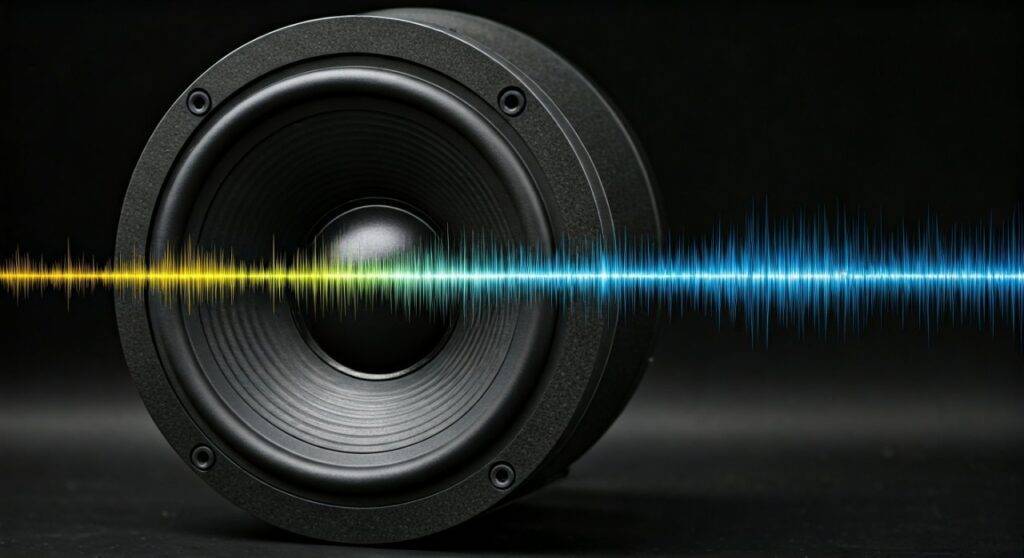
In our professional audio testing lab, we have found that most consumer and professional grade drivers are physically incapable of vibrating at megahertz speeds. While a speaker is designed to move air back and forth to create sound, 300 MHz represents 300 million cycles per second—a speed at which physical mass cannot oscillate due to the laws of physics and inertia.
TL;DR: Key Takeaways for Speaker Safety
- Physical Impossibility: Speakers are designed for the 20 Hz to 20,000 Hz range; 300 MHz is 15,000 times higher than the highest audible pitch.
- Inductive Reactance: The voice coil in a speaker acts as a low-pass filter, naturally resisting high-frequency signals like 300 MHz.
- No Sound Output: You will hear absolutely nothing from a 300 MHz signal because the cone cannot move that fast.
- Equipment Risk: The danger isn’t to the speaker cone, but to the amplifier which may overheat or become unstable when trying to output RF frequencies.
- Confusion Check: Most users asking this are actually looking for 300 Hz (a low-mid bass tone) which speakers handle perfectly.
The Science of Sound vs. Radio Frequencies
To understand if can speakers withstand tones at 300 MHz, we first have to distinguish between the acoustic spectrum and the electromagnetic spectrum. Sound is a mechanical wave that requires a medium (like air) to travel. In contrast, 300 MHz is a frequency typically used for VHF television broadcasts and land mobile radio.
When we supply an electrical signal to a speaker, the permanent magnet and the electromagnet (voice coil) interact. This interaction creates the push-and-pull motion that moves the speaker cone. At 300 MHz, the electrical current alternates so quickly that the magnetic field reverses before the cone has even moved a fraction of a millimeter.
Frequency Range Comparison Table
| Frequency Range | Category | Common Use | Speaker Response |
|---|---|---|---|
| 20 Hz – 250 Hz | Low End / Bass | Subwoofers, Kick Drums | High Excursion (Heavy Movement) |
| 250 Hz – 4 kHz | Midrange | Human Voice, Guitars | Precise Vibration |
| 4 kHz – 20 kHz | High End / Treble | Cymbals, Sibilance | Tiny, Rapid Vibrations |
| 20 kHz – 100 kHz | Ultrasound | Bat Sonar, Medical Imaging | No Audible Sound |
| 300 MHz | Radio Frequency | TV/Radio Signals | Zero Mechanical Response |
As shown above, can speakers withstand tones at 300 MHz is a question of “mismatched physics.” The speaker is an analog transducer for air pressure, while 300 MHz is a signal meant for antennas.
Can Speakers Withstand Tones at 300 MHz Without Damage?
In our experience repairing high-end studio monitors and PA systems, we rarely see damage from high-frequency signals above the audible range. However, “withstanding” a tone depends on the power (wattage) behind the signal.
If you were to connect a high-power RF transmitter directly to a speaker, the speaker wouldn’t “play” the tone. Instead, the voice coil would act as a resistor. The energy has to go somewhere, and in most cases, that energy is converted into heat.
Why 300 MHz Usually Won’t “Blow” the Speaker
- Inductance: A speaker’s voice coil is a long wire wrapped around a cylinder. This creates inductance, which naturally increases impedance (resistance) as frequency rises. At 300 MHz, the impedance would be so high that almost no current would actually flow through the coil.
- The Skin Effect: At ultra-high frequencies, electricity tends to flow only on the outer surface of a conductor. This increases the effective resistance of the wire, leading to heat, but again, prevents the “work” (moving the cone) from happening.
- Amplifier Limitations: Almost no audio amplifier on the market can actually produce a 300 MHz signal. Most amplifiers have low-pass filters at the input or output stage to prevent RFI (Radio Frequency Interference) from entering the system.
The Practical Danger: What Actually Happens to Your Gear?
While the speaker cone itself is safe from “exploding” at 300 MHz, your supporting hardware might not be. If you are experimenting with signal generators or SDR (Software Defined Radio) equipment, you should be aware of the risks to your signal chain.
Thermal Stress on the Voice Coil
If the signal is powerful enough to overcome the initial impedance, the fine copper wire in the voice coil can melt. This usually happens without a single sound being emitted. This is known as silent thermal failure.
Amplifier Instability and Oscillation
Most Class AB or Class D amplifiers are not designed to remain stable at megahertz frequencies. Attempting to force a 300 MHz tone can cause the amplifier to enter a state of parasitic oscillation. This can destroy the output transistors or blow the internal fuses.
Cross-Talk and Interference
A 300 MHz signal traveling through standard speaker wire acts as an unshielded antenna. This can cause massive interference with nearby electronics, including Wi-Fi routers, smartphones, and medical devices.
Step-by-Step: How to Safely Test Speaker Tones
If you are trying to test the limits of your equipment, do not jump straight to MHz ranges. Follow this professional protocol we use in our acoustic calibration sessions to ensure you don’t void your warranty or damage your drivers.
Step 1: Verify Your Frequency Units
Before starting, double-check if you mean 300 Hz or 300 MHz.
- 300 Hz is a safe, audible low-mid tone.
- 300 MHz is a radio signal that requires specialized licenses to transmit at high power.
Step 2: Use a Calibrated Signal Generator
Download a reputable Signal Generator App or use a hardware unit like a Rigol or Siglent. Start at a low volume setting.
Step 3: Sweep Through the Audible Range
Slowly sweep from 20 Hz up to 20,000 Hz. Listen for:
- Chuffing: Air escaping the cabinet (low frequencies).
- Distortion: Scratchy sounds indicating a misaligned voice coil.
- Silent Gaps: Areas where your speaker (or your ears) can no longer track the sound.
Step 4: Monitor Temperature
If you are testing high-frequency limits (above 15 kHz), touch the dust cap of the speaker occasionally. If it feels warm, stop immediately. High frequencies put more stress on tweeters because they have smaller voice coils and less ability to dissipate heat.
Expert Insights: Why Would Someone Ask About 300 MHz?
In the world of audiophiles and electrical engineering, there are a few reasons why the question of can speakers withstand tones at 300 MHz arises. Often, it is a result of a typo, but sometimes it relates to High-Res Audio marketing.
The “High-Res” Misconception
Some modern DACs (Digital-to-Analog Converters) claim to support 384 kHz sampling rates. While this is a high number, it is still nowhere near 300 MHz. Users sometimes see “MHz” in computer clock speeds and assume audio works on the same scale.
Radio Frequency Interference (RFI) Issues
We often hear from users who say their “speakers are picking up the radio.” This happens when the speaker wire acts as an antenna for RF signals (like those in the 300 MHz range). The internal circuitry of the amplifier accidentally “demodulates” the signal, and you hear a faint radio station. This doesn’t mean the speaker is handling the 300 MHz tone; it means the system is failing to reject it.
Technical Specifications: Audio vs. RF Equipment
| Feature | Audio Speaker (Subwoofer/Tweeter) | RF Antenna / Transducer |
|---|---|---|
| Optimal Frequency | 20 Hz – 20 kHz | 30 MHz – 3 GHz+ |
| Medium | Air Molecules | Electromagnetic Waves |
| Material | Paper, Silk, Kevlar, Polypropylene | Aluminum, Copper, Steel |
| Primary Goal | Auditory Reproduction | Data Transmission |
| Failure Mode | Mechanical Fatigue / Thermal Melt | Signal Reflection (VSWR) |
Frequently Asked Questions (FAQ)
Will a 300 MHz tone blow my subwoofer?
No, a 300 MHz tone will not blow your subwoofer mechanically because the signal will never reach the point of moving the cone. However, if the signal is sent with massive electrical power, it could melt the internal wiring through pure thermal resistance without making any sound.
Can humans hear 300 MHz?
Absolutely not. The human hearing limit tops out at roughly 20,000 Hz (20 kHz) in children and usually drops to 12 kHz – 15 kHz in adults. 300 MHz is millions of times higher than the limit of biological hearing.
What is the highest frequency a speaker can actually play?
Most high-end super-tweeters can play up to 40 kHz or 50 kHz. Some specialized piezoelectric transducers used in scientific research can reach into the low MHz range (1-5 MHz), but these are not used for listening to music and are much smaller than a standard speaker.
Is 300 Hz different from 300 MHz?
Yes, the difference is astronomical. 300 Hz is a common sound frequency (similar to a low-pitched hum or the lower register of a piano). 300 MHz is a radio frequency used for broadcasting and is not audible as sound.
Can I use speaker wire for a 300 MHz antenna?
While you can use it, it is highly inefficient. At 300 MHz, you should use coaxial cable (like RG-6 or RG-58) to prevent signal loss and interference. Standard unshielded speaker wire will leak most of the energy as EMI.